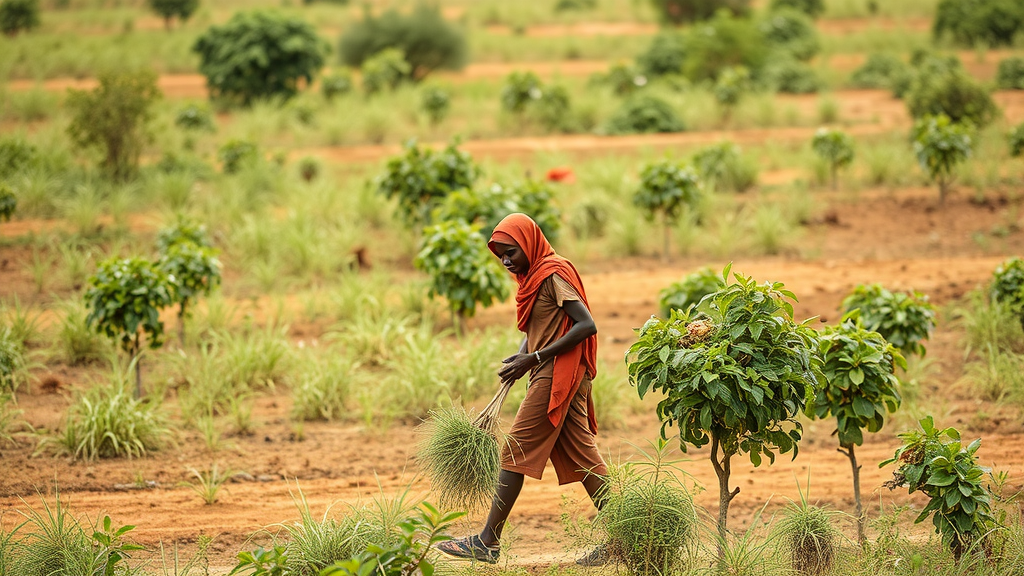
In the densely populated highlands of eastern Ethiopia, smallholder farmers are watching their climate change in real time, and most of them are responding without any help from formal institutions. A new study of 384 farming households in Kersa District, in the East Hararghe Zone of Oromia, reveals that while nearly every farmer surveyed has personally experienced a shifting climate, the information they act on comes overwhelmingly from neighbours, family members and radio broadcasts rather than from the agricultural extension agents and district experts who are nominally responsible for reaching them. The findings, published in the open-access journal Heliyon, offer a detailed portrait of how perception, experience and social position shape the spontaneous adaptation decisions of some of the world’s most climate-vulnerable farmers.
The research team, led by Mohammed Aman Ogeto of Haramaya University together with John F. Morton, Laxmi Prasad Pant and Fekadu Beyene Kenee, set out to answer a deceptively simple question: what actually determines whether a farmer decides to adopt an adaptation strategy? The study focuses on what the Intergovernmental Panel on Climate Change calls autonomous adaptation, meaning adjustments made in response to experienced climate impacts without deliberate planning or conscious targeting of climate change as such. In a district where livelihoods depend on mixed crop and livestock farming, where average landholdings are just over half a hectare and average rainfall has been declining for decades, these spontaneous decisions carry enormous weight for household food security.
The context is stark. In 2022, Ethiopia, Kenya and Somalia endured their worst drought in forty years after five consecutive failed rainy seasons, leaving an estimated 23 million people acutely food insecure across the Horn of Africa and killing 13.4 million livestock. Ethiopia alone accounted for 17.2 million of the 32 million people affected. The World Bank estimates that Ethiopia will need roughly 27.6 billion US dollars in investment for climate change adaptation and mitigation by 2050. Agriculture employs about 65 percent of Ethiopia’s labour force, yet the sector’s share of national output has been slipping, and increasingly erratic rainfall and rising temperatures are compounding pressure on already fragile farming systems.
To capture the situation on the ground, the researchers used multi-stage sampling, purposively selecting East Hararghe for its severe climate variability, randomly choosing Kersa District within the zone, and then randomly sampling 384 farming households using a standard formula for categorical data. Data came from face-to-face interviews with semi-structured questionnaires, two key informant interviews and four focus group discussions separated by age and gender, supplemented by district agricultural records and meteorological data spanning 1992 to 2022. For analysis, the team combined descriptive statistics with a probit econometric model, a nonlinear approach suited to a binary outcome, in this case whether a household decided to adopt autonomous adaptation strategies or not. The model passed goodness-of-fit and heteroskedasticity diagnostics and correctly classified about 77 percent of observations.
The perception results are striking in their consistency. Roughly 90 percent of farmers agreed that rainfall has decreased over the past three decades, nearly 86 percent reported water shortages, 85 percent cited increasingly frequent drought, and 84 percent perceived rising temperatures, findings that closely match the district’s meteorological records. Around 78 percent reported crop failure as a climate impact. By contrast, very few farmers perceived waterlogging, landslides or flooding as serious problems, a pattern the focus groups explained by pointing to the district’s declining rainfall. In other words, farmers’ lived experience of the climate aligns remarkably well with the instrumental record, suggesting that perception in this setting is grounded in observable reality rather than rumour or short-term weather noise.
But perception is not evenly distributed. Male farmers were significantly more likely than female farmers to perceive rising temperatures, changing precipitation, frequent drought and livestock disease outbreaks, and significantly more likely to have access to climate change information in the first place, 88 percent versus 71 percent. The researchers attribute this gap to men’s better access to information channels, particularly radio, which 72 percent of male farmers used compared with just 33 percent of female farmers, and to men’s greater freedom of mobility. Female farmers, however, reported significantly more frequent social interaction within their villages, averaging 21 contacts per year against 15 for men, indicating that women’s social capital is strong even as their access to formal and broadcast information lags.
The information landscape itself is perhaps the study’s most policy-relevant finding. Farmers rely primarily on neighbours, at 70 percent, family members at nearly 69 percent, radio at 60 percent and peer farmers at 52 percent. Only 48 percent receive information from agricultural extension agents and just 36 percent from district experts. This is a striking indictment of the formal extension system, and it means that the people most officially charged with delivering climate services are not the primary conduits through which climate knowledge actually flows. The authors argue that smallholder farmers will not benefit from relying solely on formal sources, and that interventions should blend formal and informal channels rather than trying to replace the social networks that already do the work.
When it comes to action, farmers have assembled a portfolio of eleven autonomous strategies. The most widely adopted are soil and water conservation at nearly 64 percent, crop diversification at 61 percent, crop rotation at 55 percent, tree planting at 47 percent, adjusting planting dates at 45 percent and improved crop varieties at 41 percent. The dominance of soil and water conservation reflects the district’s mountainous terrain and erosion vulnerability, while crop diversification reflects both tiny landholdings and the desire to spread risk. At the other extreme, integrated crop-livestock management, seasonal migration and destocking were adopted by only 22, 19 and 11 percent of farmers respectively, largely because small herds, the absence of grazing land and the higher returns from crop production make livestock-centred strategies unattractive. Significant gender differences emerged in several practices, with male farmers more likely to adjust planting dates, diversify crops, rotate crops, plant trees and destock, differences the authors link to men’s greater access to technology, training and mobility.
The probit model then identified who decides to adapt. Older farmers were less likely to adopt, with each additional year of age reducing the probability by 1.3 percent. A higher share of income from crops, larger livestock holdings excluding oxen, longer crop farming experience and larger total landholdings all increased the likelihood of adoption, with each additional hectare of total land raising adoption probability by 38.2 percent and each additional tropical livestock unit raising it by 4.8 percent. Interestingly, larger cultivated land area reduced adoption probability by 45.6 percent per hectare, consistent with evidence that farmers with smaller cultivated plots invest more intensively in adaptation. Male-headed households were 8.2 percent more likely to adopt than female-headed ones. Perhaps most tellingly, simply having heard about climate change had no significant effect on the decision to adapt, underscoring that experience and resource endowments, not abstract awareness, drive action.
The authors are careful about the limits of their cross-sectional design, noting that the analysis identifies correlations rather than causal effects and covers only autonomous rather than planned or anticipatory adaptation. Still, the policy implications are concrete. They call for improved access to climate information, especially for female farmers, through platforms that integrate formal and informal sources, for stronger and more accessible extension services, and for promotion of drought-tolerant, early-maturing crop varieties and climate-smart practices. They also urge gender- and youth-inclusive approaches, arguing that targeted support for female-headed households is essential if the adaptation gap documented here is to close. As climate variability intensifies across the Horn of Africa, the study suggests that the most effective adaptation policy may begin not with new messages, but with the neighbours, families and radios that farmers already trust.
Subject of Research: Smallholder farmers' perceptions of climate change impacts and their adoption of autonomous adaptation strategies in eastern Ethiopia
Article Title: Farmers’ perceived climate change impacts and their decisions to adopt autonomous adaptation strategies to climate variability in eastern Ethiopia
Article References: Ogeto, M. A., Morton, J. F., Pant, L. P., & Kenee, F. B. (2026). Farmers’ perceived climate change impacts and their decisions to adopt autonomous adaptation strategies to climate variability in eastern Ethiopia. Heliyon, 12(15), Article e45471. https://doi.org/10.1016/j.heliyon.2026.e45471
Image Credits: AI Generated
DOI: 10.1016/j.heliyon.2026.e45471
Keywords: climate change, Ethiopia, smallholder farmers, autonomous adaptation, climate variability, gender, agricultural extension, probit model, soil and water conservation, crop diversification, food security, East Hararghe
Cite Scienmag News
Sloane Callahan. (September 22, 2026). Ethiopian Farmers Rely on Informal Networks to Adapt to Climate Change. Scienmag. https://scienmag.com/ethiopian-farmers-rely-on-informal-networks-to-adapt-to-climate-change/
Sloane Callahan. "Ethiopian Farmers Rely on Informal Networks to Adapt to Climate Change." Scienmag, 22 September 2026, https://scienmag.com/ethiopian-farmers-rely-on-informal-networks-to-adapt-to-climate-change/. Accessed 22 September 2026.
Sloane Callahan. "Ethiopian Farmers Rely on Informal Networks to Adapt to Climate Change." Scienmag. September 22, 2026. https://scienmag.com/ethiopian-farmers-rely-on-informal-networks-to-adapt-to-climate-change/