


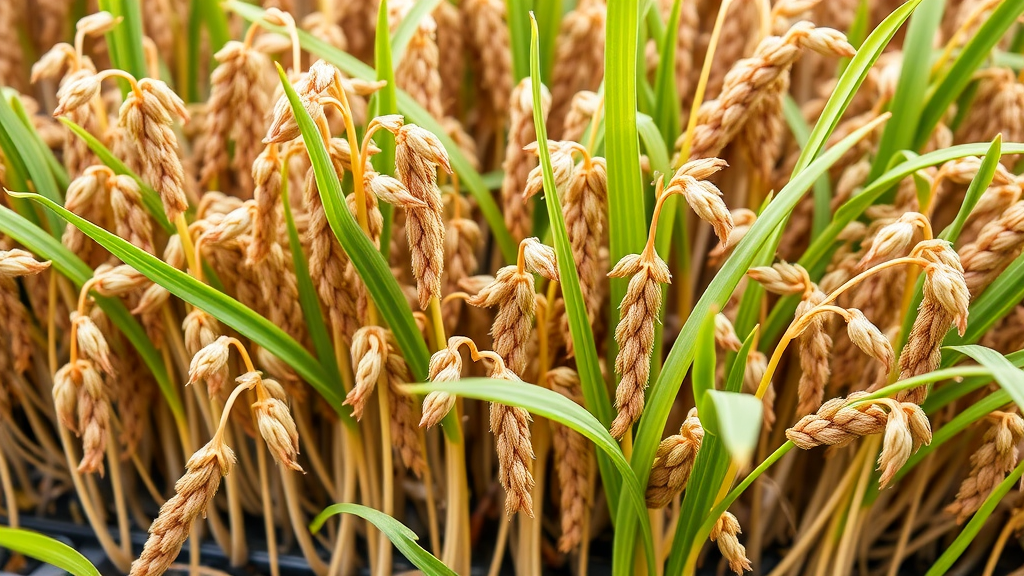
Soil salinization is quietly strangling agriculture across the globe. As rising temperatures, shrinking freshwater supplies, and decades of over-fertilization push salt deeper into once-fertile fields, crop yields are falling in some of the world’s most productive regions. Now, a team of researchers at Shandong Normal University in China has identified a single genetic switch that helps one of agriculture’s most resilient crops shrug off salt stress—and their findings could reshape how scientists breed salt-tolerant cereals. Writing in the journal Stress Biology, Simin Li, Zishuo Han, and colleagues report that a sorghum transcription factor called SbbHLH168 acts as a master coordinator of salt tolerance, simultaneously controlling sodium accumulation, antioxidant defenses, and the build-up of lignin, the tough polymer that stiffens plant cell walls.
Transcription factors are the conductors of the plant genome. They bind to specific DNA sequences in the promoters of target genes, switching entire genetic programs on or off in response to environmental cues. Among the largest of these regulator families are the basic helix-loop-helix, or bHLH, proteins—second only to the MYB family in eukaryotes. In rice, wheat, tomato, and pear, bHLH factors have already been shown to govern salt responses by tuning ion transport, boosting reactive oxygen species scavenging, and promoting osmotic adjustment. Yet in sorghum, a C4 cereal prized for its drought hardiness, high photosynthetic efficiency, and value as both a grain and biofuel feedstock, the bHLH family remained largely unexplored. Only a handful of members, such as SbbHLH85—which paradoxically worsens salt damage by promoting sodium uptake through root hairs—had been functionally characterized.
The new study began with a clue from earlier transcriptome work: SbbHLH168 was highly expressed in the roots of salt-tolerant sorghum varieties. The gene encodes a compact protein of 232 amino acids, with a conserved helix-loop-helix domain spanning residues 37 to 106. Structural modeling revealed a V-shaped dimer in which two pairs of alpha-helices interlock through hydrophobic surfaces—a geometry that immediately suggested the protein would need to pair with itself or with a partner to regulate transcription. Phylogenetic analysis across fifteen grass species and three outgroups placed SbbHLH168 in a monophyletic clade with its closest orthologs from maize and Miscanthus, with the bHLH-SF domain—particularly the basic DNA-binding region and Helix 1—showing the strongest conservation. Flanking regions that mediate protein-protein interactions, by contrast, had diverged considerably, hinting that even closely related orthologs might wire up very different regulatory networks.
Subcellular localization experiments confirmed that a SbbHLH168-GFP fusion protein accumulated exclusively in the nucleus, co-localizing with DAPI-stained DNA. Reporter assays using the SbbHLH168 promoter driving GUS staining showed activity in roots, leaves, siliques, and inflorescences, and publicly available sorghum transcriptome data detected transcripts across all tissues and developmental stages, with peak abundance in leaf and root at the three-leaf stage. Most strikingly, the gene proved salt-inducible: when tobacco leaves carrying the proSbbHLH168:GUS reporter were treated with 100 millimolar sodium chloride, GUS activity rose sharply, and quantitative PCR showed sorghum SbbHLH168 transcripts peaking just three hours after salt exposure. The protein, in other words, is poised throughout the plant and switches on almost immediately when sodium arrives.
To test whether that activation matters, the team generated SbbHLH168-overexpressing Arabidopsis lines and challenged them with 100 millimolar NaCl. The transgenic seedlings stayed greener and grew larger than wild type, retaining significantly more shoot and root biomass in both fresh and dry weight. Histochemical staining with nitro blue tetrazolium and diaminobenzidine revealed far less superoxide and hydrogen peroxide accumulation in the overexpression lines, pointing to enhanced antioxidant capacity. Ion analysis told an equally compelling story: the engineered plants accumulated markedly less sodium and maintained a lower sodium-to-potassium ratio, while potassium levels were unaffected. Relative electrical conductivity—a proxy for membrane damage—dropped as well, indicating that cellular membranes in the transgenic plants leaked far fewer electrolytes under stress.
Crucially, the effect held up in sorghum itself. Using Rhizobium rhizogenes-mediated hairy root transformation, the researchers produced sorghum plants overexpressing SbbHLH168 and subjected them to 150 millimolar NaCl for seven days. Three independent overexpression lines grew more robustly than controls, with longer roots and greater fresh and dry weight, alongside reduced sodium content and a lower sodium-to-potassium ratio. The reciprocal experiment sealed the case: virus-induced gene silencing of SbbHLH168 rendered sorghum hypersensitive to salt, with silenced lines showing significantly shorter roots, reduced biomass, and a significantly elevated sodium-to-potassium ratio. Together, the gain-of-function and loss-of-function data establish that SbbHLH168 is both necessary and sufficient for its salt-tolerance role—a benchmark few candidate stress genes achieve.
The most unexpected discovery emerged when the team probed the gene’s downstream targets. Quantitative PCR revealed that three key lignin biosynthesis genes—SbC4H, SbF5H, and SbCOMT1—were significantly upregulated in overexpression plants under salt stress, with SbF5H showing the strongest induction. Biochemical measurement confirmed the consequence: while lignin content was indistinguishable between genotypes under control conditions, salt treatment raised lignin in all plants, and the increase was dramatically larger in the SbbHLH168 overexpression lines. Lignin reinforces the apoplastic barrier at Casparian bands, the watertight seals in root endodermal cells that block sodium from diffusing freely into the xylem. By thickening this structural firewall, SbbHLH168 appears to protect aboveground tissues from ion toxicity—linking a transcription factor to cell-wall architecture as an integral component of salt tolerance.
The researchers also identified the protein’s working partner. Yeast two-hybrid assays showed that SbbHLH168, used as bait, robustly recruited SbbHLH35 as prey, with co-transformed yeast growing on quadruple dropout medium and turning blue with X-α-Gal. Bimolecular fluorescence complementation then confirmed the interaction in living plant cells: strong YFP fluorescence, confined to the nucleus, appeared only when both fusion proteins were co-expressed. SbbHLH35 itself was upregulated by salt in wild-type sorghum, and the salt-tolerant cultivar M-81E showed markedly higher basal expression of the gene than the salt-sensitive cultivar Roma. Because bHLH proteins typically function as homo- or heterodimers—and because dimerization can switch target-gene specificity—the authors propose that the SbbHLH168-SbbHLH35 heterodimer is the functional unit, potentially recognizing distinct promoter elements in the ion-homeostasis and lignin pathways.
The findings also resolve a curious contradiction in the literature. In rice, the bHLH protein OsbHLH034 promotes lignin accumulation through jasmonate signaling, yet its overexpression increases salt sensitivity. SbbHLH168 and its rice counterpart share a similarity score of just 50—indistinguishable from non-grass outgroups—suggesting substantial divergence outside the core DNA-binding domain. The authors argue that the spatial pattern of lignin deposition is likely decisive: targeted lignification of Casparian bands restricts apoplastic sodium entry and is beneficial, whereas ectopic lignification of cortical or epidermal cells rigidifies walls, impairs root growth, and worsens stress. To their knowledge, SbbHLH168 is the first bHLH factor shown to coordinate ion homeostasis and lignin biosynthesis as a single integrated salt-tolerance mechanism; other characterized members regulate one process or the other, but not both.
Open questions remain. Whether SbbHLH168 directly binds the promoters of ion transporter genes, as some bHLH factors do in rice, or acts through intermediaries is unknown, and distinguishing between parallel transcriptional regulation, passive structural coupling through Casparian band reinforcement, and partner-dependent target selection will require genome-wide binding maps and transcriptomic profiling under salt stress. What is already clear, however, is the practical payoff. Sorghum’s compact genome and abundant salt-tolerant allelic variation—including the recently discovered alkaline-tolerance gene AT1—make it a strategic model for stress research, and SbbHLH168 now offers breeders a direct molecular target. In a warming world where saline land keeps expanding, a single gene that hardens roots, balances ions, and quenches oxidative damage may prove one of agriculture’s most valuable tools.
Subject of Research: The role of the bHLH transcription factor SbbHLH168 in regulating salt tolerance in sorghum through ion homeostasis, ROS scavenging, and lignin biosynthesis.
Article Title: The transcription factor SbbHLH168 enhances salt tolerance by coordinating ion homeostasis and lignin content in sorghum
Article References: The transcription factor SbbHLH168 enhances salt tolerance by coordinating ion homeostasis and lignin content in sorghum. (n.d.). https://doi.org/10.1007/s44154-026-00330-4
Image Credits: AI Generated
DOI: 10.1007/s44154-026-00330-4
Keywords: sorghum, salt stress, SbbHLH168, transcription factor, bHLH, ion homeostasis, lignin biosynthesis, Casparian bands, reactive oxygen species, SbbHLH35, soil salinization, molecular breeding
Cite Scienmag News
Juliet Wilcox. (September 22, 2026). Salt-Tolerant Sorghum Gene SbbHLH168 Boosts Resilience by Rewiring Ion Balance and Lignin. Scienmag. https://scienmag.com/salt-tolerant-sorghum-gene-sbbhlh168-boosts-resilience-by-rewiring-ion-balance-and-lignin/
Juliet Wilcox. "Salt-Tolerant Sorghum Gene SbbHLH168 Boosts Resilience by Rewiring Ion Balance and Lignin." Scienmag, 22 September 2026, https://scienmag.com/salt-tolerant-sorghum-gene-sbbhlh168-boosts-resilience-by-rewiring-ion-balance-and-lignin/. Accessed 22 September 2026.
Juliet Wilcox. "Salt-Tolerant Sorghum Gene SbbHLH168 Boosts Resilience by Rewiring Ion Balance and Lignin." Scienmag. September 22, 2026. https://scienmag.com/salt-tolerant-sorghum-gene-sbbhlh168-boosts-resilience-by-rewiring-ion-balance-and-lignin/


