


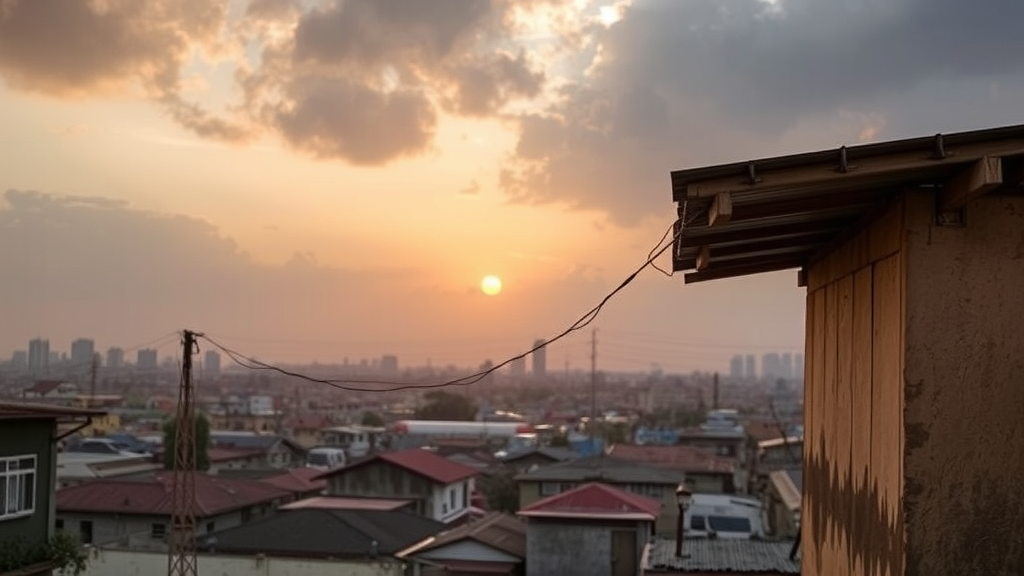
In the sprawling informal settlements of East Africa, a hidden climate crisis is unfolding at a pace that has caught scientists off guard. A new decade-long satellite study of Kampala, Nairobi and Dar es Salaam reveals that surface urban heat island intensity in informal neighborhoods has climbed sharply between 2014 and 2024, with Nairobi’s lightweight low-rise settlements warming by an alarming 3.65 degrees Celsius within their own seasonal context. The findings, published in the journal Discover Cities, provide the first standardized, multi-temporal Local Climate Zone analysis of the region’s major metropolises and expose heat-amplifying mechanisms that conventional global models simply cannot see.
The research, conducted by Godfrey Nkugwa of Wuhan University of Technology, tackles a glaring blind spot in urban climate science. While the Local Climate Zone framework introduced by Stewart and Oke has been widely applied across Europe, Asia and North America through the WUDAPT initiative, standardized LCZ-based analyses in Africa remain strikingly rare. This omission matters because Africa’s urbanization follows a fundamentally different trajectory than that of industrialized regions. Instead of factory-driven growth, East African cities are expanding through what researchers call urbanization without industrialization, fueled by poverty and climate-driven migration, and producing vast informal settlements in the process. More than 70 percent of Dar es Salaam’s inhabitants already live in informal neighborhoods, and Nairobi’s Kibera ranks among the largest slums on the continent.
To capture this distinctive urban fabric, the study introduced a methodological innovation: a validated subclass labeled LCZ 3_(7), which describes compact low-rise morphology built with lightweight informal materials such as corrugated metal, timber and mud. The subclass was defined operationally based on physical surface properties that correlate strongly with known slum boundaries, distinguishing it from the open, single-storey LCZ 7 class by its taller structures and denser layout. Classification accuracy for these informal classes exceeded 0.85 across all three cities and all years, verified through 2,000 randomly sampled points cross-checked against multi-temporal satellite imagery by three independent analysts. The authors caution that this remains a physical proxy rather than a legal designation of informality, but it offers a potentially transferable tool for monitoring vulnerable neighborhoods where tenure data are unavailable.
Using Landsat 8 and 9 imagery acquired in strict dry-season, cloud-free conditions for 2014, 2020 and 2024, the analysis mapped land surface temperature and urban morphology at a uniform 100-meter grid. The results reveal a consistent two-stage trajectory of urban growth across all three cities. Between 2014 and 2020, the metropolises expanded horizontally, converting vegetation and peri-urban land into built fabric at a furious pace. Dar es Salaam was the most aggressive, with its dominant open low-rise class surging from 33.7 percent to 49.0 percent of the built-up area, while its natural tree cover plummeted from 27.2 percent to just 9.0 percent. After 2020, the pattern shifted to spatial consolidation, with class persistence soaring above 85 to 95 percent as cities filled in rather than spread out.
The thermal story is equally dramatic and sharply divergent. Within each city’s seasonal baseline, informal settlement heat island intensity rose over the decade by 1.22 degrees Celsius in Kampala, 2.48 degrees in Dar es Salaam and 3.65 degrees in Nairobi, making Nairobi the most rapidly warming informal environment in the region. By 2024, Nairobi’s LCZ 7 class recorded an absolute heat island intensity of 6.35 degrees Celsius, the highest of any informal class across all three cities. What was previously considered a case of thermal stabilization has now been revealed as a strong warming regime, concentrated precisely in the densifying settlements where the region’s most vulnerable populations live.
Beneath these headline numbers lies a more subtle discovery: a regime shift in the drivers of urban heat. During the expansion phase, two-dimensional impervious cover, measured by the normalized difference impervious surface index, dominated warming across all cities. But after 2020, in the inland capitals of Nairobi and Kampala, three-dimensional building density captured by the normalized difference bareness and building index overtook imperviousness as the primary predictor. This structural transition signals that once the urban footprint is established, the vertical packing of compact low-rise structures becomes the dominant locus of heat retention, effectively locking heat exposure into the morphology of consolidated informal settlements, a legacy effect that is notoriously difficult to retrofit.
Geographically weighted regression, which models how driver relationships vary across space, exposed mechanisms invisible to global statistics. In Kampala, the coefficient for surface moisture reversed sign in dense informal areas between 2020 and 2024, suggesting that water in these neighborhoods no longer provides evaporative cooling but instead marks stagnant moisture trapped within narrow canyons of corrugated metal, creating hyperlocal heat traps. In Nairobi, nighttime lights and building density spatially decoupled after 2020, revealing that the most severe thermal hotspots form precisely where unlit, consolidated low-rise housing blocks intersect with brightly lit commercial corridors, a convergence of poverty and economic activity that defines a specific urban form for targeted intervention. In coastal Dar es Salaam, by contrast, surface albedo delivers measurable cooling only near the shoreline, where sea breezes amplify heat advection, while impervious cover retains primacy inland, suggesting coastal ventilation partially offsets densification-driven warming.
Hotspot analysis using the Getis-Ord Gi* statistic confirmed these shifting geographies of risk. Nairobi’s heat exposure originated in peripheral transitional scrublands during the expansion phase but by 2024 had concentrated firmly within densifying informal settlements. Kampala’s hotspots decayed from intense clusters in compact cores to diffuse patterns, while Dar es Salaam’s persisted in compact low-rise districts with emerging informal heat exposure. The cooling capacity of natural and water-covered zones weakened across the board, from wetlands in Dar es Salaam to vegetated sinks in Kampala, signaling that encroachment on blue and green spaces is eroding the region’s natural thermal defenses.
These divergent trajectories argue forcefully against one-size-fits-all mitigation prescriptions. For Kampala and Dar es Salaam, where the combination of high building density and lightweight materials drives heat amplification, the study points to cool-roof retrofits, transitioning from corrugated metal to high-albedo reflective materials, alongside protection of remaining blue spaces and managed pervious drainage to restore evaporative cooling. Empirical support exists: white roof coatings applied across 11,000 square meters of roofing in Nairobi’s informal settlements and cool-roof paint trials in rural Sub-Saharan Africa have both demonstrated measurable indoor temperature reductions. For Nairobi, the priority is different: surgical, targeted green infrastructure such as pocket parks, green courtyards and strategic street trees at the identified intersection points of dense informal housing and commercial activity, since blanket city-wide greening would be far less effective.
The study’s limitations are candidly acknowledged, including single-date thermal snapshots per year, the absence of in-situ validation, and the fact that biophysical heat exposure rather than socioeconomic vulnerability was assessed. Even so, the validated LCZ framework and its novel informal subclass offer a standardized baseline for tracking thermal equity across data-scarce, rapidly urbanizing regions. As East African cities continue their transition from horizontal expansion to consolidation, the research delivers a clear warning: heat exposure in informal settlements is not homogeneous but is produced by geographically specific intersections of land cover, building density, economic activity and coastal or inland climate. Meeting it will require exactly the kind of context-sensitive, spatially explicit intelligence this study now provides.
Subject of Research: Multi-temporal Local Climate Zone analysis of surface urban heat island drivers in East African informal settlements
Article Title: Socio-spatial drivers of thermal environment evolution in East African informal settlements based on multi-temporal LCZ analysis of major metropolises
Article References: Socio-spatial drivers of thermal environment evolution in East African informal settlements based on multi-temporal LCZ analysis of major metropolises. (n.d.). https://doi.org/10.1007/s44327-026-00366-1
Image Credits: AI Generated
DOI: 10.1007/s44327-026-00366-1
Keywords: local climate zones, surface urban heat island, informal settlements, East Africa, remote sensing, land surface temperature, Nairobi, Kampala, Dar es Salaam, urban heat, climate adaptation, geographically weighted regression
Cite Scienmag News
Sloane Callahan. (September 22, 2026). Slums Are Heating Up Fast: Satellites Reveal Nairobi, Kampala and Dar es Salaam’s Invisible Heat Crisis. Scienmag. https://scienmag.com/slums-are-heating-up-fast-satellites-reveal-nairobi-kampala-and-dar-es-salaams-invisible-heat-crisis/
Sloane Callahan. "Slums Are Heating Up Fast: Satellites Reveal Nairobi, Kampala and Dar es Salaam’s Invisible Heat Crisis." Scienmag, 22 September 2026, https://scienmag.com/slums-are-heating-up-fast-satellites-reveal-nairobi-kampala-and-dar-es-salaams-invisible-heat-crisis/. Accessed 22 September 2026.
Sloane Callahan. "Slums Are Heating Up Fast: Satellites Reveal Nairobi, Kampala and Dar es Salaam’s Invisible Heat Crisis." Scienmag. September 22, 2026. https://scienmag.com/slums-are-heating-up-fast-satellites-reveal-nairobi-kampala-and-dar-es-salaams-invisible-heat-crisis/


