


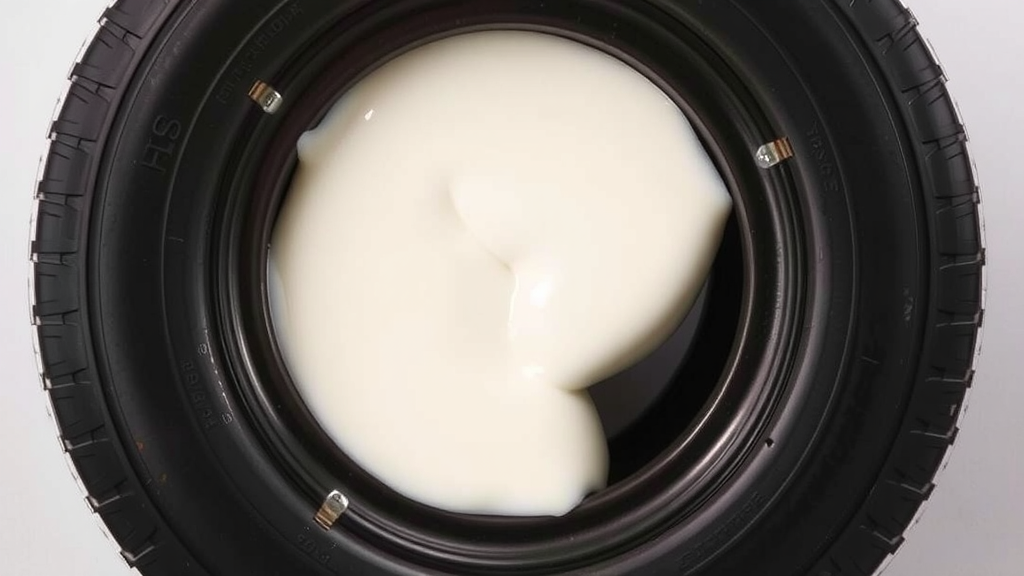
Milk is one of the most closely monitored foods in the world, screened routinely for bacteria, antibiotic residues, and a long list of environmental pollutants. Yet a new study from Switzerland suggests that an unexpected class of contaminants may have been slipping past regulators and consumers alike: the chemical additives that give rubber its elasticity, strength, and resistance to aging. Researchers analyzing raw cow milk from dairy farms across the country detected trace levels of rubber-related compounds, including chemicals that have made global headlines for their toxicity to fish, in more than forty percent of the samples they tested. The finding points to a previously overlooked route by which tire-derived pollution and food-production equipment may introduce industrial chemicals into the human diet.
The chemicals in question come from the vast world of technical rubber—tires, hoses, seals, gaskets, and tubing. Every year, an estimated six million tons of tire and road wear particles are released into the environment worldwide as tires grind against pavement. These particles carry a cocktail of additives: vulcanization accelerators that make rubber cure properly, antioxidants and antiozonants that protect it from heat, oxygen, and cracking, and plasticizers that keep it flexible. As tires degrade on the road, these compounds spread through atmospheric deposition, road runoff, and even biosolid fertilizers applied to farmland, embedding themselves in the soils where food is grown and where livestock graze.
Some of these compounds have already earned a troubling reputation. The tire antioxidant 6-PPD and its oxidation product 6-PPDQ became infamous after scientists discovered that 6-PPDQ washes off roads and kills coho salmon in urban streams within hours of exposure. Subsequent work in mice showed that oral exposure to both chemicals caused dose-dependent accumulation in the liver, elevated liver weight, increased triglycerides, and disruptions in glycolipid metabolism, immune signaling, and glutathione pathways. Another rubber additive, the vulcanization accelerator 1,3-diphenylguanidine, or DPG—produced or imported into the European Economic Area at rates of 10,000 to 100,000 tons per year—has been linked in animal studies to reproductive abnormalities, including altered sperm morphology and reduced fertility, and more recently to genotoxic effects in laboratory bioassays.
Until now, however, almost nothing was known about whether these compounds reach milk. Earlier research had shown that tire-derived chemicals such as benzothiazoles, 6-PPD, and 6-PPDQ can be taken up and metabolized by edible plants like lettuce and carrots, with a compound’s lipophilicity strongly influencing how readily it moves through plant tissues. A recent cross-country survey also found p-phenylenediamines and their quinone derivatives in chicken eggs from thirteen countries across four continents, at concentrations reaching thousands of nanograms per kilogram of egg yolk. Milk, consumed in enormous quantities worldwide and produced on farms that often sit beside busy roads and rely heavily on rubber equipment, represented an obvious but unexamined gap in the picture of dietary exposure.
To close that gap, a team led by Florian Breider and Beat J. Brüschweiler collected seventeen raw cow milk samples from sixteen Swiss farms spanning a range of environments: three alpine farms far from major traffic, three farms near highways carrying roughly 50,000 to 150,000 vehicles per day, four farms near departmental roads with 3,000 to 30,000 vehicles daily, and six farms near country roads with only 500 to 5,000 vehicles. Samples were drawn directly from the milk tanks connected to the milking machines and analyzed using liquid chromatography coupled with tandem mass spectrometry, a sensitive technique capable of detecting trace organic compounds in complex matrices. Deuterated internal standards, matrix-matched calibration, procedural blanks, and recovery corrections were applied throughout, though the authors note that the complexity of milk makes the reported concentrations best regarded as semi-quantitative.
The results revealed that seven of the seventeen samples—41 percent—contained at least one rubber-related compound above the limit of quantification. Four compounds were detected: the benzothiazole vulcanization accelerator S-BTH, the guanidine accelerator DPG, the antioxidant 6-PPD, and its oxidation product 6-PPDQ. DPG appeared in 23 percent of samples at concentrations ranging from 38.8 to 223.3 nanograms per liter, with a median of 68.0. 6-PPD was found in two samples at 71.4 to 99.1 nanograms per liter, and 6-PPDQ appeared once at 75.6 nanograms per liter. S-BTH showed up in a single sample at a striking 26,258.5 nanograms per liter—an apparent outlier that the researchers suggest could reflect localized contamination or release from a specific rubber component, though more sampling would be needed to say for certain.
Intriguingly, none of the target compounds were detected in milk from the three alpine farms located away from major road traffic, while detections occurred at farms near country, departmental, and highway roads. That pattern is compatible with reduced environmental exposure to road-related emissions at high-altitude sites, but the study found no clear relationship between traffic intensity and either detection frequency or concentration—several positive samples in fact came from farms along the quietest roads. With a limited number of farms in each traffic category, and with differences in feeding practices, husbandry conditions, and milking equipment potentially confounding the comparison, the authors are careful not to attribute the contamination solely to road traffic. Determining the true contribution of traffic emissions will require larger studies that also measure these chemicals in air, soil, and feed.
That caution is reinforced by the study’s second, perhaps more surprising, finding. When the researchers analyzed eight rubber components taken directly from dairy production systems—teatcup liners, elbow connectors, rubber sleeves, tubing, connectors, and plugs, all of which touch milk during milking, transfer, or storage—they found fourteen rubber-related chemicals in nearly every component. Total bulk concentrations ranged from 42.9 micrograms per gram up to 3.7 milligrams per gram, averaging 817 micrograms per gram, levels comparable to those in car tires. S-BTH dominated at 49 to 715 micrograms per gram, while 6-PPD reached up to 2.7 milligrams per gram and its chemical cousin IPPD up to 921 micrograms per gram. DPG, aniline—a degradation product of several accelerators—and the cyclic amines CPU and DCU were also widespread. The chemical fingerprints of these components closely resemble those of automotive rubber, meaning the same additives raising environmental concerns are sitting inside the equipment that handles milk every day.
The researchers also rinsed the interior surfaces of these components with methanol to estimate how much of the additive load could be released on contact. This worst-case solubilization test does not replicate real milking conditions—milk is an aqueous, fatty matrix rather than an organic solvent—but it demonstrated that the compounds are available for leaching, and that what comes off the surface mirrors the composition of the bulk rubber. The authors stress that no formal migration test was performed, so compliance with existing migration limits cannot be assessed either way. Still, the results establish a theoretically plausible second pathway: rubber parts in milking machines and dairy processing equipment could, under the right conditions of temperature, contact time, and fat content, transfer their additives directly into milk.
That possibility lands in a regulatory gray zone. Under German Federal Institute for Risk Assessment recommendations, milking equipment rubber is generally classified as category 3, short-term food contact, with compositional caps of 1.5 percent for 6-PPD, 0.3 percent for DPG, and 1 percent for S-BTH, and a migration ceiling of 0.3 milligrams per liter for 6-PPD into liquids contacted at 40 degrees Celsius for ten minutes. A 2020 French decree likewise sets specific migration limits for DPG and 6-PPD. But no compositional limits or migration criteria currently exist for the other eleven compounds detected in the dairy equipment, including 6-PPDQ, which was found directly in milk samples. The detection of a transformation product that can form as rubber ages or oxidizes in real use highlights how far regulation lags behind the chemistry.
The measured concentrations in milk were low—nanograms per liter, far below any established health threshold—and the authors are careful to frame the work as an initial occurrence study rather than a risk assessment. It does not capture daily or seasonal variability on individual farms, and it cannot disentangle environmental exposure from equipment-derived migration. But the convergence of two plausible contamination routes, the presence of chemicals with documented hepatotoxic, reproductive, and genotoxic effects in animals, and the sheer scale of global milk consumption all argue for urgency. The researchers call for long-term monitoring of air, soil, and feed on dairy farms, migration studies under realistic milking conditions, targeted risk assessments of chronic dietary exposure, and ultimately the development of safer rubber formulations for food-contact applications. For now, the message is less alarm than awareness: the rubber that keeps the modern world moving may also be leaving faint chemical fingerprints in its food supply, and those fingerprints deserve a closer look.
Subject of Research: Contamination of raw cow milk and dairy equipment with tire-derived rubber additives such as 6-PPD, 6-PPDQ, DPG, and benzothiazoles.
Article Title: Rubber-related chemical contamination in milk: Implications for dairy production systems
Article References: Breider, F., Grandjean, D., Andrey, C., Masset, T., & Brüschweiler, B. J. (2026). Rubber-related chemical contamination in milk: Implications for dairy production systems. Food Chemistry: X, 39, Article 104373. https://doi.org/10.1016/j.fochx.2026.104373
Image Credits: AI Generated
DOI: 10.1016/j.fochx.2026.104373
Keywords: tire wear particles, 6-PPD, 6-PPDQ, diphenylguanidine, benzothiazoles, raw milk, dairy production, food contamination, rubber additives, food contact materials, mass spectrometry, dietary exposure
Cite Scienmag News
Daisy Hatcher. (September 22, 2026). Tire Chemicals Turn Up in Milk, Raising Questions About Dairy Safety. Scienmag. https://scienmag.com/tire-chemicals-turn-up-in-milk-raising-questions-about-dairy-safety/
Daisy Hatcher. "Tire Chemicals Turn Up in Milk, Raising Questions About Dairy Safety." Scienmag, 22 September 2026, https://scienmag.com/tire-chemicals-turn-up-in-milk-raising-questions-about-dairy-safety/. Accessed 22 September 2026.
Daisy Hatcher. "Tire Chemicals Turn Up in Milk, Raising Questions About Dairy Safety." Scienmag. September 22, 2026. https://scienmag.com/tire-chemicals-turn-up-in-milk-raising-questions-about-dairy-safety/


