


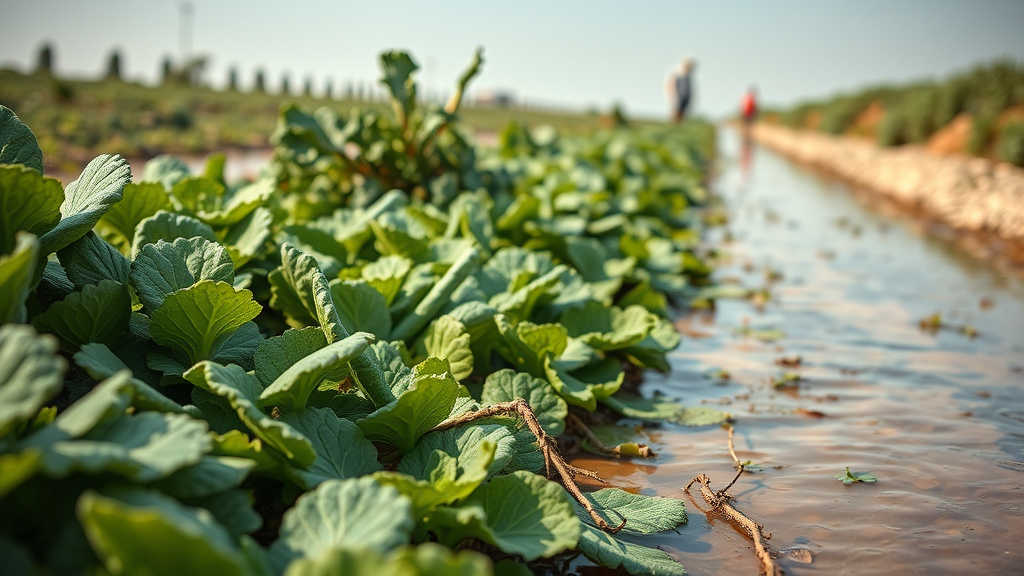
In the vegetable fields of northeastern Algeria, the water that nourishes tomatoes, lettuce, and peppers is carrying a hidden load of fecal bacteria, according to a new study that offers one of the most detailed pictures yet of how river pollution translates into contamination of fresh produce. The research, published in Environmental Monitoring and Assessment, examined the Boumerzoug River, a waterway that flows through the densely populated city of Constantine before reaching farmland downstream, and found that fecal coliform concentrations in its irrigation waters exceeded the World Health Organization’s reference value of 10³ colony-forming units per 100 milliliters for unrestricted irrigation. Every vegetable sample collected from fields irrigated with this water tested positive for total and fecal coliforms, with Escherichia coli detected at varying concentrations across crop types.
The implications reach far beyond a single river. Untreated or inadequately treated wastewater discharged into surface waters is a growing concern in many regions where urban expansion outpaces sanitation infrastructure, and farmers often have few alternatives to river water in semi-arid climates. When that water carries human and animal waste onto crops that are eaten raw, the microbial journey from sewage pipe to dinner plate can be remarkably short. The new findings suggest that contaminated irrigation water may contribute substantially to the microbial burden on fresh vegetables, a food category repeatedly implicated in foodborne illness outbreaks worldwide.
To quantify the problem, the research team, led by Sara Bouaroudj of Abdelhafid Boussouf University in Mila, Algeria, together with colleagues from Saad Dahlab University of Blida 1, sampled 20 agricultural fields during both the dry and wet seasons. They collected 40 irrigation water samples and 160 vegetable samples representing three crops: tomato (Solanum lycopersicum), lettuce (Lactuca sativa), and pepper (Capsicum annuum). Sampling across two seasons was critical because rainfall, temperature, and river flow all influence how fecal bacteria survive and travel. Heavy rains can wash waste from urban surfaces, livestock areas, and riverbank soils into the channel, while warm, dry conditions can either concentrate bacteria in shrinking flows or kill them off through ultraviolet exposure and desiccation.
In the laboratory, the team applied standard culture-based methods to enumerate five microbial groups: total aerobic heterotrophic bacteria, total coliforms, fecal coliforms, fecal streptococci, and E. coli. These indicators form the backbone of water quality assessment worldwide. Total coliforms signal general microbial contamination, fecal coliforms and E. coli point specifically to fecal pollution, and fecal streptococci help corroborate the fecal origin because they persist in the intestinal tracts of warm-blooded animals. The presence of E. coli is particularly significant because although most strains are harmless, the species serves as a sentinel for the possible presence of more dangerous enteric pathogens such as Salmonella enterica and pathogenic E. coli strains like O157:H7.
The results revealed substantial microbiological contamination in the river water itself. Fecal coliform concentrations consistently surpassed the WHO guideline of 10³ CFU/100 mL, the threshold considered acceptable for irrigating crops that are eaten raw without further processing. This benchmark, established in the landmark 1989 WHO health guidelines for wastewater use in agriculture, is not an arbitrary line. Studies across multiple continents have shown that irrigation water exceeding such limits reliably deposits fecal indicator bacteria onto produce surfaces, where organisms can attach to leaves, hide in stomata, and persist through harvest, transport, and even washing.
On the vegetables themselves, the picture was uniformly grim for coliforms but more nuanced for E. coli. All 160 vegetable samples were contaminated with total and fecal coliforms, confirming that bacterial contamination of irrigated produce was not an occasional event but a systemic condition of this farming system. E. coli, the more specific fecal indicator, appeared at varying concentrations depending on the vegetable type, suggesting that crop architecture and surface properties play a decisive role in how much contamination each vegetable retains. Tomatoes, with their smooth waxy skins, can be rinsed more effectively and offer fewer attachment sites, while leafy vegetables present expansive, textured surfaces that shelter bacteria from washing and sunlight.
Indeed, the study found that lettuce generally exhibited higher contamination levels than tomato and pepper, a result consistent with a broad international literature on leafy greens. Lettuce leaves possess large, ruffled surfaces with a rough cuticle and abundant stomata on both leaf faces, features that create countless microscopic refuges for bacteria. Prior research has demonstrated that E. coli and Salmonella can become internalized within leaf tissue through stomata or root uptake, rendering surface disinfection incomplete. In outbreaks from California to Germany, leafy greens have repeatedly been the vehicle of choice for enteric pathogens, and the Algerian findings reinforce why food safety authorities in the European Union and the United States have imposed specific microbial criteria and irrigation water standards for this crop category.
Season also mattered. Contamination varied significantly between the dry and wet sampling periods, a pattern that mirrors findings from irrigation studies in Brazil, Ghana, and elsewhere. Rainfall-driven runoff is a well-documented route for transporting fecal indicator bacteria from land to stream, particularly in mixed urban-agricultural watersheds like that of the Boumerzoug, which receives the runoff of a metropolitan area of several hundred thousand people along with discharges from informal settlements and livestock activity upstream. At the same time, seasonal changes in temperature, sunlight, and water flow alter bacterial die-off rates in the water column and on crop surfaces, complicating any simple prediction of risk. The fact that both water and vegetable contamination shifted with season suggests that food safety interventions in the region may need to be seasonal as well, with heightened vigilance during periods when the river’s microbial load peaks.
The Constantine region’s relationship with the Boumerzoug River has been strained for decades. Previous studies by Algerian researchers have documented heavy metal contamination in the river’s sediments and in watercress growing along its banks, and the current team’s earlier work reported accumulation of heavy metals in food crops irrigated with the same water. The new study adds a microbial dimension to that toxicological picture, portraying a waterway burdened simultaneously by chemical and biological pollution. For the farmers who depend on the river, neither hazard is of their own making; the contamination originates largely upstream, in a city whose wastewater treatment capacity has not kept pace with its population growth.
What can be done? The study’s authors frame their findings as a call for improved wastewater treatment before discharge, regular monitoring of irrigation water quality, and the adoption of protective agricultural practices. International evidence supports a range of pre-harvest measures: switching from overhead sprinklers to drip irrigation dramatically reduces contact between water and edible plant surfaces; lengthening the interval between the last irrigation and harvest allows natural die-off to reduce bacterial loads; and treating or storing water in reservoirs before use can lower pathogen concentrations. Post-harvest, effective washing and sanitizing can reduce but not eliminate surface contamination, which is why prevention in the field remains the most reliable strategy. The researchers also emphasize the need for policy action, noting that Algerian regulations on microbiological criteria for foodstuffs exist but depend on the quality of the water that farmers have available.
Ultimately, the study delivers a clear message with global resonance: the microbiological quality of irrigation water is a first-order determinant of fresh produce safety, and where rivers double as informal sewage channels, the contamination travels directly into the food supply. As demand for fresh vegetables rises worldwide and water scarcity pushes farmers toward marginal water sources, the Boumerzoug case illustrates the tension between agricultural livelihoods and public health. Resolving it will require investment in sanitation infrastructure, accessible water quality testing for smallholder farmers, and crop-specific guidance on safe irrigation, so that the vegetables that reach consumers in Constantine and beyond nourish rather than endanger the people who eat them.
Subject of Research: Microbiological contamination of irrigation water and fresh vegetables in the Boumerzoug River watershed, Algeria
Article Title: Microbiological assessment of irrigation water from the Boumerzoug River, Algeria, and associated contamination of fresh vegetables
Article References: Bouaroudj, S., Bouchetat, F., Boudjahem, I., Zentar, A., Rebbah, A. C., Bouchareb, N., & Bounamous, A. (2026). Microbiological assessment of irrigation water from the Boumerzoug River, Algeria, and associated contamination of fresh vegetables. Environmental Monitoring and Assessment, 198(10), Article 1092. https://doi.org/10.1007/s10661-026-15928-4
Image Credits: AI Generated
DOI: 10.1007/s10661-026-15928-4
Keywords: irrigation water, microbiological quality, fresh vegetables, Escherichia coli, fecal coliforms, Boumerzoug River, food safety, Algeria, wastewater, lettuce, WHO guidelines, water pollution
Cite Scienmag News
Violet Maxwell. (September 22, 2026). Algerian River Water Feeding Vegetable Farms Fails Safety Limits for Fecal Bacteria. Scienmag. https://scienmag.com/algerian-river-water-feeding-vegetable-farms-fails-safety-limits-for-fecal-bacteria/
Violet Maxwell. "Algerian River Water Feeding Vegetable Farms Fails Safety Limits for Fecal Bacteria." Scienmag, 22 September 2026, https://scienmag.com/algerian-river-water-feeding-vegetable-farms-fails-safety-limits-for-fecal-bacteria/. Accessed 22 September 2026.
Violet Maxwell. "Algerian River Water Feeding Vegetable Farms Fails Safety Limits for Fecal Bacteria." Scienmag. September 22, 2026. https://scienmag.com/algerian-river-water-feeding-vegetable-farms-fails-safety-limits-for-fecal-bacteria/


