


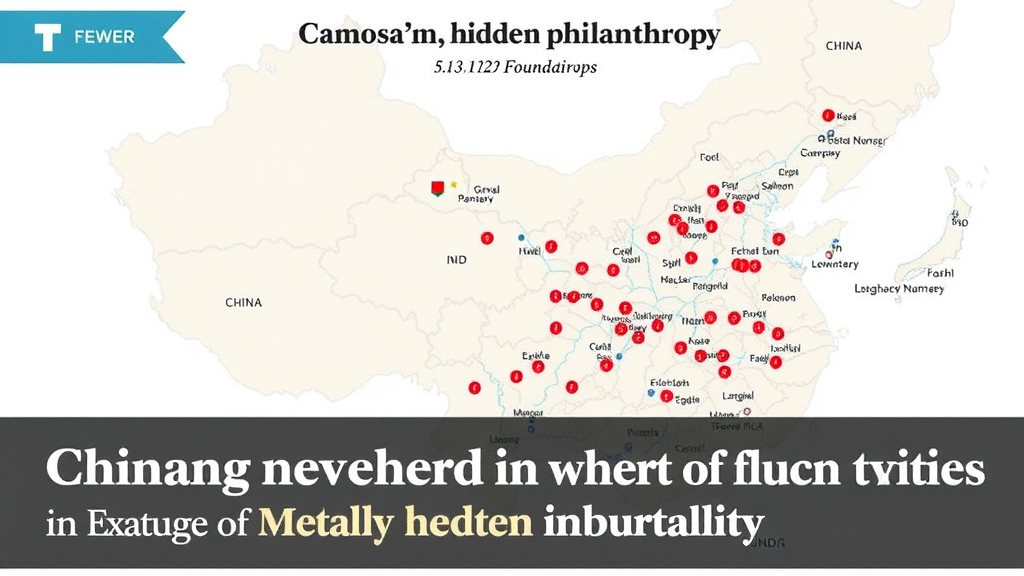
Charitable giving in China has grown into an enormous enterprise, yet the question of where philanthropic money actually lands has remained largely unanswered. A new study published in Global Public Policy and Governance offers the most detailed picture to date, reconstructing the nationwide web of donations that links Chinese foundations to one another. Drawing on annual reports filed by foundations across the country between 2016 and 2023, the research team assembled a dataset of 34,325 donation ties connecting 5,123 recipient foundations. The resulting map reveals a philanthropic sector that has expanded dramatically in scale while remaining strikingly unequal in how its financial resources are distributed among organizations.
The study marks a deliberate shift in how scholars examine charitable behavior. Much of the existing philanthropy research focuses on individual donors: why people give, what motives drive them, and how trust or social norms shape their choices. By contrast, the Chinese team treated the donation itself as a tie between organizations, moving the analytic focus from personal giving decisions to observed interorganizational flows of money. This network perspective allowed the researchers to ask structural questions that individual-level studies cannot easily address. Who occupies the center of the philanthropic system? Which foundations act as intermediaries channeling resources to others, and which sit quietly at the edges receiving little attention?
Methodologically, the researchers combed through mandatory annual reports that Chinese foundations are required to file, extracting every recorded donation from one foundation to another. Because the reports cover the entire country and an eight-year span, the dataset captures the philanthropic system at a scale rarely possible in Western studies, where giving data are often fragmented across surveys, tax records, or grant databases. Each donation between a donor and a recipient foundation became an edge in a growing network, with the donation amount attached as a weight. Across the 2016 to 2023 window, the number of ties grew substantially, signaling an increasingly dense web of financial relationships within the foundation sector.
Yet growth in the number of connections did not translate into a more even distribution of money. One of the study’s clearest findings is that financial resources remained highly concentrated throughout the period. Lower-value donation ties became more common over time, suggesting that many foundations now engage in frequent but modest exchanges. However, large and major donations continued to account for nearly all of the annual donation amounts recorded in the network. In other words, the topology of giving broadened while its economic backbone stayed narrow: a small number of heavyweight transfers still carried the overwhelming bulk of philanthropic capital each year.
To make sense of thousands of organizations and tens of thousands of ties, the researchers classified recipient foundations according to two structural dimensions: donor reach, meaning how many distinct donors a foundation attracted, and brokerage, meaning how strongly a foundation served as an intermediary through which donations passed within the network. Combining these dimensions produced four distinct structural positions. Broker hubs combined high donor reach with the strongest brokerage, acting as central crossroads where money from many sources converged and was passed onward. Reach hubs had the broadest donor base but relatively limited brokerage, collecting funds from many donors without serving as major conduits for other organizations’ exchanges.
The remaining two positions rounded out the structural map. Core receivers showed moderate donor reach and limited brokerage, occupying a middle tier of foundations that reliably attract support but do not channel flows between others. Peripheral receivers, finally, had limited donor reach and little brokerage, sitting at the margins of the network with few incoming ties and no meaningful intermediary role. This fourfold typology transforms an abstract network diagram into an organizational sociology of Chinese philanthropy, showing that foundations are not interchangeable recipients of charity but occupy differentiated niches defined by how they connect to the wider system.
What determines whether a foundation climbs into one of the coveted hub positions? The study found that organizational characteristics mattered systematically. Older recipient foundations were more commonly found in broker hub and reach hub positions, reflecting the accumulation of reputation, relationships, and track record over time. Public fundraising qualification, a regulatory status in China that permits foundations to solicit donations from the general public rather than relying on restricted sources, also increased the likelihood of occupying a hub position. Foundations with larger boards and more full-time staff were similarly overrepresented among the hubs, suggesting that organizational capacity and governance structures translate directly into network centrality.
These findings carry significant implications beyond China. The country now hosts one of the world’s largest foundation sectors, yet it remains understudied relative to Western philanthropy, where most theory about charitable giving has been built. By demonstrating that network position, not just donation volume, differentiates organizations, the study provides a template for analyzing philanthropic systems in other large non-Western settings. It also echoes earlier work on nonprofit networks, which has shown that board interlocks and network embeddedness shape grant acquisition and organizational growth. The Chinese evidence extends that tradition with nationwide data, linking structural position to concrete organizational attributes such as staffing and fundraising rights.
The concentration of resources identified in the study raises practical concerns for policymakers and sector leaders. If large and major donations dominate the flow of philanthropic money, then a limited set of well-connected hub foundations effectively controls access to the sector’s financial lifeblood. Peripheral receivers, despite their numbers, may struggle to secure funding regardless of the quality of their programs. At the same time, the rise of lower-value ties suggests a broadening participation in giving that could, over time, diversify the funding base. Whether that broadening eventually dilutes the dominance of major gifts, or merely adds a long tail beneath an unchanged top tier, is a question the coming years of foundation reports may answer.
For now, the study stands as the most comprehensive structural portrait of Chinese philanthropy yet produced, and a demonstration of what large-scale network analysis can reveal about the third sector. By reconstructing 34,325 donation ties across eight years, the researchers showed that an expanding philanthropic network can coexist with persistent inequality in resource distribution, and that four clearly defined organizational positions structure who gives, who receives, and who connects. As charitable giving continues to grow worldwide, the lesson from China is that understanding philanthropy requires looking not only at individual generosity but at the architecture of organizations through which that generosity flows.
Subject of Research: The structure of interorganizational donation networks among Chinese foundations from 2016 to 2023
Article Title: Mapping the donation network in China: evidence of 5,123 foundations from 2016 to 2023
Article References: Mapping the donation network in China: evidence of 5,123 foundations from 2016 to 2023. (n.d.). https://doi.org/10.1007/s43508-026-00159-7
Image Credits: AI Generated
DOI: 10.1007/s43508-026-00159-7
Keywords: charitable giving, donation network, foundations, social network analysis, philanthropy in China, brokerage, donor reach, resource concentration, nonprofit organizations, third sector research, Mapping, donation
Cite Scienmag News
Courtney Benton. (September 22, 2026). China’s Hidden Philanthropy Map: 5,123 Foundations Reveal Where the Money Really Flows. Scienmag. https://scienmag.com/chinas-hidden-philanthropy-map-5123-foundations-reveal-where-the-money-really-flows/
Courtney Benton. "China’s Hidden Philanthropy Map: 5,123 Foundations Reveal Where the Money Really Flows." Scienmag, 22 September 2026, https://scienmag.com/chinas-hidden-philanthropy-map-5123-foundations-reveal-where-the-money-really-flows/. Accessed 22 September 2026.
Courtney Benton. "China’s Hidden Philanthropy Map: 5,123 Foundations Reveal Where the Money Really Flows." Scienmag. September 22, 2026. https://scienmag.com/chinas-hidden-philanthropy-map-5123-foundations-reveal-where-the-money-really-flows/


