


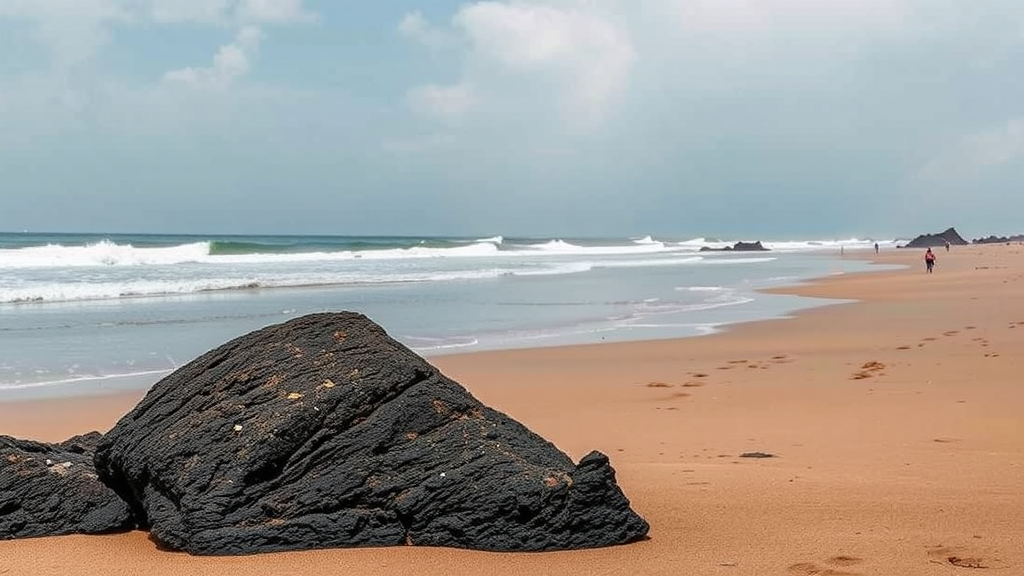
Along a slender stretch of India’s southwestern shoreline, between Vellanathuruthu Beach in Kollam district and Thumpoly Beach in Alappuzha district, the sand itself hums with radiation. This is one of the world’s celebrated High Background Radiation Areas, a coastal strip where black sands rich in the thorium-bearing mineral monazite have kept natural radiation levels elevated for millennia. Now, a team of Indian researchers has carried out one of the most integrated assessments of this remarkable environment to date, combining gamma-ray spectrometry, X-ray fluorescence, magnetic measurements and a battery of multivariate statistics to answer a deceptively simple question: how do the physical and chemical properties of sediment control where radionuclides, heavy metals and magnetic minerals end up along the Kerala coast?
The study, published in the open-access journal Discover Geoscience, analysed twenty sampling sites spaced five to ten kilometres apart along the shoreline. Sediment was collected during the pre-monsoon season using a Peterson grab sampler, a timing chosen deliberately because pre-monsoon conditions reveal sediment texture and ecological patterns most clearly and because metal concentrations tend to peak in this season relative to monsoon and post-monsoon periods. Each roughly two-kilogram sample was cleared of shells and litter, air-dried, oven-dried to a stable weight and prepared for a suite of analytical techniques that together paint a comprehensive portrait of the coastal geochemistry.
The physical characterisation alone yielded striking results. Grain size analysis by mechanical sieving showed that the sediments are overwhelmingly fine-grained, classified predominantly as silty clay loam. Sand content ranged from a mere 0.30 percent to 9.18 percent, while silt dominated at 28.12 to 84.97 percent and clay ranged from 13.97 to 71.01 percent. The pH measurements told a story of gentle alkalinity: most sites fell in the very slightly alkaline range of 7.1 to 7.5, with only a handful of mildly acidic readings near 6.6 to 6.9 and no strongly acidic or strongly alkaline samples anywhere. Electrical conductivity values between 0.20 and 0.82 dS/m confirmed non-saline conditions with limited ionic activity, reflecting the local geochemical and hydrodynamic conditions of this monsoon-battered coast.
For the geochemical work, the team turned to energy-dispersive X-ray fluorescence, a non-destructive spectrometric technique that quantifies elemental concentrations with the help of certified reference materials such as IAEA-433 and NIST-2709a. Eleven elements were measured: vanadium, chromium, manganese, iron, copper, zinc, barium, aluminium, zirconium, arsenic and lead. Their abundance followed a clear hierarchy, with aluminium and iron at the top, followed by zirconium, manganese, barium, vanadium, chromium, zinc, copper, lead and finally arsenic at the lowest concentrations. Aluminium and iron dominate because they occur naturally at high levels in sediments, but the enrichment patterns of the trace metals point to something more troubling: anthropogenic inputs from wastewater discharge, aquaculture and shipping, alongside industrial, agricultural and vehicular sources.
The radiological measurements revealed why this coast has fascinated radioecologists for decades. Using a 3-by-3-inch NaI(Tl) scintillation detector shielded by four inches of lead on each side, which suppresses background by roughly 95 percent, the researchers counted each sample for 20,000 seconds after a four-week sealing period to allow the uranium-238 and thorium-238 decay chains to reach secular equilibrium. The mean activity concentrations of uranium-238, thorium-232 and potassium-40 all exceeded the global average values of 35, 30 and 400 Bq per kilogram respectively. The culprit is mineralogy: monazite, a phosphate mineral packed with thorium and lesser amounts of uranium, accumulates in these beach sands alongside zircon, garnet, ilmenite, rutile and apatite, driven shoreward by the net movement of heavy minerals in the wave-dominated coastal zone.
Magnetic susceptibility added a third dimension to the picture. Measured with a Bartington MS2B dual-frequency meter at low frequency of 0.47 kilohertz and high frequency of 4.7 kilohertz, with five readings per sample averaged at each frequency, the technique tracks the concentration of magnetic mineral grains in the sediment. The difference between the low- and high-frequency readings, expressed as frequency-dependent susceptibility, serves as a proxy for fine-grained magnetic particles. Together with the radiochemical and geochemical data, these measurements fed into a statistical framework built on Pearson correlation, factor analysis and hierarchical cluster analysis conducted in SPSS, an approach the authors argue should become a model for integrated sediment assessment worldwide.
The statistical engine of the study produced some of its most intriguing findings. For the magnetic parameters, factor analysis identified two components explaining 61.71 percent of total variance, with the first factor loading positively on clay percentage and both susceptibility measures. Correlation analysis reinforced the pattern: high-frequency susceptibility rose with clay content and fell with sand, silt, pH and conductivity, indicating that magnetic properties strengthen as the fine fraction increases. For heavy metals, two principal components accounted for about 56 percent of the variance, with the first dominated by vanadium, zirconium, arsenic, zinc, iron and manganese in a signature the authors attribute to anthropogenic pollution, and the second capturing sediment texture and physicochemical conditions through silt, pH, conductivity and aluminium. Notably, most metals correlated positively with clay and pH, confirming that clay particles, with their enormous specific surface area, are the preferred adsorption substrate for trace metals.
The radionuclide statistics told a subtly different story. Principal component analysis revealed two components explaining 71.66 percent of variance, with the first dominated by uranium-238, thorium-232 and potassium-40, indicating a geogenic rather than anthropogenic source. Clay percentage showed a significant positive association with all three radionuclides, while sand and silt correlated negatively, and the clay correlations were considerably stronger. The message is consistent: activity concentrations climb as particle size decreases, because the heavy radioactive minerals are concentrated in the finer fractions. Intriguingly, pH and electrical conductivity showed little influence on radionuclide levels, and cluster analysis separated the radionuclides into a group distinct from the physicochemical parameters, underscoring that geology, not sediment chemistry, governs the distribution of natural radioactivity here. A negative loading for pH in the factor model did suggest, however, that radionuclide mobility may increase under acidic conditions.
Descriptive statistics added texture to the narrative. Most variables displayed strong positive skewness, with sharp right tails for sand, clay, frequency-dependent susceptibility, vanadium, iron, chromium, zinc, zirconium, arsenic, thorium-232 and potassium-40, signalling localised enrichment hotspots and high-value outliers scattered along the coast. Silt, by contrast, skewed negatively, while pH and lead were nearly symmetrical. Overall, the skewness and kurtosis coefficients deviated substantially from those of a normal distribution, pointing toward log-normal behaviour that reflects sediment heterogeneity and the patchwork of local geochemical processes operating along this dynamic shoreline.
The authors conclude that clay and silt percentages emerge as the master variables controlling the concentrations of the studied parameters, and that the combination of spectroscopic techniques with multivariate statistics offers a powerful, transferable methodology for disentangling natural from human influences in coastal sediments. In a region where monazite-rich black sands have shaped both the environment and the lives of coastal communities, understanding how grain size, pH and conductivity modulate the behaviour of radionuclides and heavy metals is more than an academic exercise. It provides environmental managers with a practical tool for monitoring pollution from agricultural runoff, industrial waste and urban encroachment, and offers future researchers a tested framework for assessing environmental quality on one of the most naturally radioactive coastlines on Earth.
Subject of Research: Influence of sediment physicochemical properties on natural radionuclides, heavy metals and magnetic susceptibility in Kerala coast beach sediments.
Article Title: Influence of physicochemical properties on natural radionuclides, heavy metal, and magnetic susceptibility in the sediment of Kerala Coast with statistical approach
Article References: Kiruba, T., Jayaprakash, P., Raju, K., Venkatamuthukumar, J., Ravi, A., & Ravisankar, R. (2026). Influence of physicochemical properties on natural radionuclides, heavy metal, and magnetic susceptibility in the sediment of Kerala Coast with statistical approach. Discover Geoscience, 4(1), Article 374. https://doi.org/10.1007/s44288-026-00753-6
Image Credits: AI Generated
DOI: 10.1007/s44288-026-00753-6
Keywords: Kerala coast, natural radionuclides, heavy metals, magnetic susceptibility, monazite, sediment texture, high background radiation area, gamma-ray spectrometry, EDXRF, multivariate analysis, clay content, geochemistry
Cite Scienmag News
Violet Maxwell. (September 22, 2026). Monazite Sands and Heavy Metals: Scientists Decode the Geochemistry of Kerala’s Radioactive Coast. Scienmag. https://scienmag.com/monazite-sands-and-heavy-metals-scientists-decode-the-geochemistry-of-keralas-radioactive-coast/
Violet Maxwell. "Monazite Sands and Heavy Metals: Scientists Decode the Geochemistry of Kerala’s Radioactive Coast." Scienmag, 22 September 2026, https://scienmag.com/monazite-sands-and-heavy-metals-scientists-decode-the-geochemistry-of-keralas-radioactive-coast/. Accessed 22 September 2026.
Violet Maxwell. "Monazite Sands and Heavy Metals: Scientists Decode the Geochemistry of Kerala’s Radioactive Coast." Scienmag. September 22, 2026. https://scienmag.com/monazite-sands-and-heavy-metals-scientists-decode-the-geochemistry-of-keralas-radioactive-coast/


