


Antibiotic residues in rivers, lakes, and wastewater effluents have become one of the most stubborn water-quality challenges of the past decade, and among them sulfamethoxazole, a widely used sulfa drug, ranks near the top of the worry list. Now, a team of Chinese researchers has engineered a composite material that dismantles this persistent pollutant with remarkable speed: more than 98 percent of sulfamethoxazole was removed from water within just 10 minutes under optimized conditions. The work, published in Environmental Science and Pollution Research, centers on a deceptively simple pairing of two well-known materials—nanoscale zero-valent iron and reduced graphene oxide—combined into a single catalyst that supercharges a powerful oxidation chemistry.
The technology belongs to a family of treatments known as advanced oxidation processes, which rely on highly reactive chemical species to break down organic contaminants that conventional treatment plants cannot fully remove. In this study, the oxidant of choice was peroxydisulfate, a stable and inexpensive persulfate salt that, in its ordinary state, is too sluggish to attack most pollutants. The trick is activation: persuading the peroxydisulfate molecule to split apart and generate reactive species capable of shredding complex organic structures such as the sulfonamide backbone of sulfamethoxazole. Iron-based activators have long been favored for this job because iron is abundant, cheap, and environmentally benign compared with alternatives like cobalt.
Nanoscale zero-valent iron, or nZVI, is essentially iron metal ground down to particles tens of nanometers across. At that scale, iron is ferociously reactive, donating electrons that can cleave the peroxydisulfate molecule and set the oxidation cascade in motion. But nZVI has a notorious flaw: the nanoparticles clump together, or agglomerate, driven by magnetic forces and high surface energy. When they aggregate, much of their reactive surface becomes buried inside the clusters, inaccessible to the oxidant and the pollutant alike. The particles also corrode and passivate quickly, further eroding their catalytic punch over time.
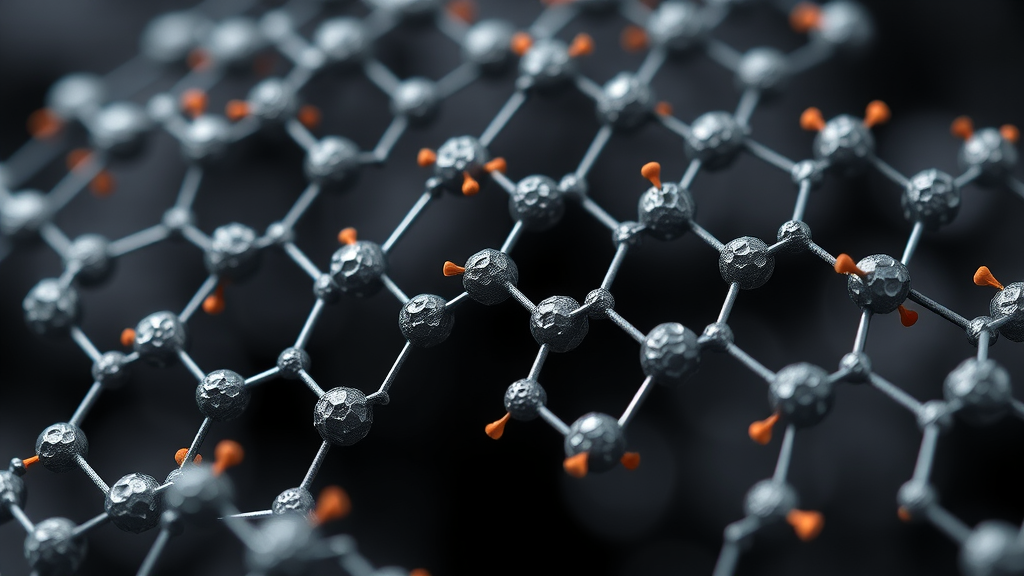
The research team, led by Honglei Fan of the North University of China in Taiyuan, together with colleagues from Shihezi University and Southwest University, tackled the agglomeration problem by growing the iron nanoparticles directly on sheets of reduced graphene oxide, a conductive, high-surface-area carbon material derived from graphite. Using an in situ liquid-phase reduction method, they formed the composite so that the iron particles nucleate and anchor on the graphene scaffold rather than on each other. Characterization of the resulting material showed that the graphene support did exactly what the designers hoped: it improved the dispersion of the iron nanoparticles and increased both the specific surface area and the pore volume of the composite, exposing far more active sites to the surrounding water.
The performance gains were dramatic. Under the optimized reaction conditions, the rGO/nZVI/PDS system achieved greater than 98 percent removal of sulfamethoxazole within 10 minutes. The apparent rate constant of the degradation was 5.6 times higher than that of a system using nanoscale zero-valent iron alone with peroxydisulfate, and 13.2 times higher than peroxydisulfate on its own. Those multipliers matter, because in water treatment the difference between a reaction that finishes in minutes and one that takes an hour or more determines whether a technology is a laboratory curiosity or a practical engineering option.
Perhaps the most intriguing part of the study is what the researchers found when they probed the underlying chemistry. In the textbook picture of persulfate activation, the oxidant splits into sulfate radicals and, secondarily, hydroxyl radicals—aggressive, short-lived species that indiscriminately oxidize organic molecules in solution. But when the team ran quenching experiments, using selective scavenger chemicals to neutralize specific reactive species, and confirmed their results with electron paramagnetic resonance spectroscopy, a different story emerged. Freely diffusing sulfate radicals and hydroxyl radicals were not the predominant species driving sulfamethoxazole degradation under the tested conditions. Instead, the evidence pointed to singlet oxygen, a milder but selective excited state of molecular oxygen, as the key player.
Singlet oxygen belongs to the growing catalog of so-called non-radical or surface-mediated oxidation pathways in advanced oxidation chemistry. Unlike free radicals, which are quenched almost instantly by the background matrix of natural waters—chloride, bicarbonate, and natural organic matter all act as radical sinks—singlet oxygen and related surface-bound processes tend to be far more tolerant of complex water chemistries. That resilience is a major practical advantage, because real wastewater is never as clean as laboratory reagent water. A treatment that depends on free radicals can lose most of its efficiency the moment it encounters a realistic water matrix, whereas a singlet-oxygen-dominated process can keep working.
The authors attribute the enhanced performance of the rGO/nZVI composite to several converging factors. The improved dispersion of iron-containing sites means more of the metal is available to interact with peroxydisulfate. The increased accessibility of the composite surface, a direct consequence of the graphene scaffold’s high area and open pore structure, allows both the oxidant and the pollutant to reach those sites efficiently. In addition, the researchers suggest that the conductive graphene network may alter interfacial electron-transfer processes during peroxydisulfate activation, facilitating the movement of electrons from the iron core to the oxidant and steering the reaction network toward singlet oxygen generation rather than radical fragmentation. Graphene’s role as an electron highway between catalytic sites and adsorbed molecules is a recurring theme in carbon-supported catalyst research, and this study adds another data point to that picture.
The broader context makes the result timely. Sulfamethoxazole is one of the most frequently detected pharmaceuticals in surface waters and wastewater treatment effluents worldwide, and its persistence raises concerns beyond simple toxicity. Residual antibiotics in the environment exert selection pressure on bacteria, accelerating the spread of antibiotic resistance genes—one of the most serious public health threats identified by global health agencies. Conventional activated sludge treatment removes only a fraction of the drug, and biodegradation of sulfamethoxazole is slow and incomplete. That gap between what treatment plants deliver and what the environment needs has fueled an intense search for fast, robust polishing technologies, and persulfate-based advanced oxidation has emerged as a leading candidate because of its low cost, chemical stability, and ease of transport and storage compared with alternatives such as ozone or hydrogen peroxide under certain conditions.
Iron-carbon composites of various kinds have been explored for this purpose before, including biochar-supported iron, iron-carbon materials derived from industrial wastes, and graphene oxide-supported sulfidated zero-valent iron. What distinguishes the new work is the combination of extreme speed, the clear mechanistic evidence for a singlet oxygen pathway, and the straightforward in situ synthesis route, which grows the composite in a single liquid-phase step rather than requiring multi-stage high-temperature processing. Simplicity of manufacture is often the deciding factor in whether a promising catalyst ever leaves the laboratory, and a one-pot aqueous synthesis is about as simple as nanomaterial preparation gets.
Challenges remain before the technology can be scaled. The study reports performance under controlled laboratory conditions, and real-world application will require testing across a wider range of water matrices, pH values, and competing contaminants. The long-term stability and reusability of the composite, the fate of the iron as it corrodes, and the cost of reduced graphene oxide at industrial scale all need to be addressed. The authors also note that the datasets generated in the study are available from the corresponding author on reasonable request, inviting further scrutiny and replication. The work was supported by the Fundamental Research Program of Shanxi Province of China and the National Natural Science Foundation of China.
Even with those caveats, the study offers a compelling demonstration of how rational materials design can transform a familiar chemistry. By giving unruly iron nanoparticles a graphene scaffold to stand on, the researchers unlocked a degradation rate that outpaces conventional iron activation by more than a factor of five and revealed a selective, matrix-tolerant oxidation pathway in the process. As water utilities grapple with a steady stream of emerging contaminants, composite activators like rGO/nZVI may well become a standard tool in the effort to strip antibiotics—and the resistance risks they carry—out of the water we all share.
Subject of Research: Activation of peroxydisulfate by reduced graphene oxide-supported nanoscale zero-valent iron for rapid degradation of the antibiotic sulfamethoxazole in water
Article Title: Enhanced peroxydisulfate activation by rGO/nZVI composites for efficient sulfamethoxazole degradation
Article References: Fan, H., Sun, Z., Xuan, K., Liu, Y., Zhou, S., & Huang, J. (2026). Enhanced peroxydisulfate activation by rGO/nZVI composites for efficient sulfamethoxazole degradation. Environmental Science and Pollution Research. https://doi.org/10.1007/s11356-026-38202-z
Image Credits: AI Generated
DOI: 10.1007/s11356-026-38202-z
Keywords: rGO/nZVI, peroxydisulfate activation, sulfamethoxazole, singlet oxygen, advanced oxidation processes, nanoscale zero-valent iron, reduced graphene oxide, water treatment, antibiotic degradation, sulfate radical, non-radical pathway, emerging contaminants
Cite Scienmag News
Neil Sanderson. (September 22, 2026). Graphene-Supported Iron Nanoparticles Shatter Antibiotic Pollutants in Minutes. Scienmag. https://scienmag.com/graphene-supported-iron-nanoparticles-shatter-antibiotic-pollutants-in-minutes/
Neil Sanderson. "Graphene-Supported Iron Nanoparticles Shatter Antibiotic Pollutants in Minutes." Scienmag, 22 September 2026, https://scienmag.com/graphene-supported-iron-nanoparticles-shatter-antibiotic-pollutants-in-minutes/. Accessed 22 September 2026.
Neil Sanderson. "Graphene-Supported Iron Nanoparticles Shatter Antibiotic Pollutants in Minutes." Scienmag. September 22, 2026. https://scienmag.com/graphene-supported-iron-nanoparticles-shatter-antibiotic-pollutants-in-minutes/


