


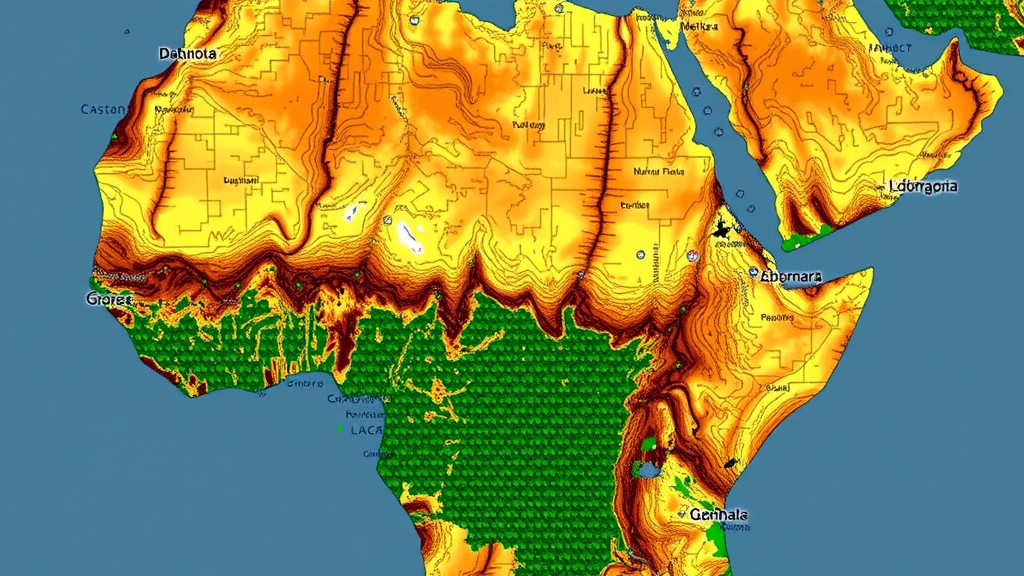
The world’s second-largest tropical rainforest, the vast belt of humid forest that stretches across the Congo Basin, has long been regarded as one of the planet’s most reliable buffers against climate change. Unlike the Amazon, which has shown mounting evidence of stress and in some regions a transition from carbon sink to carbon source, Central African forests have appeared comparatively resilient, absorbing a substantial share of the carbon dioxide that human activity pumps into the atmosphere each year. That reputation has now been shaken by a new study published in Nature Communications, which used high-resolution satellite-derived maps of biomass change to reveal that, at least in recent years, these forests have been losing more carbon than they gain. The finding, reported under the title Net carbon losses in Central African forests revealed by high-resolution biomass change maps, carries sobering implications for global carbon budgets and for the international programs that depend on tropical forests to offset emissions.
The research rests on a deceptively simple question: across the whole of Central Africa, is the forest gaining or losing woody carbon? Answering it has been notoriously difficult. Traditional approaches to estimating tropical carbon stocks rely either on sparse ground plots, which sample tiny fractions of the landscape, or on coarse-resolution satellite products that blur the fine-grained mosaic of intact forest, secondary growth, smallholder agriculture and logging gaps that characterizes the region. Averaged over tens or hundreds of kilometers, such coarse products can hide critical dynamics: a hectare of intensifying degradation next to a hectare of recovering vegetation may appear perfectly balanced in a low-resolution pixel, even as the actual carbon balance tips into deficit. The new maps, by contrast, resolve biomass change at a spatial grain fine enough to distinguish individual disturbance events, from industrial logging roads snaking into remote concessions to the slow expansion of farmland at forest edges.
To build these maps, the researchers combined multiple streams of satellite observation into a single, temporally consistent record of aboveground biomass. Spaceborne radar instruments are particularly valuable in the perpetually cloud-covered Congo Basin, where optical sensors are frequently blinded by persistent cloud cover. Radar signals penetrate clouds and, at longer wavelengths, interact directly with the woody structure of the forest, providing a measure of how much vegetation is standing on the ground. These radar observations were fused with data from spaceborne lidar, which samples vertical forest structure along satellite tracks, and with optical imagery that captures disturbance timing and vegetation recovery. Machine-learning models trained against forest inventory plots tie the satellite signals to actual quantities of carbon per hectare, allowing the mapping to extend calibrated, plot-level measurements continuously across tens of millions of hectares.
What distinguishes the new analysis is not merely the spatial detail but the accounting. Rather than snapshotting carbon stocks at two points in time and subtracting, which is vulnerable to errors in either map, the study tracks biomass change pixel by pixel through time, capturing both the losses caused by deforestation and degradation and the gains accumulated by growing forests. This dual bookkeeping matters because the two flows are of very different character. Losses are usually abrupt: a forest cleared for agriculture or hauled away as timber releases decades of stored carbon within months or years. Gains are slow: a recovering forest needs decades to rebuild what was lost. When the researchers tallied both sides of the ledger across Central Africa, the result was unambiguous: gains in growing biomass were insufficient to compensate for losses, yielding a net emission of carbon from the region’s forests rather than the net removal that many global models had assumed.
The geography of these losses is as informative as their magnitude. The study shows that the net sink strength varies enormously across the region, and that the declines are concentrated in specific zones rather than spread evenly across the basin. Forests in the western part of the Congo Basin, including areas of Cameroon, the Republic of Congo, Gabon and Equatorial Guinea, have historically exhibited among the highest biomass densities of any tropical forest on Earth, with some stands holding more carbon per hectare than lowland Amazonia. The new maps indicate that where these carbon-dense forests are disturbed, the resulting emissions are disproportionately large, because each hectare lost carries an exceptionally heavy carbon cargo. In other areas, long-term degradation from selective logging, fuelwood harvesting and shifting cultivation thins the forest canopy and erodes biomass gradually, a process that is largely invisible to conventional deforestation monitoring, which traditionally registers only complete forest clearance.
This distinction between deforestation and degradation is one of the study’s central contributions. International policy frameworks, including REDD+ programs that channel climate finance into forest conservation, have historically focused on monitoring deforestation, the visible and permanent conversion of forest to non-forest. But the high-resolution biomass change maps make clear that degradation, the partial and often reversible loss of carbon within standing forest, accounts for a large share of the region’s net carbon losses. Selective logging removes only the commercially valuable stems, yet each extracted tree leaves behind damaged neighbors, abandoned roads and a canopy gap through which the forest floor dries and decomposes faster. Fire, increasingly frequent at the humid forest’s dry margins, similarly kills trees without clearing them. Because degraded forest remains classified as forest, its carbon losses accumulate below the threshold of conventional monitoring, silently converting a regional sink into a source.
The findings arrive at a moment of genuine uncertainty about the future of tropical carbon. Global climate models generally assume that intact tropical forests will continue to absorb carbon, offsetting a meaningful fraction of fossil fuel emissions, but the empirical basis for that assumption is weakening. Long-term forest plots across the tropics have documented a slowdown in the rate at which undisturbed forest gains biomass, a pattern widely attributed to increasing drought, heat stress and atmospheric changes. If the Central African forests, previously the most resilient of the major tropical forest blocks, are now slipping into net carbon loss, the implications extend beyond the region itself. Carbon budgets consistent with the Paris Agreement already have little room for the world’s forests to flip from helping to hindering; a Central African reversal would consume a portion of that remaining room all on its own.
The study also underscores a regional irony with global resonance. Central Africa’s per capita emissions are among the lowest in the world, and its forests have been doing the planet a service for decades by storing carbon at exceptional densities. Yet the drivers of the emerging carbon losses are entangled with pressures that are partly global in origin: demand for timber and agricultural commodities, infrastructure corridors that open previously inaccessible forest, and climatic shifts driven by emissions generated far from the basin. Drought episodes that once receded without lasting damage now leave measurable scars in the biomass record. The high-resolution maps make it possible to see, for the first time with clarity at scale, how these pressures interact across the landscape, and where intact forest refugia still persist as anchors for conservation.
There are, however, constructive signals embedded in the data. The same maps that reveal net losses also identify the places where forests are reliably gaining carbon: regrowing secondary forests, abandoned agricultural land recovering toward maturity, and well-protected core areas where intact forests continue to accumulate biomass. This spatial intelligence is precisely what national forest monitoring systems and international climate finance mechanisms need in order to target interventions where they will matter most. Protecting the carbon-dense forests of the western basin, accelerating the recovery of degraded areas, and strengthening enforcement against illegal logging all emerge as evidence-backed priorities. The study’s methodology also offers a template that other forest nations can adopt, demonstrating that plot-calibrated, multi-sensor satellite mapping can now deliver wall-to-wall carbon accounting at a resolution fine enough to guide policy.
For decades, the Congo Basin forests have been the quiet heroes of the global carbon story, absorbing emissions without fanfare while deforestation focused global attention elsewhere. The new biomass change maps retire that comfortable assumption and replace it with a more demanding truth: these forests are not immune to the pressures reshaping tropical ecosystems worldwide, and their carbon balance has already tipped negative. Whether that tipping proves to be a temporary fluctuation, driven by drought and disturbance pulses that forests can still recover from, or the early stage of a durable transition from sink to source, is one of the most consequential open questions in climate science. What is no longer open to question is that the answer must be tracked in detail. With high-resolution biomass monitoring now demonstrated at regional scale, the world’s ability to see what Central African forests are doing, and to act before their decline accelerates, has taken a decisive step forward.
Subject of Research: Satellite-based high-resolution mapping of biomass and carbon changes in Central African tropical forests
Article Title: Net carbon losses in Central African forests revealed by high-resolution biomass change maps
Article References: Wan, L., Ciais, P., de Truchis, A., Xu, Y., Brandt, M., Chave, J., Bourgoin, C., Wigneron, J.-P., Bastin, J.-F., Li, W., Ryu, Y., Liu, S., Purnell, D., Fayad, I., Sagang, L. B., Vander Linden, A., Besisa, T., & Ploton, P. (2026). Net carbon losses in Central African forests revealed by high-resolution biomass change maps. Nature Communications. https://doi.org/10.1038/s41467-026-77531-y
Image Credits: AI Generated
DOI: 10.1038/s41467-026-77531-y
Keywords: Central Africa, tropical forests, carbon cycle, biomass mapping, remote sensing, climate change, carbon sink, deforestation, forest degradation, Nature Communications, net carbon loss, satellite imagery
Cite Scienmag News
Denise Maddox. (September 21, 2026). High-Resolution Maps Reveal Central African Forests Are Losing Carbon. Scienmag. https://scienmag.com/high-resolution-maps-reveal-central-african-forests-are-losing-carbon/
Denise Maddox. "High-Resolution Maps Reveal Central African Forests Are Losing Carbon." Scienmag, 21 September 2026, https://scienmag.com/high-resolution-maps-reveal-central-african-forests-are-losing-carbon/. Accessed 21 September 2026.
Denise Maddox. "High-Resolution Maps Reveal Central African Forests Are Losing Carbon." Scienmag. September 21, 2026. https://scienmag.com/high-resolution-maps-reveal-central-african-forests-are-losing-carbon/


