


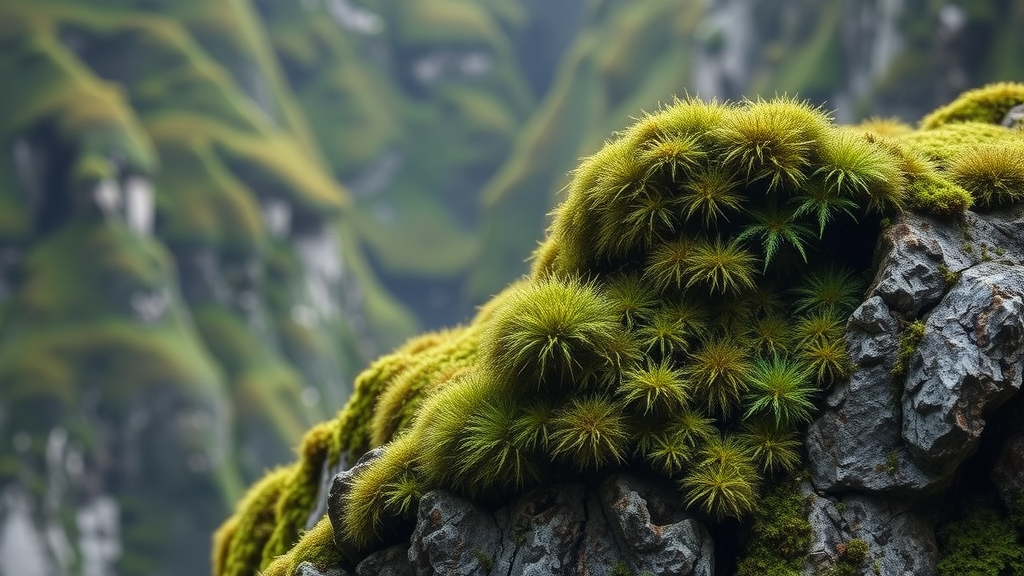
Beneath the cracked, chalky surfaces of southern China’s degraded karst terrain, an unexpected biological empire has been quietly holding the ground together. A new study of biological soil crusts—thin, living skins of mosses, lichens, algae, and cyanobacteria that bind soil particles at the land surface—reveals that these communities in Guizhou Province are strikingly different from their celebrated dryland counterparts. Published in Plant Biosystems, the research offers the most comprehensive species-level portrait yet of biocrusts in the South China Karst, a region where centuries of land-use pressure and soluble carbonate bedrock have produced some of the most severe rocky desertification on Earth.
Biological soil crusts are among the most studied living surfaces in arid and semi-arid environments, where they stabilize soils, fix carbon and nitrogen, and modulate water infiltration across millions of square kilometers. Yet the subtropical humid karst landscapes of Guizhou have remained a conspicuous gap in this global picture. Unlike deserts, these humid regions receive abundant rainfall and support dense vegetation mosaics, raising questions about whether biocrusts even form meaningful communities there, and if so, which species assemble them and why. The new study set out to answer precisely those questions by surveying six representative areas spanning a gradient of ecosystem degradation across the province.
The findings are taxonomically striking. Across all six study areas, the researchers documented 22 distinct biocrust species drawn from four major phyla. Mosses led the roster with 12 species spanning six families and nine genera, followed by eight algal and cyanobacterial species from six families and seven genera, and two lichen species from the phylum Ascomycota. Within the algal component, cyanobacteria dominated heavily, accounting for six species against only two green algae. This asymmetry hints that nitrogen-fixing, stress-tolerant cyanobacteria play a foundational role in these humid, calcium-rich soils, much as they do at the earliest successional stages of crust development in drylands.
But it is the mosses that rule the surface. In every area surveyed, mosses were the absolute dominant crust type, contributing between 75 and 100 percent of total biocrust cover. At the heart of this dominance sits a single, remarkably persistent species: Hyophila rosea, an acrocarpous moss that emerged as the ubiquitous dominant across the entire degradation gradient. Whether a site was lightly disturbed or profoundly degraded, H. rosea held its ground, a biological constant in landscapes otherwise defined by change. Its closest co-dominants, Brachymenium exile and Trichostomum brachydontium, share a similar profile of extremotolerance—traits that allow these diminutive plants to endure the thin soils, high calcium concentrations, and episodic desiccation that define karst surfaces.
Not every moss in these communities is a hardened local specialist. The cosmopolitan silvergreen bryum moss, Bryum argenteum, appeared as an associated, gap-filling taxon, exploiting bare patches between the dominants rather than anchoring the community itself. This division of labor—resilient local specialists forming the structural backbone while widespread opportunists fill the interstices—offers a textbook illustration of how habitat filtering and dispersal dynamics jointly shape community assembly. In karst environments, where soil calcium acts as a well-documented environmental filter, only lineages with tolerance for calcareous, drought-prone microhabitats can persist, and the species list reflects that pruning with unusual clarity.
The study also uncovered a strong spatial signature in where biocrusts thrive. Rather than spreading evenly across the landscape, the crusts showed pronounced habitat preferences, becoming notably enriched in managed groves such as plantations of Zanthoxylum bungeanum, the Sichuan pepper tree, and Camellia oleifera, the oil-tea camellia. By contrast, croplands and natural grasslands supported far less crust development. The pattern makes ecological sense: managed groves experience less frequent mechanical disturbance than cultivated fields, while their canopy structure moderates temperature and moisture extremes at the soil surface in ways that open grasslands do not. Human management, in other words, is not merely degrading these landscapes—it can actively create refugia for the very organisms that aid recovery.
Perhaps the most consequential result emerges from the study’s global comparison. When the team overlapped its species list with the extensive biocrust literature from the world’s drylands, the taxonomic overlap proved vanishingly small—less than five percent. Nearly everything living in these Guizhou crusts is different from what lives in desert crusts elsewhere on the planet. Only one cyanobacterial species, the globally widespread Nostoc commune, bridged the two worlds. Every other cyanobacterial and algal species identified in the karst study sites was exclusive to these habitats. Such profound biogeographic differentiation suggests that the prevailing scientific emphasis on dryland biocrusts has, until now, left an entire class of humid-climate crust ecosystems essentially unclassified.
Why does this matter beyond taxonomy? Biocrusts are increasingly recognized as engineers of ecosystem function, and karst landscapes are in desperate need of engineering. Rocky desertification—the exposure of barren carbonate bedrock following soil erosion—degrades water retention, carbon storage, and agricultural productivity across millions of hectares in southwestern China. Prior work by overlapping research groups has shown that moss-dominated crusts in these landscapes modulate soil nitrogen, influence microbial communities, and alter enzyme activities, with effects that vary along degradation gradients. Knowing precisely which species build the crusts provides the species-level baseline required to move from description to intervention: restoration practitioners can now identify, cultivate, and transplant the actual organisms best adapted to the harshest karst conditions.
The study’s implications also run in the opposite direction. As global change reshapes disturbance regimes, humid-region biocrusts may prove more vulnerable than their desert-adapted relatives, which have evolved under chronic water stress. Understanding which species anchor crust cover in managed groves—and why agricultural and grassland settings suppress them—gives land managers in Guizhou a concrete tool for steering vegetation recovery. A system in which H. rosea and its co-dominants can be encouraged on the right land uses, and shielded on the wrong ones, transforms a minute layer of the biosphere into a lever for landscape-scale rehabilitation.
For a layer of life often dismissed as a smear of green on stone, the biological soil crusts of Guizhou have now been given a name, a roster, and an ecological identity all their own. Twenty-two species, one indispensable moss, and a community unlike any other on Earth: the living skin of China’s karst is no longer an anonymous footnote to dryland science, but a distinct biogeographic province in its own right—one whose guardians may hold the keys to healing one of the world’s most degraded terrains.
Subject of Research: Species composition and community assembly of biological soil crusts in degraded subtropical karst ecosystems of Guizhou, China
Article Title: Species composition and community assembly characteristics of biological soil crusts in degraded karst ecosystems of Guizhou, China
Article References: Liu, J., Zhao, X., Deng, M., Zhang, F., Wu, Q., Liu, R., Long, M., & Li, X. (2026). Species composition and community assembly characteristics of biological soil crusts in degraded karst ecosystems of Guizhou, China. Plant Biosystems, 160(5), Article 249. https://doi.org/10.1007/s44473-026-00257-8
Image Credits: AI Generated
DOI: 10.1007/s44473-026-00257-8
Keywords: biological soil crusts, karst ecosystems, mosses, cyanobacteria, rocky desertification, Guizhou, community assembly, environmental filtering, Hyophila rosea, ecosystem restoration, biogeography, Plant Biosystems
Cite Scienmag News
Gavin Prescott. (September 21, 2026). Hidden Moss Worlds Thrive on China’s Degraded Karst Landscapes. Scienmag. https://scienmag.com/hidden-moss-worlds-thrive-on-chinas-degraded-karst-landscapes/
Gavin Prescott. "Hidden Moss Worlds Thrive on China’s Degraded Karst Landscapes." Scienmag, 21 September 2026, https://scienmag.com/hidden-moss-worlds-thrive-on-chinas-degraded-karst-landscapes/. Accessed 21 September 2026.
Gavin Prescott. "Hidden Moss Worlds Thrive on China’s Degraded Karst Landscapes." Scienmag. September 21, 2026. https://scienmag.com/hidden-moss-worlds-thrive-on-chinas-degraded-karst-landscapes/


