


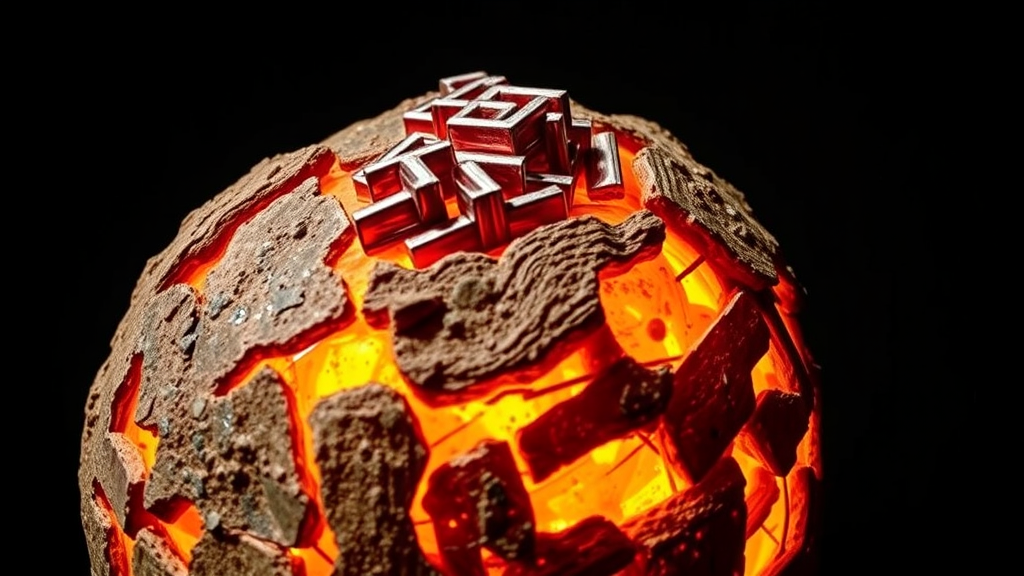
When the solar system was still a swirling disk of gas and dust more than four and a half billion years ago, the raw materials available for building its first solid bodies fell into two very different categories. On one side were chondrules, millimeter-sized beads of rock that had been flash-heated to molten temperatures and then cooled rapidly, carrying with them the chemical signature of a hot, fiery environment. On the other side was matrix, an ultra-fine grained dust rich in water ice and organic molecules, representing the cold, volatile-laden outskirts of the forming planetary system. A new study led by researchers at Yale University now provides the first geochemical evidence that, from the very first million years of solar system history, the process of assembling planetesimals strongly favored the fiery chondrules over the icy dust. The finding, published in the journal Nature Astronomy, pushes back the timeline for this selective sorting by several million years and reshapes how scientists understand the birth of the planets.
Previous research had already hinted that something like this preferential sorting was taking place, but only in objects that formed between two and four million years after the solar system’s origin. Among carbonaceous chondrites, the primitive stony meteorites that contain organic compounds and water within their silicate minerals, those that formed earlier consistently contained a higher percentage of chondrules and a lower percentage of matrix. This pattern suggested that in the regions where the first planetesimals were coalescing, the icy, volatile-rich dust was already being squeezed out in favor of the heat-forged rocky beads. What was missing was direct evidence from the very earliest epoch, the first million years, when the first generation of solid bodies came together. No undifferentiated bodies from that period survive intact today, leaving a critical gap in the record of how the solar system’s construction began.
Damanveer Grewal, an assistant professor of Earth and planetary sciences in Yale’s Faculty of Arts and Sciences and first author of the study, set out to close that gap with an unconventional approach. Rather than searching for preserved early bodies, which do not exist, he turned to iron meteorites whose parent bodies formed in the outer solar system during that missing first million years. These parent bodies had accumulated so much of the radioactive isotope aluminum-26 that they melted completely, destroying every physical trace of their original chondrule-to-matrix composition. On the surface, that total melting would seem to erase all useful information. But Grewal and his colleagues realized that the chemical fingerprints of the original ingredients would survive the melting, locked into the metallic cores of these differentiated bodies.
The team identified two independent chemical tracers, both tied specifically to the matrix component. The first is sulfur, which exists in concentrated form within matrix material. The amount of sulfur preserved in the iron meteorites therefore reveals how much fine-grained, volatile-rich dust the original parent body had incorporated before it melted. The second tracer is the oxidation state of iron, which reflects how much water ice and oxidized dust the original body contained. Because matrix is the component that carries water ice and oxidized material, a low oxidation state in the surviving metal indicates that very little icy dust was present when the body assembled. By measuring both tracers in the same set of meteorites, the researchers could reconstruct the original composition of bodies that had otherwise lost all physical memory of their building blocks.
The results were striking. Using the paired tracers, the researchers calculated that matrix made up only 8 to 17 percent of the original bodies sampled by these iron meteorites. That range is lower than the matrix fraction found in any known chondrite, meaning the earliest planetesimals of the outer solar system were more chondrule-dominated than any primitive meteorite ever recovered on Earth. In other words, the first solid bodies ever built in the solar system were constructed from 83 to 92 percent chondrules, with only a small admixture of the icy, volatile-rich dust that dominates objects that formed later. The two tracers, measured independently, converged on the same answer, giving the team confidence that the reconstruction was robust rather than an artifact of any single measurement.
Both tracers independently tell the same story: these early planetesimals were remarkably matrix-poor, Grewal explained. That convergence is what makes the result robust. The finding demonstrates that the assembly process was remarkably selective from the very beginning, sorting heat-forged chondrules into the first generation of solid bodies while excluding most of the cold, volatile-bearing dust. This selectivity implies that physical processes in the young protoplanetary disk, such as aerodynamic sorting of particles by size and density, were already operating efficiently within the first million years, concentrating the millimeter-sized chondrules and winnowing away the finer matrix grains before the first planetesimals accreted.
The discovery also resolves a long-standing puzzle about the meteorite record itself. Chondrules from the earliest epoch are scarce among the meteorites collected on Earth, and the new study explains why. The bodies that incorporated those oldest chondrules were the same bodies that accumulated enough radioactive aluminum-26 to melt completely, and that melting erased the physical evidence of their chondrule-rich composition. The oldest chondrules were not absent from the early solar system; they were simply swallowed by bodies that later transformed beyond recognition, leaving only their chemical ghosts in the iron meteorites that survive today. The scarcity of ancient chondrules in chondrites is thus a consequence of planetary differentiation, not of their original rarity.
Beyond solving that puzzle, the findings carry broader implications for understanding how the planets themselves came to be. Chondrules are the ubiquitous little beads of rock that served as the basic building blocks from which the planets were eventually assembled, and the new work shows that they were already being sorted and incorporated into the first generation of solid bodies from the very start. If the earliest planetesimals were so strongly enriched in chondrules and so depleted in volatile-rich matrix, then the seeds of the planets began their lives chemically dry and rocky, with the water and organic material arriving later or in different proportions than many models had assumed. This has consequences for theories of how Earth acquired its water and for understanding the volatile budgets of the outer solar system’s icy bodies.
The study was co-authored by Zhongtian Zhang of Princeton University and Joanna Drążkowska of the Max Planck Institute for Solar System Research in Germany, and the research was funded by Yale University. For Grewal, the work also carries a sense of deep connection to the deep past. Chondrules are found inside chondrites, the most primitive meteorites in geological collections, and holding one in your hand means holding a fragment of a process that started billions of years ago, a timescale that is hard to wrap your head around. By reading the chemical memory preserved in melted iron cores, the team has recovered a chapter of solar system history that physical evidence alone could never provide, revealing that when the solar system first began to build, it chose fire over ice.
Subject of Research: Geochemical reconstruction of the chondrule-to-matrix composition of the solar system's first planetesimals
Article Title: From the start, the solar system chose fire over ice to build its first bodies
Article References: From the start, the solar system chose fire over ice to build its first bodies. (n.d.). Original publication
Image Credits: AI Generated
DOI: Not provided
Keywords: chondrules, matrix, planetesimals, iron meteorites, carbonaceous chondrites, solar system formation, aluminum-26, protoplanetary disk, Yale University, Nature Astronomy, oxidation state, volatile-rich dust
Cite Scienmag News
Grant Pearson. (September 20, 2026). Ancient Meteorites Reveal the Solar System’s First Bodies Were Built From Fire. Scienmag. https://scienmag.com/ancient-meteorites-reveal-the-solar-systems-first-bodies-were-built-from-fire/
Grant Pearson. "Ancient Meteorites Reveal the Solar System’s First Bodies Were Built From Fire." Scienmag, 20 September 2026, https://scienmag.com/ancient-meteorites-reveal-the-solar-systems-first-bodies-were-built-from-fire/. Accessed 20 September 2026.
Grant Pearson. "Ancient Meteorites Reveal the Solar System’s First Bodies Were Built From Fire." Scienmag. September 20, 2026. https://scienmag.com/ancient-meteorites-reveal-the-solar-systems-first-bodies-were-built-from-fire/


