


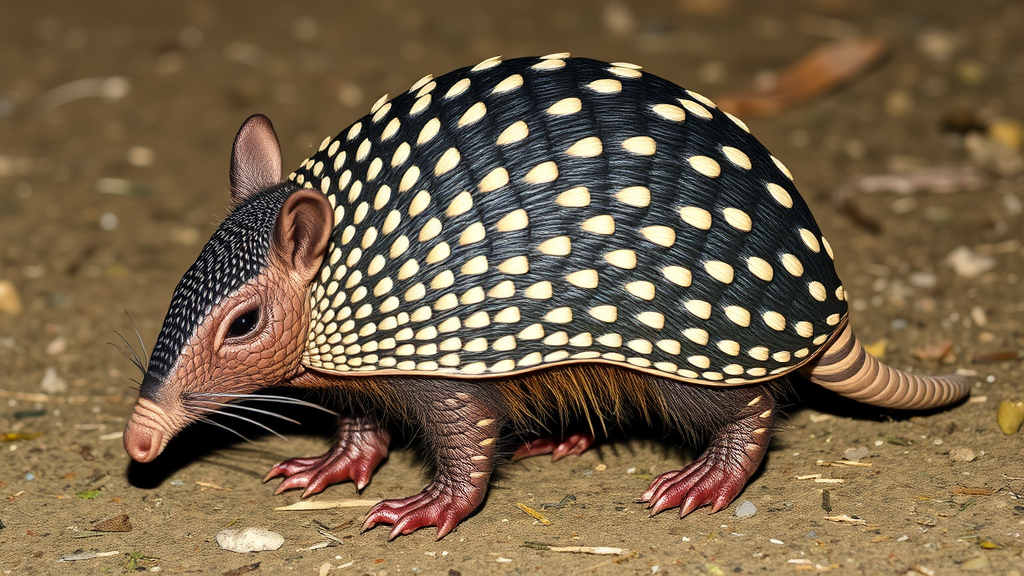
The greater naked-tailed armadillo, a secretive burrowing mammal that spends most of its life underground across South America’s forests and savannas, is facing a far hotter and more crowded future than conservation planners have assumed. A new modeling study projects that climate change could erase more than half of the climatically suitable habitat for the species by the end of the century under high greenhouse gas emissions, shrinking a range that currently spans nearly two million square kilometers and squeezing the remaining favorable conditions into a progressively smaller southern corner of the continent. The findings, published in the journal Discover Conservation, offer one of the most detailed spatial assessments yet of how a warming world may reorganize the distribution of a fossorial Neotropical mammal whose biology makes it unusually sensitive to rising temperatures.
The research, conducted by Bruno Lucas Fontes and Ricardo Bovendorp of the Universidade Estadual de Santa Cruz in Bahia, Brazil, applied ecological niche modeling to understand where Cabassous tatouay can live today and where it might persist in the coming decades. The team compiled 352 georeferenced occurrence records from peer-reviewed and gray literature, museum databases such as GBIF and VertNet, and their own camera-trap surveys in the Brazilian state of Bahia. After rigorous quality control to remove impossible coordinates, duplicates, and records clustered around cities, museums, and administrative centers, the dataset was spatially thinned to retain only one record per ten-kilometer radius, yielding 220 spatially independent occurrences for model calibration. This careful filtering was essential because the species is rare, cryptic, and solitary, producing sparse and biased records that can undermine model reliability.
The technical architecture of the study reflects the current state of the art in species distribution modeling. Environmental predictors were drawn from the WorldClim database at approximately one-kilometer resolution, with nine bioclimatic variables retained after removing strongly correlated temperature and precipitation metrics. Future climate projections came from two independent Coupled Model Intercomparison Project Phase 6 general circulation models, MIROC6 and IPSL-CM6A-LR, run under three Shared Socioeconomic Pathways spanning intermediate to high emissions: SSP2-4.5, SSP3-7.0, and SSP5-8.5. The researchers used the MaxEnt algorithm, tuning model complexity across alternative feature classes and regularization multipliers, and validated performance with geographically structured block cross-validation to guard against spatial autocorrelation inflating accuracy estimates. Consensus maps were generated for the years 2050, 2070, and 2090, and continuous suitability surfaces were converted into binary suitable-versus-unsuitable classifications using a conservative tenth-percentile training presence threshold.
Under historical climate conditions averaged across 1970 to 2000, the model projected approximately 1.94 million square kilometers of climatically suitable habitat, concentrated in southern and southeastern Brazil, particularly within the Atlantic Forest and Pampa biomes and adjacent Cerrado regions. Suitability declined along a latitudinal gradient toward the warmer, drier north and northeast of the species’ range. When the selected model was projected into future climates, every combination of emission scenario and time period produced a net loss of suitable area. Under the intermediate SSP2-4.5 pathway the losses were substantial; under the extreme SSP5-8.5 scenario by 2090, suitable habitat contracted to roughly 1.04 million square kilometers, a reduction of 54 percent relative to the historical baseline.
Perhaps the most striking result was what the models did not find: no newly suitable areas anywhere in any scenario. Gain was zero across the board, meaning the species’ future range dynamics are driven entirely by habitat loss rather than expansion into novel territory. The authors note that this pattern is unlikely to be an artifact of modeling constraints, since projections were conducted within a broadly defined calibration area based on continuous suitability outputs. For a species that cannot simply shift its range elsewhere, the contraction represents a genuine narrowing of livable space, with the remaining favorable environments becoming spatially concentrated and increasingly fragmented.
The geography of the losses matters as much as their magnitude. Reductions in suitability were proportionally greatest in the central and northern portions of the distribution, especially within Brazil’s warmer and semi-arid regions such as the Caatinga biome in the northeast, where high temperatures and limited rainfall already push the species toward its physiological limits. Projected warming and altered precipitation in these areas may intensify existing climatic constraints beyond what even the armadillo’s burrowing behavior can buffer. In contrast, southern areas retained comparatively higher suitability across all scenarios, producing a progressive southward concentration of the species’ climatic envelope. The projections hint at a potential discontinuity between northern and southern populations, which could restrict gene flow and dispersal, compounding extinction risk for a fossorial mammal with presumed limited movement capacity.
The study also examined how these shifts intersect with the protected-area network, treating national parks, reserves, and indigenous territories as a single static category. Historically, protected areas encompassed 9.60 percent of the species’ suitable habitat, about 186,307 square kilometers. By 2090 under SSP5-8.5, suitable habitat within protected boundaries fell to 113,398 square kilometers, an absolute loss of nearly 73,000 square kilometers. Yet because suitability declined even faster outside reserves, the proportional share of the remaining suitable habitat inside protected areas rose to about 10.88 percent. This counterintuitive result means protected areas are not becoming more climatically favorable; rather, the surrounding unprotected landscape is deteriorating more rapidly, making the parks and reserves that retain suitability disproportionately valuable as potential refugia and stepping stones.
Why should the fate of one little-studied armadillo command global attention? Armadillos are what physiologists call imperfect homeotherms, characterized by low basal metabolic rates, high thermal conductance, and a bony armored carapace, traits that constrain their ability to regulate body temperature in hot environments. While burrows and dense vegetation offer partial thermal buffering, these behavioral strategies may prove insufficient under rapid climatic shifts. Moreover, Cabassous tatouay is an ecosystem engineer: its excavation activities modify soil structure, influence aeration, water infiltration, microbial communities, and nutrient redistribution, and create subterranean microhabitats used by many other organisms. The species also occupies threatened biomes, the Atlantic Forest and the Cerrado, where habitat destruction and fragmentation are already eroding its adaptive capacity, and where hunting and land-use change may further interact with climatic stress in ways the models did not capture.
The study has clear limitations that the authors acknowledge. Ecological niche models assume that species-environment relationships remain stable over time, which may not capture adaptive responses or shifting ecological interactions. The models relied exclusively on climatic variables, omitting land-use change, biotic interactions, and dispersal constraints that shape distributions at finer scales. Consequently, the results should be read as estimates of potential climatic suitability rather than realized distributions. Even so, consistent patterns across two independent climate models and multiple emission scenarios lend robustness to the central conclusion that the species faces rising climatic exposure and potential spatial isolation, and comparative evidence suggests similar contractions may await other Xenarthra, including giant armadillos and giant anteaters.
The practical implications point toward urgent, spatially targeted conservation. The authors argue for strengthening ecological corridors between fragmented habitats, expanding protected-area networks to include regions projected to retain suitable conditions, and aligning habitat protection with mapped climatic refugia, particularly in southern portions of the range. Because the species remains classified as Least Concern globally despite being Data Deficient in Brazil and Near Threatened in Argentina, proactive planning may be the only buffer before declines become detectable. The findings reinforce a broader lesson for twenty-first-century conservation: strategies grounded solely in current distributions are already obsolete, and safeguarding climate-sensitive mammals will require anticipating where suitable conditions will survive, not merely where they exist today, alongside aggressive reductions in greenhouse gas emissions to limit the magnitude of the change itself.
Subject of Research: Climate change impacts on climatically suitable habitat and protected area coverage for the greater naked-tailed armadillo (Cabassous tatouay)
Article Title: Climate change threatens future climatically suitable habitat and protected area coverage of the greater naked-tailed armadillo (Cabassous tatouay)
Article References: Fontes, B. L., & Bovendorp, R. (2026). Climate change threatens future climatically suitable habitat and protected area coverage of the greater naked-tailed armadillo (Cabassous tatouay). Discover Conservation, 3(1), Article 27. https://doi.org/10.1007/s44353-026-00096-w
Image Credits: AI Generated
DOI: 10.1007/s44353-026-00096-w
Keywords: ecological niche modeling, Cabassous tatouay, climate change, protected areas, climatic refugia, habitat connectivity, Neotropical mammals, species distribution modeling, biodiversity conservation, fossorial mammals, MaxEnt, SSP scenarios
Cite Scienmag News
Sloane Callahan. (September 20, 2026). Climate Change Could Strip Half of Suitable Habitat From the Greater Naked-Tailed Armadillo by 2090. Scienmag. https://scienmag.com/climate-change-could-strip-half-of-suitable-habitat-from-the-greater-naked-tailed-armadillo-by-2090/
Sloane Callahan. "Climate Change Could Strip Half of Suitable Habitat From the Greater Naked-Tailed Armadillo by 2090." Scienmag, 20 September 2026, https://scienmag.com/climate-change-could-strip-half-of-suitable-habitat-from-the-greater-naked-tailed-armadillo-by-2090/. Accessed 20 September 2026.
Sloane Callahan. "Climate Change Could Strip Half of Suitable Habitat From the Greater Naked-Tailed Armadillo by 2090." Scienmag. September 20, 2026. https://scienmag.com/climate-change-could-strip-half-of-suitable-habitat-from-the-greater-naked-tailed-armadillo-by-2090/


