


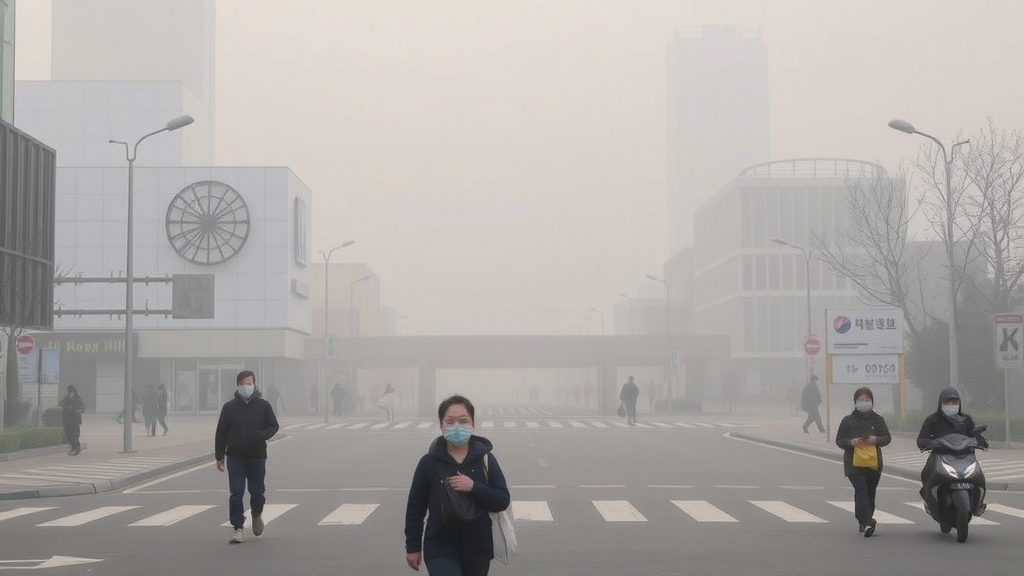
A severe air pollution episode that gripped South Korea in early 2019 may have helped set the stage for an unusual influenza resurgence weeks afterward, according to a new nationwide analysis that links spikes in fine particulate matter to delayed waves of flu activity. The study, published in the journal Air Quality, Atmosphere & Health, draws on more than a decade of air quality monitoring and laboratory-confirmed influenza surveillance to probe a question that has long frustrated epidemiologists: can a pollution episode act not as an immediate trigger of respiratory infections, but as a delayed one, seeding an outbreak five or six weeks down the line?
Most previous research on the connection between PM2.5 — airborne particles smaller than 2.5 micrometers that can penetrate deep into the lungs — and influenza has focused on short delays measured in days. Those studies have generally found that elevated pollution coincides with, or slightly precedes, increased influenza activity. But the possibility that severe episodes could exert an influence over a timescale of weeks has remained largely untested, largely because it requires long, continuous surveillance records and statistical machinery capable of examining a whole range of lag intervals simultaneously. The new research set out to fill that gap using an unusually rich national dataset.
The research team, led by atmospheric scientists and environmental health specialists from Yonsei University, Jeju National University and the National Institute of Environmental Research, assembled weekly PM2.5 observations from South Korea’s nationwide monitoring network alongside laboratory-confirmed influenza surveillance data spanning 2015 through 2025. To avoid the distortions introduced by the COVID-19 pandemic, which dramatically suppressed influenza transmission through nonpharmaceutical interventions, the years 2020 to 2022 were excluded from the analysis. The investigators then converted the raw concentrations into anomalies calculated by epidemiological week, a statistical maneuver that isolates how much each week’s pollution and influenza activity deviated from typical levels for that point in the season, stripping away the strong seasonal cycles that could otherwise masquerade as associations.
Two complementary modeling approaches anchored the analysis. The first was a repeated single-lag model, which estimates the association between a pollution anomaly in one week and an influenza anomaly a fixed number of weeks later, repeating the calculation across a sequence of lag times. The second was a constrained distributed lag model, which fits the shape of the lagged effect across multiple weeks at once while limiting how wildly the estimated effect can swing from one lag to the next. Together, the two frameworks provide a check on one another: a genuine delayed signal should appear consistently in both, whereas statistical noise typically produces estimates that lurch unpredictably across the lag dimension.
When the models were run across all weeks of the year, no robust lagged association between PM2.5 and influenza emerged. The picture changed, however, when the analysis was restricted to epidemiological weeks 8 through 20 — roughly late February through mid-May, the tail of the Korean influenza season and the height of the spring haze season. In that window, the estimated associations rose steadily as the lag increased, peaking at lags of five and six weeks in both models. The signal was strongest and most consistent for P90, a metric defined as the 90th percentile of weekly PM2.5 concentrations measured across all monitoring stations nationwide. Unlike a simple weekly average, P90 captures how severe the worst exposures in a given week were, making it a sensitive indicator of pollution episodes. Crucially, the association at lags 5 and 6 remained statistically significant even when the anomalous year 2019 was removed from the analysis entirely, suggesting the pattern was not merely an artifact of a single dramatic event.
That event, however, remains the study’s most striking illustration. During epidemiological weeks 7 through 9 of 2019, South Korea experienced an exceptionally severe spring haze episode. Weekly mean PM2.5 concentrations averaged 53.3 micrograms per cubic meter during that stretch, with the 90th percentile reaching 70.1 micrograms per cubic meter — levels far above typical early-spring values and well beyond thresholds generally considered harmful. In the weeks that followed, influenza activity resurged, climbing to a peak at epidemiological weeks 15 and 16, a delay of roughly six to nine weeks from the pollution episode. The timing aligns closely with the five-to-six-week lags where the statistical association was strongest, providing a concrete case study for the broader pattern detected across the decade of data.
The researchers were careful to examine whether meteorology could explain away the connection. Cold, dry conditions are well established as favorable for influenza transmission, influencing both the survival of virus-laden aerosols and host susceptibility. In 2019, the weeks spanning the resurgence window — weeks 12 through 16 — recorded mean temperatures that ranked lowest among all study years and relative humidity that ranked second lowest, a combination that would independently favor viral spread. When the team adjusted for delayed meteorological effects in their models, the estimates at the later lags were attenuated, indicating that part of the apparent pollution-influenza association is entangled with the cold, dry weather that often accompanies severe spring haze episodes. The authors interpret this honestly: severe pollution episodes may not act alone, but rather in concert with transmission-friendly conditions that frequently follow them.
Additional lines of evidence strengthen the plausibility of a true viral phenomenon. The 2019 resurgence was clearly visible in pediatric influenza surveillance data, and importantly, no comparable increase appeared in surveillance of other respiratory viruses among hospitalized children. If the late-spring uptick had been driven by changes in testing behavior, healthcare-seeking patterns, or generic respiratory irritation from polluted air, one might expect other viruses to rise in parallel. Their absence points instead to influenza specifically. Laboratory work offers several biological mechanisms that could underlie a delayed effect: fine particles can impair antiviral immune defenses, suppress interferon responses and inflammasome activation in the airways, and reduce the antiviral activity of pulmonary macrophages through epigenetic changes, while also physically carrying viral particles deeper into the respiratory tract. Such pollution-induced immunological weakening could plausibly increase susceptibility to infection in the weeks following exposure, or facilitate chains of transmission among a population of partially immunocompromised hosts.
The findings carry practical implications for public health surveillance. If severe PM2.5 episodes during the late winter and spring can foreshadow influenza resurgences five or six weeks later, then real-time air quality data could serve as a supplementary environmental early-warning signal, prompting health authorities to intensify influenza monitoring, vaccination campaigns, and clinical preparedness in the weeks following a major haze event. The authors are careful to frame the association as conditional: the delayed link was evident during epidemiological weeks 8 through 20 rather than throughout the year, and the effect appeared to require the subsequent arrival of conditions favorable to transmission. In other words, a pollution episode may prime the population, but cold, dry weather appears to help light the fuse. With climate change and transboundary haze continuing to threaten air quality across East Asia, and with influenza seasons increasingly prone to unusual timing in the post-pandemic era, the ability to anticipate resurgence weeks in advance — even imperfectly — could prove a valuable addition to the epidemiologist’s toolkit. The study also underscores a broader lesson about the health consequences of air pollution: its harms may unfold not only in the hours and days after exposure, but across the weeks that follow.
Subject of Research: Delayed association between severe PM2.5 air pollution episodes and influenza resurgence in South Korea
Article Title: Delayed influenza resurgence following high PM2.5 episodes: insights from the 2019 spring anomaly in South Korea
Article References: Delayed influenza resurgence following high PM2.5 episodes: insights from the 2019 spring anomaly in South Korea. (n.d.). https://doi.org/10.1007/s11869-026-02096-0
Image Credits: AI Generated
DOI: 10.1007/s11869-026-02096-0
Keywords: PM2.5, influenza, air pollution, South Korea, distributed lag model, 2019 spring haze, epidemiology, respiratory virus, influenza surveillance, environmental health, seasonality, public health
Cite Scienmag News
Russell Cooper. (September 20, 2026). Air Pollution Episodes May Trigger Influenza Resurgence Weeks Later in South Korea. Scienmag. https://scienmag.com/air-pollution-episodes-may-trigger-influenza-resurgence-weeks-later-in-south-korea/
Russell Cooper. "Air Pollution Episodes May Trigger Influenza Resurgence Weeks Later in South Korea." Scienmag, 20 September 2026, https://scienmag.com/air-pollution-episodes-may-trigger-influenza-resurgence-weeks-later-in-south-korea/. Accessed 20 September 2026.
Russell Cooper. "Air Pollution Episodes May Trigger Influenza Resurgence Weeks Later in South Korea." Scienmag. September 20, 2026. https://scienmag.com/air-pollution-episodes-may-trigger-influenza-resurgence-weeks-later-in-south-korea/


