


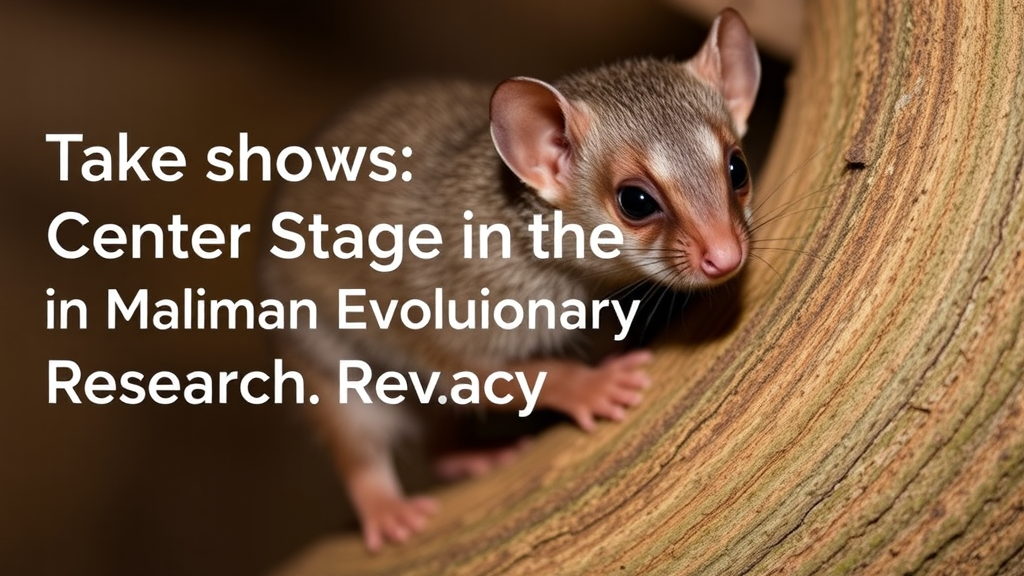
A sweeping new review published in Frontiers in Zoology has pulled together decades of scattered findings on one of Asia’s most intriguing but underappreciated groups of mammals, the treeshrews, and mapped out exactly where the field stands and where it needs to go. The work, led by Tongtong Gu and Wanlong Zhu of Yunnan Normal University together with colleagues, synthesizes the latest progress on the phylogeny, biogeography, genetic diversity, and molecular mechanisms of adaptive evolution in Scandentia, the mammalian order to which treeshrews belong. Far from being a mere summary, the review functions as a research roadmap, identifying the genomic, taxonomic, and biogeographic questions that will define treeshrew science in the coming decade.
Treeshrews are small, agile mammals that inhabit the forests of South and Southeast Asia, with some species extending into southwestern China. Despite their name, they are neither true shrews nor particularly arboreal in all cases; they occupy a bewildering middle ground in mammalian classification that has fascinated evolutionary biologists for more than a century. Their most celebrated claim to scientific fame is their phylogenetic position within Euarchonta, the grand clade that also contains primates, colugos, and rodents and rabbits in the broader Euarchontoglires grouping. This placement makes treeshrews a living reference point for understanding what the ancestors of primates may have been like, and it underpins their growing status as biomedical models in studies of vision, immunity, and metabolism.
The review’s authors emphasize that treeshrews offer a rare combination of features that make them unusually informative for studying mammalian evolution. They are phylogenetically distinctive, meaning that their lineage separated early and retains a mosaic of ancestral and derived traits. Their history of diversification is heterogeneous, with island species in maritime Southeast Asia following very different evolutionary trajectories from their mainland relatives, producing natural experiments in isolation, dwarfism, and speciation. And the recent explosion of genomic resources for the group means that researchers can now move beyond morphology-based trees to test hypotheses about relationships and adaptation with genome-scale data.
On the phylogenetic front, the review organizes treeshrew evolutionary history across three nested levels. At the interordinal level, the question is where Scandentia sits relative to primates and colugos within Euarchonta, a problem that has oscillated across decades of molecular and morphological analyses. At the intraordinal level, the review traces the diversification of treeshrew families and genera, including the split between the largely terrestrial, plains-dwelling tupaiids and the more scansorial ptilocercids, exemplified by the pen-tailed treeshrew, as well as the subsequent radiations that produced the species richness seen today. At the intraspecific level, the authors examine population differentiation within widespread species, where geography, altitude, and habitat fragmentation have carved genetic structure into populations that often look deceptively uniform in the field.
Biogeography emerges as a central theme of the synthesis. The islands of Southeast Asia, from the Sunda Shelf to the Philippines and Sulawesi, have repeatedly acted as both cradles and traps for treeshrew lineages. Sea-level fluctuations during Pleistocene glacial cycles alternately connected and severed land bridges, allowing populations to mix and then isolate in pulses. The review highlights that mainland and island treeshrews have followed qualitatively different diversification histories, with island populations frequently showing deep genetic divergence over small geographic distances, particularly on ecologically complex islands such as Borneo and Sulawesi. Disentangling these patterns requires explicit testing of alternative biogeographic models, something the authors flag as a major priority rather than an afterthought.
The genetic diversity section of the review underscores how much remains unknown about treeshrew species boundaries. Morphology alone has historically underestimated diversity in the group, and mitochondrial genetic studies have revealed cryptic lineages within what were once considered single widespread species. The authors argue for integrative taxonomic revision, combining genome-wide markers, acoustic and ecological data, and museum specimens to redraw the species map of Scandentia. This matters not only for evolutionary theory but for conservation, since several treeshrew species are restricted to narrow island ranges or threatened forest habitats, and mislabeled species boundaries can hide endangered lineages within seemingly common ones.
Perhaps the most technically rich portion of the review concerns the molecular mechanisms underlying adaptive evolution in treeshrews. The authors survey evidence for the genetic basis of specialized sensory, immune, and metabolic traits that set treeshrews apart. Treeshrews possess remarkable visual acuity among small mammals, and studies have identified signatures of selection in phototransduction and cone-related genes consistent with their diurnal, color-rich lifestyles. Their immune systems have drawn attention because treeshrews tolerate certain pathogens differently than laboratory rodents, making comparative immunogenomics both medically relevant and evolutionarily revealing. Metabolic adaptations, including the famous ability of some treeshrews to consume large quantities of fermented nectar rich in ethanol without apparent intoxication, point to accelerated evolution in alcohol-metabolizing enzymes and related pathways, a trait that has made them a favorite case study in debates about the evolutionary origins of ethanol metabolism in primates.
The review does not stop at cataloguing these adaptations; it frames them as candidate systems demanding experimental validation. Genome scans and comparative analyses can identify genes with signatures of positive selection, but the authors stress that demonstrating function requires experimental work, from gene expression studies to physiological assays and, ultimately, functional validation of candidate adaptive genes. This call for mechanistic rigor reflects a broader shift in evolutionary biology from correlation to causation, and treeshrews, with their emerging genomic resources and established laboratory husbandry protocols, are well positioned to make that transition.
Looking forward, the authors lay out a clear set of research priorities. Comprehensive taxon sampling remains fundamental, since many species and populations have never been included in molecular analyses. Chromosome-level genome assemblies and population resequencing across the full geographic range would provide the resolution needed to reconstruct demographic history, detect local adaptation, and settle long-standing phylogenetic disputes. Integrative taxonomy should be applied systematically to resolve species boundaries. Biogeographic hypotheses need to be tested formally against explicit models rather than accepted by narrative plausibility. And candidate adaptive genes emerging from comparative genomics must be validated experimentally. Each of these priorities, the review argues, is now technically feasible given advances in long-read sequencing, computational phylogenetics, and genome editing.
The broader significance of the review lies in its insistence on integration. Genomic data alone, the authors contend, cannot resolve the evolutionary history of Scandentia; it must be woven together with morphological, ecological, and functional evidence. Treeshrews sit at a phylogenetic crossroads that illuminates the deep history of Euarchonta, yet their species-level diversity remains incompletely described, their biogeography only partly modeled, and their adaptive biology only beginning to be understood at the molecular level. By consolidating what is known and specifying what must be done next, Gu and colleagues have effectively set the agenda for a field that is small in numbers of researchers but outsized in evolutionary importance. For anyone watching the intersection of genomics, biogeography, and mammalian diversity in tropical Asia, treeshrews are no longer a footnote; they are fast becoming a textbook example of how modern evolutionary biology dissects the origins of a lineage.
Subject of Research: Phylogenetic relationships and adaptive evolution of treeshrews (order Scandentia)
Article Title: Phylogenetic and adaptive evolution of treeshrews (Scandentia)
Article References: Gu, T., Zhang, H., Mu, R., Qi, H., Lin, Z., & Zhu, W. (2026). Phylogenetic and adaptive evolution of treeshrews (Scandentia). Frontiers in Zoology. https://doi.org/10.1186/s12983-026-00633-2
Image Credits: AI Generated
DOI: 10.1186/s12983-026-00633-2
Keywords: treeshrews, Scandentia, phylogenetics, biogeography, genetic diversity, adaptive evolution, Euarchonta, molecular evolution, species boundaries, genomics, Southeast Asia, mammalian evolution
Cite Scienmag News
Gavin Prescott. (September 20, 2026). Treeshrews Take Center Stage in Mammalian Evolutionary Research. Scienmag. https://scienmag.com/treeshrews-take-center-stage-in-mammalian-evolutionary-research/
Gavin Prescott. "Treeshrews Take Center Stage in Mammalian Evolutionary Research." Scienmag, 20 September 2026, https://scienmag.com/treeshrews-take-center-stage-in-mammalian-evolutionary-research/. Accessed 20 September 2026.
Gavin Prescott. "Treeshrews Take Center Stage in Mammalian Evolutionary Research." Scienmag. September 20, 2026. https://scienmag.com/treeshrews-take-center-stage-in-mammalian-evolutionary-research/


