


Every day, the atmosphere carries an almost unimaginable volume of water—an estimated tens of thousands of cubic kilometers at any given moment—distributed as vapor across climates from arid deserts to humid coastlines. For regions where groundwater is depleted and surface water is scarce, that airborne reservoir represents a tantalizing resource. Atmospheric water harvesting, or AWH, seeks to tap it directly by extracting moisture from ambient air and condensing it into usable freshwater. Now, a study published in Water Resources Management offers a rigorously controlled, experimentally grounded answer to a deceptively simple question: which factors actually matter most when you try to pull drinking water out of thin air with nothing but sunshine, a desiccant, and a modest solar collector?
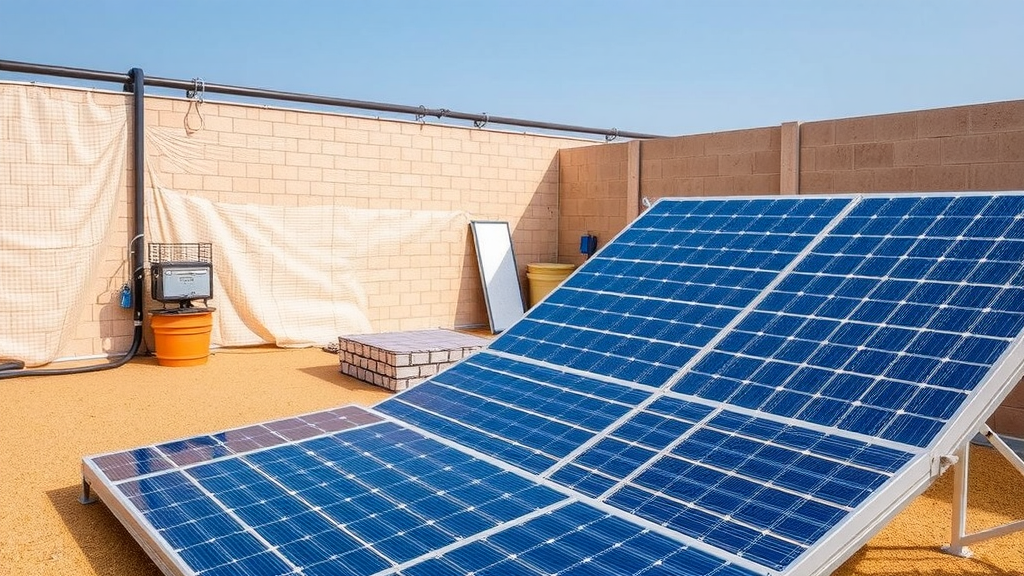
Researchers Ali Fayaz and Elshan Soltani of the Department of Mechanical Engineering at Islamic Azad University in Takestan, Iran, designed a systematic parametric study around a desiccant-based solar collector system. Their setup pairs a flat solar collector with a host bed impregnated with calcium chloride (CaCl₂), a hygroscopic salt solution that absorbs water vapor from the surrounding air. During the day, the desiccant-loaded bed soaks up atmospheric moisture; as solar radiation heats the collector, the absorbed water is regenerated and released as vapor, which then condenses and is collected as liquid water. The elegance of the approach lies in its simplicity: no compressors, no refrigerants, no grid electricity—only a passive material doing chemistry with the sky.
What sets this study apart from many earlier efforts is its use of the Taguchi experimental design, a statistical framework widely used in engineering to evaluate multiple factors efficiently with a limited number of experimental runs. Implemented in Minitab, the Taguchi approach allowed the researchers to vary seven parameters simultaneously—relative humidity, CaCl₂ desiccant concentration, bed material, solar collector inclination, bed height, ambient temperature, and operating time—without needing to run every possible combination in isolation. The harvested-water yield served as the response variable, and the relative importance of each factor was quantified through Pareto analysis, a statistical technique that ranks contributions by the magnitude of their effect.
The desiccant concentrations tested spanned 40, 60, and 80 percent CaCl₂, while the bed materials included four distinct candidates: sawdust, a wool blanket, cotton fabric, and a polyurethane sponge. These materials serve as porous host beds that hold the liquid desiccant and present a large wetted surface area to the ambient air. Collector inclination angles were varied to explore how solar capture geometry influences regeneration, and bed height—the vertical distance between the desiccant bed and the underside of the collector glass—was adjusted to probe its effect on heat transfer and vapor release. Experiments were conducted under contrasting climatic conditions, including a humid coastal setting in Tonekabon and a drier inland site at Qazvin, allowing the researchers to evaluate how climate shapes system performance.
The Pareto analysis delivered a clear and somewhat surprising hierarchy. The bed material emerged as the single most influential factor governing water yield, outranking every environmental and geometric variable tested. Ambient temperature ranked second, followed by desiccant concentration and relative humidity. By contrast, collector inclination, operating time, and bed height had comparatively modest effects on the outcome. This ranking carries real engineering significance: it suggests that designers of solar desiccant water harvesters should prioritize material selection and thermal environment over fine-tuning the collector’s tilt or the depth of the desiccant bed. In other words, the choice of what you put in the tray matters more than how you angle the glass above it.
The performance of the wool blanket as a host bed proved particularly noteworthy. Under the investigated conditions, the combination of humid coastal air and a wool blanket bed was associated with the highest water harvesting results. This outcome is consistent with the material’s fiber structure, which can retain substantial quantities of CaCl₂ solution while maintaining capillary pathways for vapor transport, though the study’s authors frame the result empirically rather than attributing it to any single mechanism. The finding also hints at a broader design philosophy for low-cost water harvesting in developing regions: everyday textiles, rather than exotic engineered sorbents, may offer competitive performance when paired with the right desiccant and climate.
In quantitative terms, the system’s best daily performance reached a cumulative yield of 314 milliliters of water from the 0.36-square-meter collector area—equivalent to approximately 0.87 liters per day per square meter of collector. This normalized productivity figure gives the work immediate practical relevance, providing a benchmark against which other solar desiccant systems reported in the literature can be compared. The authors are careful to note that such comparisons are inherently approximate, since reported yields depend strongly on local climatic conditions, seasonal variation, and operating protocols that differ from study to study. Even so, the figure places this simple, passive configuration within the range of performance reported for considerably more complex solar-driven atmospheric water generation systems.
Beyond the ranking of individual factors, the study examined how parameters interact through two-dimensional contour plots and combined response plots, revealing that the effects of the variables are not purely additive. The interplay between ambient temperature and desiccant concentration, for example, illustrates a fundamental thermodynamic tension: higher temperatures accelerate the regeneration and release of absorbed water, but they also shift the vapor pressure equilibrium in ways that can influence how much moisture the desiccant can retain during the absorption phase. Mapping these combined effects experimentally provides a data-driven foundation for predicting water yield across a range of operating scenarios, effectively turning the experimental matrix into a predictive tool for system designers.
The full experimental dataset—including operating conditions, hourly and cumulative water yields for both the Tonekabon and Qazvin experiments, and identified bed materials—is published as an appendix and made available in machine-readable format as supplementary material. This commitment to data transparency positions the study as a reusable resource for the growing community of researchers working on atmospheric water harvesting, including those applying machine learning and optimization algorithms to the same class of systems. Related work from the same research group has explored neural networks and evolutionary algorithms for optimizing desiccant-driven water production, and an open experimental dataset of this kind provides exactly the ground truth that such computational approaches require.
The broader context makes the work timely. With global freshwater demand rising and roughly two billion people lacking access to safely managed drinking water, technologies that produce water from air using renewable energy have attracted intense scientific attention, from metal-organic framework sorbents to desiccant-coated heat exchangers. Thermodynamic analyses have established that the theoretical limits of atmospheric water harvesting depend critically on ambient humidity and temperature, meaning that practical systems must be matched to the climates they serve. The new study’s demonstration that material choice and climate dominate the parameter space—while geometric refinements matter less—offers a pragmatic simplification. For communities on humid coastlines where sunlight is abundant and infrastructure is limited, a wool blanket, a salt solution, and a sloped pane of glass may one day translate directly into a reliable daily ration of drinking water, harvested one sunlit cycle at a time.
Subject of Research: Experimental parametric study of atmospheric water harvesting using a solar collector and calcium chloride desiccant system
Article Title: An Experimental and Combined Parametric Study on Predicting Atmospheric Water Harvesting in a Solar Collector and Desiccant-Based System
Article References: Fayaz, A., & Soltani, E. (2026). An Experimental and Combined Parametric Study on Predicting Atmospheric Water Harvesting in a Solar Collector and Desiccant-Based System. Water Resources Management, 40(12), Article 526. https://doi.org/10.1007/s11269-026-04885-9
Image Credits: AI Generated
DOI: 10.1007/s11269-026-04885-9
Keywords: atmospheric water harvesting, desiccant, solar collector, calcium chloride, Taguchi experimental design, water scarcity, Pareto analysis, renewable energy, bed material, coastal climate, water resources management, solar thermal
Cite Scienmag News
Violet Maxwell. (September 20, 2026). Simple Bed Materials and Humid Coastal Air Drive Water Harvesting in Solar Desiccant Systems, Study Finds. Scienmag. https://scienmag.com/simple-bed-materials-and-humid-coastal-air-drive-water-harvesting-in-solar-desiccant-systems-study-finds/
Violet Maxwell. "Simple Bed Materials and Humid Coastal Air Drive Water Harvesting in Solar Desiccant Systems, Study Finds." Scienmag, 20 September 2026, https://scienmag.com/simple-bed-materials-and-humid-coastal-air-drive-water-harvesting-in-solar-desiccant-systems-study-finds/. Accessed 20 September 2026.
Violet Maxwell. "Simple Bed Materials and Humid Coastal Air Drive Water Harvesting in Solar Desiccant Systems, Study Finds." Scienmag. September 20, 2026. https://scienmag.com/simple-bed-materials-and-humid-coastal-air-drive-water-harvesting-in-solar-desiccant-systems-study-finds/

