


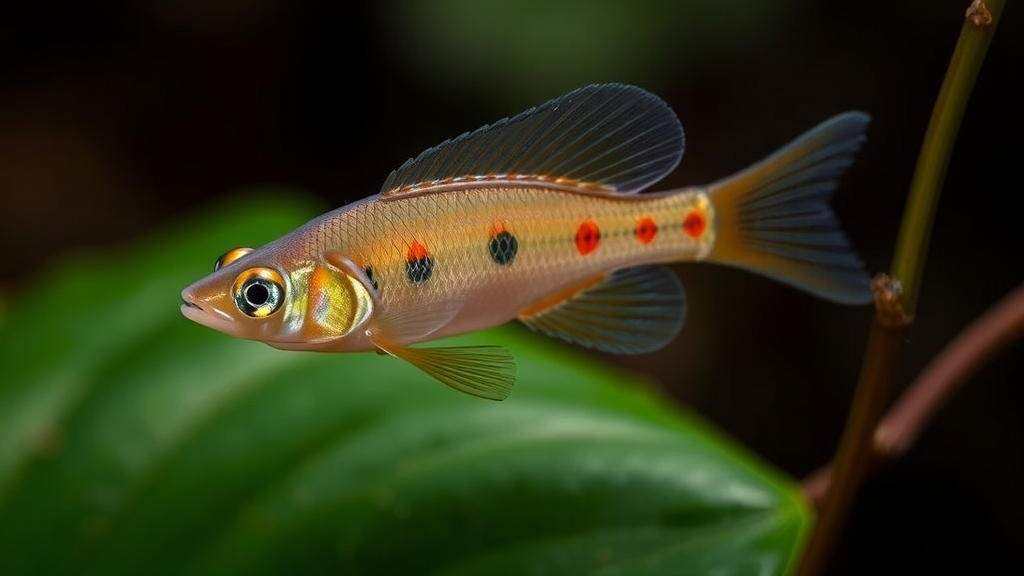
Deep in the Melaleuca forests of Tra Su in Vietnam’s An Giang Province, a small, strikingly patterned fish has been quietly shaping the ecology of one of the Mekong Delta’s most important wetlands. Now, for the first time, scientists have assembled a detailed biological portrait of the three-spot gourami, Trichopodus trichopterus, drawing on morphometric measurements, growth analysis, digestive anatomy, and stomach content examination. The study, conducted by researchers at Can Tho University and published in the journal Discover Animals, offers the first comprehensive dataset on this ecologically and economically significant species from the Tra Su region, and its findings carry implications for conservation, fisheries management, and even the future of ornamental fish aquaculture across the delta.
The three-spot gourami is easy to recognize. Its laterally compressed body carries two distinct black spots along the flanks, adults display faint vertical stripes, and its dorsal fin, shorter than the anal fin, bears both spines and soft rays. Individuals typically reach about ten centimeters in length. The species thrives in ponds, swamps, canals, and floodplains throughout the Mekong River basin, where submerged vegetation offers both shelter and feeding grounds in water temperatures between 24 and 30 degrees Celsius. Beyond its role in local food webs, where it serves as prey for larger carnivores such as the snakehead Channa striata and the striped catfish Pangasianodon hypophthalmus, the gourami is prized in the ornamental fish trade, making its biology relevant to both ecologists and aquaculturists.
To build their dataset, the researchers collected 32 specimens from Tra Su in March 2025 using hand nets with a 2.5 centimeter mesh, preserving the fish in 4 percent formalin before laboratory analysis. In the lab, they recorded total length, standard length, body weight, eye diameter, interorbital distance, body depth, head length, and mouth width, along with fin ray counts for the pectoral, pelvic, dorsal, anal, and caudal fins. The fish sampled ranged from 6.70 to 9.00 centimeters in total length, averaging 7.76 centimeters, and weighed between 4.10 and 10.30 grams with a mean of 6.50 grams. This meticulous measurement campaign provides a baseline against which future populations can be compared, a critical tool in a region where freshwater ecosystems are under mounting pressure.
The meristic counts revealed a remarkably stable anatomical blueprint. Caudal fins carried 14 to 16 rays, with 16 the most frequent. Each pelvic fin consistently bore a single ray, while the pectoral fins consisted of two elongated filaments positioned anterior to the anal fin. Dorsal fins held 5 to 7 spines, most commonly 7, and 6 to 10 soft rays, typically 8 or 9. The anal fin showed a fixed count of 11 spines with 30 to 35 soft rays, most often 32 or 33, and pectoral fins carried 8 to 12 rays, usually 9 or 10. These figures align closely with earlier descriptions from the Mekong Delta and Cambodia, reinforcing the view that the species maintains morphological stability across varied environmental conditions and strengthening the taxonomic foundation for identifying T. trichopterus in the region.
Growth analysis delivered one of the study’s most consequential findings. Using the classic length-weight relationship, in which body weight scales with total length raised to an exponent b, the team estimated a growth coefficient of 2.98 plus or minus 0.16, statistically indistinguishable from 3, the hallmark of isometric growth. In practical terms, the fish gains weight in proportion to its length, reflecting balanced somatic development. The coefficient of determination exceeded 0.93, meaning more than 93 percent of the variation in body weight was explained by length alone. Comparable near-isometric patterns have been reported for the species in the Ogan Ilir peat swamp of South Sumatra, Indonesia, and for other Mekong Delta fishes such as the tank goby Glossogobius giuris, though the exponent is known to shift with environmental conditions.
That flexibility was underscored by aquaculture experiments elsewhere, in which probiotic-supplemented diets containing Bacillus subtilis and B. circulans pushed the growth exponent to 3.28, indicating positive allometric growth, while control groups ranged from 2.41 to 2.93. The Tra Su result, sitting almost exactly at isometry, suggests the wetland provides a stable and adequate natural food supply for the gourami, a positive indicator of habitat quality. The regression equation derived from the study can now serve as a practical tool for estimating biomass, monitoring growth, and managing resources in both wild and cultured populations, reinforcing the ecological case for continued conservation of the Tra Su landscape.
The study’s anatomical detective work focused on the digestive system, where the evidence pointed firmly toward an omnivorous lifestyle. The gourami possesses a terminal, slightly upward-facing mouth with a subtly protruding lower jaw, an arrangement suited to surface feeding. Its jaws are lined with numerous small, conical teeth arranged in continuous rows, an adaptation for grasping and scraping soft-bodied prey rather than tearing flesh. The tongue is elongated, flattened, and studded with a row of small V-shaped spots, a region rich in taste receptors that supports sophisticated orosensory food testing. The gill arches carry thin, elongated, closely spaced rakers, a fine filtration apparatus adapted for capturing plankton, in sharp contrast to the shorter, thicker rakers of sympatric predatory gobies.
Further down the tract, the anatomy tells the same story. A short esophagus leads to a sac-like stomach with thickened walls, followed by an extended, tightly coiled intestine ranging from 9.0 to 26.0 centimeters, averaging 17.04 centimeters, a length adapted to processing a mixed diet of plant and animal material. The relative gut length, the ratio of gut length to total body length, averaged 2.19 plus or minus 0.09, squarely within the 1 to 3 range that defines omnivores. This finding revises earlier classifications that labeled the species carnivorous, and it contrasts instructively with relatives: the congeneric Trichogaster fasciata shows a much higher relative gut length of 5.12, consistent with herbivory, while carnivorous Mekong gobies possess markedly shorter intestines.
Stomach content analysis confirmed the omnivorous verdict and revealed a striking dietary hierarchy. Fish eggs appeared in 45 percent of gut samples and dominated by biovolume at 38.02 percent, followed by zooplankton at 33.99 percent and Chlorophyta green algae at 16.98 percent. Euglenophyta, Cyanophyta, and Bacillariophyta contributed smaller shares between 1.37 and 6.15 percent. A modified Costello diagram, plotting frequency of occurrence against volumetric contribution, identified fish eggs as the primary food resource, with zooplankton and Chlorophyta serving as important supplemental items and the remaining algal groups likely ingested incidentally. The pattern reveals an opportunistic omnivore with a pronounced preference for high-protein prey, consistent with reports from Indian coastal wetlands where the species consumed detritus, algae, zooplankton, and even plastic debris.
The implications ripple outward from Tra Su. Freshwater habitats cover only 0.1 percent of the Earth’s water surface yet harbor roughly 40 percent of known fish species, and freshwater fishes rank as the second most threatened vertebrate group after amphibians, with about 20 percent of species projected to face extinction within the next 25 to 50 years. Tra Su itself presents harsh conditions, with water pH as low as 2.75, dissolved oxygen frequently below 5 milligrams per liter, and elevated ammonium and total iron concentrations, making the gourami’s success there a testament to its adaptability. By documenting stable morphology, isometric growth, and a flexible omnivorous diet, the study establishes the foundational knowledge needed for taxonomic work, ecological monitoring, artificial breeding programs, and sustainable fisheries management. The authors point toward ecological aquaculture as a promising avenue, urging further research into reproductive biology, population genetics, and adaptive capacity under culture conditions, work that could help safeguard both the species and the livelihoods that depend on the Mekong Delta’s vanishing wetlands.
Subject of Research: Morphometrics, growth pattern, and feeding ecology of the three-spot gourami Trichopodus trichopterus in the Tra Su wetlands of the Vietnamese Mekong Delta
Article Title: First report on morphometrics, length–weight relationship, feeding habit, and diet composition of Trichopodus trichopterus from Tra Su, An Giang, Vietnam
Article References: Nguyen, V. Q., Van Ly, V., Vo, L. T. T., Nguyen, H. T. K., & Dinh, Q. M. (2026). First report on morphometrics, length–weight relationship, feeding habit, and diet composition of Trichopodus trichopterus from Tra Su, An Giang, Vietnam. Discover Animals, 3(1), Article 87. https://doi.org/10.1007/s44338-025-00130-6
Image Credits: AI Generated
DOI: 10.1007/s44338-025-00130-6
Keywords: Trichopodus trichopterus, three-spot gourami, Mekong Delta, Tra Su, morphometrics, length-weight relationship, isometric growth, omnivorous diet, fish eggs, zooplankton, freshwater conservation, Vietnam
Cite Scienmag News
Margaret Porter. (September 14, 2026). Three-Spot Gourami’s Secret Life Revealed in Vietnam’s Tra Su Wetlands. Scienmag. https://scienmag.com/three-spot-gouramis-secret-life-revealed-in-vietnams-tra-su-wetlands/
Margaret Porter. "Three-Spot Gourami’s Secret Life Revealed in Vietnam’s Tra Su Wetlands." Scienmag, 14 September 2026, https://scienmag.com/three-spot-gouramis-secret-life-revealed-in-vietnams-tra-su-wetlands/. Accessed 14 September 2026.
Margaret Porter. "Three-Spot Gourami’s Secret Life Revealed in Vietnam’s Tra Su Wetlands." Scienmag. September 14, 2026. https://scienmag.com/three-spot-gouramis-secret-life-revealed-in-vietnams-tra-su-wetlands/


