


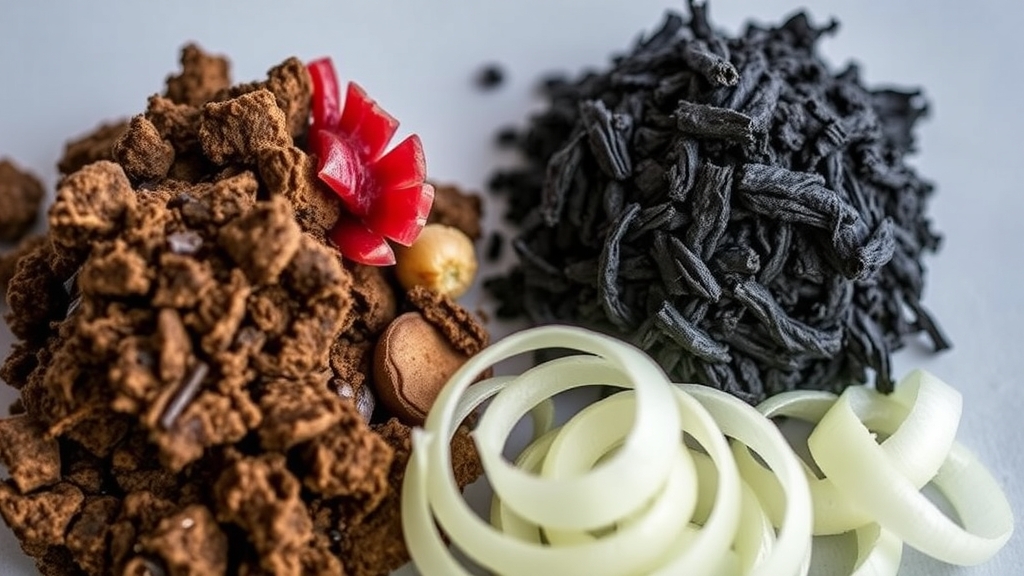
Two of the food system’s most unglamorous waste streams—chicken manure and onion peels—are emerging as unlikely allies in the fight against climate change. Researchers in Poland have shown that when these agricultural residues are heated to extreme temperatures under inert conditions, they transform into biochars capable of grabbing carbon dioxide from gas streams. The study, published in Clean Technologies and Environmental Policy, reveals a surprising twist: the best adsorbent is not simply the one with the largest surface area, and the two feedstocks capture CO2 through fundamentally different mechanisms.
The research team, led by Wojciech Jerzak of AGH University of Krakow, pyrolyzed both materials at 700, 800 and 900 degrees Celsius in a fixed-bed reactor flushed with high-purity nitrogen. Each 1.5-gram sample was held at the target temperature for one hour, after which the resulting chars were ground, sieved and subjected to a battery of analytical techniques including Fourier-transform infrared spectroscopy, X-ray diffraction, X-ray fluorescence, scanning electron microscopy, X-ray photoelectron spectroscopy, Raman spectroscopy and nitrogen sorption analysis. Carbon dioxide uptake was then measured at 20 degrees Celsius across pressures ranging from 0.5 to 110 kilopascals.
The starting materials could hardly have been more different. Chicken manure, collected from a poultry farm in southern Poland, contained just 8 percent fixed carbon but a hefty 26.4 percent ash, along with 4.1 percent nitrogen. Onion peels from a processing facility in the Kuyavian-Pomeranian Voivodeship were richer in combustible material, with 56.4 percent volatile matter, 14.9 percent fixed carbon and a lignocellulosic structure containing substantial cellulose and hemicellulose. X-ray fluorescence showed that calcium oxide dominated the ash of both feedstocks, at 48.8 percent for the manure and 40.8 percent for the peels, but the manure also carried elevated potassium, phosphorus, magnesium and sulphur, while the peels were unusually rich in silica at 33.8 percent.
As pyrolysis temperature climbed, both feedstocks lost mass, moisture and volatile components while their ash fractions concentrated in the solid residue. Manure biochar ash content soared from 26.4 percent in the raw material to 65.2 percent at 900 degrees Celsius, while onion peel biochar ash rose from 14.9 to roughly 41.8 percent. Hydrogen contents in both biochars fell below 1 percent, and nitrogen in the manure chars dropped from 4.1 to between 1.1 and 1.8 percent, reflecting the thermal cracking of volatile compounds and the release of small nitrogenous molecules. Onion peel biochars, by contrast, concentrated carbon to around 50 to 52 percent, more than the manure chars managed, thanks to their lower initial mineral burden.
Spectroscopy traced the chemical evolution in fine detail. Infrared spectra showed the progressive disappearance of hydroxyl, aliphatic and carbonyl bands with rising temperature, signalling dehydration, decarboxylation and the growth of a condensed aromatic carbon matrix. Yet phosphate and carbonate signals persisted in the manure-derived chars, underscoring the thermal stability of their inorganic constituents. X-ray diffraction revealed dramatic mineral reorganisation: at 700 degrees Celsius the manure char held quartz, portlandite and rutile, but by 800 and 900 degrees Celsius the ash had transformed into calcium oxide, whitlockite-type calcium-magnesium phosphates, magnesite, oldhamite and eventually sulfoapatite. The onion peel chars followed a different path, developing graphitic carbon alongside quartz, kalsilite, sodium carbonate and, at the highest temperature, the stable alkali aluminosilicate sanidine.
Electron microscopy captured the morphological consequences. Manure biochars remained dense, heterogeneous aggregates with no well-defined pore network, their high mineral content apparently filling or masking the developing carbon porosity. The onion peel chars told a more elegant story: at 700 degrees Celsius they retained elongated, layered fragments of the original plant tissue, and at 800 degrees Celsius they developed a striking channel-like structure the authors liken to a fish skeleton, with aligned, interconnected spaces carved out by devolatilisation. At 900 degrees Celsius, however, that ordered architecture began to fragment and partially collapse, a warning that excessive heat can destroy the very structure adsorbent designers hope to build.
Porosity measurements quantified these visual impressions. The onion peel biochar produced at 900 degrees Celsius achieved the highest specific surface area of the entire study, 109.8 square metres per gram—more than three times that of its 800-degree counterpart and nearly 6.5 times that of the 700-degree sample—with micropores contributing up to 60 percent of the internal surface in the intermediate-temperature samples. Manure biochars reached more modest areas between 14.0 and 36.2 square metres per gram, but their average pore diameter also shrank steadily with temperature, indicating progressive micropore refinement.
The carbon dioxide adsorption results upended the expectation that bigger surface area always means better capture. Among the onion peel chars, the 700-degree sample—despite its modest 17 square metres per gram—delivered the highest uptake, 26.6 cubic centimetres per gram at 100 kilopascals, while the 900-degree sample with the largest surface area actually adsorbed less. The researchers attribute this to pore widening and a shrinking population of narrow ultramicropores, those cavities below 0.7 nanometres whose dimensions closely match the kinetic diameter of CO2 and which nitrogen adsorption at cryogenic temperatures cannot fully resolve. Residual oxygen-containing surface groups may also enhance CO2-surface interactions in the cooler char.
The manure biochars behaved in almost mirror-image fashion, with CO2 uptake rising steadily as pyrolysis temperature increased, tracking the growth of microporosity and surface area. But texture alone could not explain the performance of the 900-degree manure char, which captured substantial CO2 despite a smaller surface area than its onion peel rivals. X-ray diffraction and fluorescence pointed to the missing piece: calcium oxide and calcium-rich phosphate phases that furnish basic adsorption sites with a strong affinity for acidic CO2 molecules, potentially even fixing some of the gas chemically as carbonate or bicarbonate species. In these mineral-rich chars, capture is a partnership between physical pore-filling and mineral-assisted interaction.
The practical lesson is that biochar design must be matched to feedstock chemistry. For lignocellulosic wastes like onion peels, the goal should be preserving narrow micropores rather than maximising total surface area, and avoiding the pore widening and structural collapse that come with excessive heat. For manures, engineers should exploit the inherent calcium, magnesium and potassium phases that add a chemical dimension to capture. Converting two problematic wastes into tailored carbon sorbents in a single thermal step offers a double dividend—waste valorisation and carbon management—grounded not in exotic chemistry but in a careful reading of what heat does to the organic and mineral halves of agricultural residue.
Subject of Research: Thermal conversion of chicken manure and onion peels into biochars for carbon dioxide adsorption
Article Title: Effect of thermal treatment on the structure and CO2 adsorption capacity of biochar from chicken manure and onion peels
Article References: Effect of thermal treatment on the structure and CO2 adsorption capacity of biochar from chicken manure and onion peels. (n.d.). https://doi.org/10.1007/s10098-026-03598-2
Image Credits: AI Generated
DOI: 10.1007/s10098-026-03598-2
Keywords: biochar, pyrolysis, CO2 capture, chicken manure, onion peels, carbon adsorption, microporosity, mineral phases, waste valorisation, X-ray diffraction, Raman spectroscopy, surface area
Cite Scienmag News
Sloane Callahan. (September 13, 2026). Chicken Manure and Onion Peels Turned Into Carbon Capture Materials. Scienmag. https://scienmag.com/chicken-manure-and-onion-peels-turned-into-carbon-capture-materials/
Sloane Callahan. "Chicken Manure and Onion Peels Turned Into Carbon Capture Materials." Scienmag, 13 September 2026, https://scienmag.com/chicken-manure-and-onion-peels-turned-into-carbon-capture-materials/. Accessed 13 September 2026.
Sloane Callahan. "Chicken Manure and Onion Peels Turned Into Carbon Capture Materials." Scienmag. September 13, 2026. https://scienmag.com/chicken-manure-and-onion-peels-turned-into-carbon-capture-materials/


