


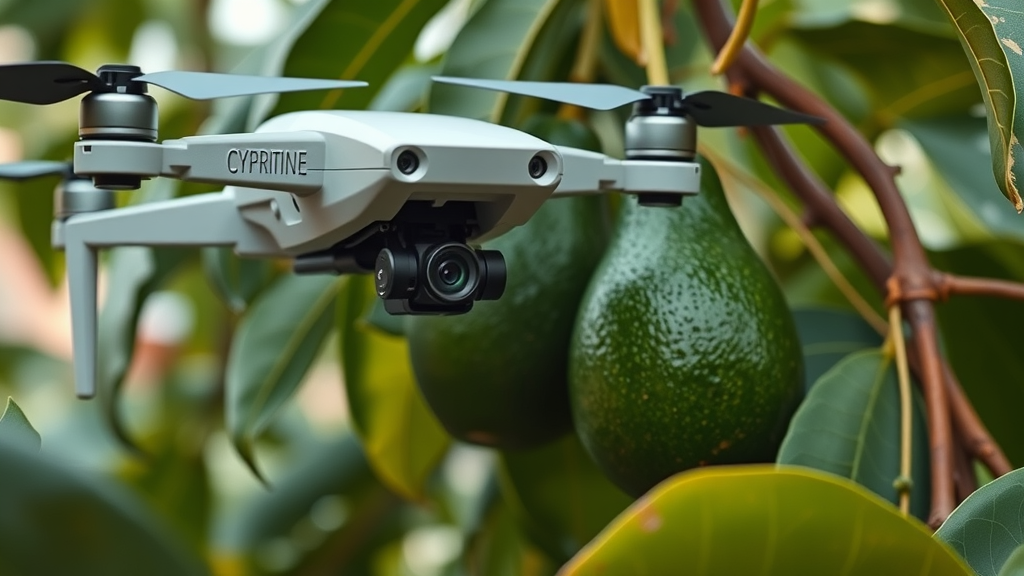
A team of researchers in Peru has built a system that can fly a drone over a Hass avocado orchard and, in real time, tell a farmer not only where every visible fruit is hanging but also how ripe each one is. The work, published in Smart Agricultural Technology, combines close-range aerial imagery with a pair of lightweight YOLO-based deep learning models, and it was tested under genuinely messy field conditions: shifting sunlight, shadows, leaves partially hiding the fruit, and the dark, textured canopy that makes Hass avocados notoriously hard to spot. The study was conducted in the district of Coalaque, in the General Sánchez Cerro province of Peru’s Moquegua region, an area dedicated to commercial Hass avocado production.
The problem the researchers set out to solve is deceptively simple to describe and remarkably hard to solve. Hass avocados change color and texture as they ripen, but distinguishing adjacent ripening stages visually is difficult even for trained human inspectors, and the presence of foliage complicates detection further. Traditional maturity assessment relies on qualified personnel walking the orchard, manually collecting data, and processing it afterward, which is slow, expensive, and subjective. Deep learning has already transformed plant disease detection and fruit counting in agriculture, but studies that integrate close-range drone image acquisition with real-time ripeness classification of Hass avocados have remained scarce. That gap motivated the new system.
Architecturally, the pipeline is a two-stage design built on the Ultralytics YOLOv8 framework. The first stage is a YOLOv8n object detection model, initialized from pretrained weights and trained for 50 epochs on 640 by 640 pixel images with a batch size of 16, that locates avocado fruits in each incoming frame and draws bounding boxes around them. The second stage is a YOLOv8n-cls image classification model, trained for 200 epochs on 224 by 224 pixel images with a batch size of 64, that takes each cropped fruit region and assigns it to one of five ripeness categories: unripe, midripe, ripe, fullripe, or overripe. The workflow runs sequentially on every frame: detection, cropping, classification, and visualization, with results displayed alongside bounding boxes on a laptop screen.
The data behind the classifier came from an existing resource, the Hass Avocado Ripening Photographic Dataset, which contains 14,710 images of 478 avocados photographed daily as they ripened under three storage temperatures of 10 degrees Celsius, 20 degrees Celsius, and ambient temperature. The original dataset labels, from underripe through breaking, ripe first and second stages, and overripe, were renamed for clarity as unripe, midripe, ripe, fullripe, and overripe. To expand the training material, the researchers automatically cropped the fruit regions out of annotated images, generating multiple samples per scene and producing a final classification dataset of 20,231 images, split into 17,237 training and 2,994 validation images distributed across the five categories in a reasonably balanced way.
Detection training data came from the orchard itself. The team flew a Xiaomi FIMI X8 SE drone equipped with a 4K camera, recording at 3840 by 2160 pixels and stabilized by a three-axis gimbal, along waypoint flight paths programmed in the FIMI Navi app. The drone flew at an estimated altitude of roughly two to three meters above ground, keeping a working distance of about 1.5 to 2.5 meters from the fruit canopy, close enough that each avocado occupied roughly 180 to 250 pixels in the frame, preserving the color and texture detail needed for ripeness judgment. From the field videos, 340 images were extracted and annotated with bounding boxes using the Roboflow platform, then augmented with horizontal flipping, brightness variation of plus or minus 15 percent, saturation adjustment, and exposure modification.
Getting the video from the drone to the algorithms without specialized transmission hardware was a clever piece of engineering in its own right. The drone streams its footage to a smartphone connected to its controller, and the open-source tool scrcpy mirrors that phone screen onto a laptop with low latency, encoding the video with efficient H.264 or H.265 codecs. A Python program using OpenCV and the mss screen-capture library then processes the mirrored frames on the fly. To keep the frame rate high, the system processes only every other frame, a technique known as frame skipping, and it persists detection boxes across eight consecutive frames even when no new detection occurs, which suppresses the flickering that would otherwise make the on-screen output unstable.
The detection results were solid for such challenging conditions. The model achieved a precision of 0.7951 and a recall of 0.7849, a mean average precision at an Intersection over Union threshold of 0.5 of 0.8388, and an mAP across the stricter 0.5 to 0.95 threshold range of 0.6308. Analysis of the confidence threshold showed a maximum F1 score of about 0.80 at an optimal operating point between 0.4 and 0.5, a balance confirmed by the validation confusion matrix, which recorded 136 true positives, 29 false positives, and 36 false negatives. The training and validation curves converged smoothly with no evident overfitting, and qualitative examples showed the detector finding fruits at multiple maturity stages despite shadows, occluding leaves, and cluttered natural backgrounds.
The classifier told a more nuanced story. Overall accuracy reached 79 percent, with a macro-average F1 of 0.77 and a weighted average F1 of 0.78. The unripe class performed best, with an F1-score of 0.91 and recall of 0.95, meaning the system rarely misses early-stage fruit, which matters most for harvest planning. The midripe class was the weakest, at an F1 of 0.67, and the confusion matrix showed most errors occurring between neighboring stages such as ripe and fullripe, or fullripe and overripe. The researchers attribute this to the gradual physiological transition of avocado maturation: during intermediate stages, differences in skin color, texture, and apparent illumination are subtle even to human observers. Training curves revealed moderate overfitting beginning around epoch 60, with validation loss rising while training loss fell toward 0.12, suggesting that additional regularization or earlier stopping could improve generalization.
The authors are candid about the system’s limits. Detection performance can degrade under severe occlusion, extreme illumination, or when fruits are largely hidden by foliage, and the dataset, while substantial, remains small compared to large-scale agricultural benchmarks, which may constrain generalization to other orchards, cultivars, or lighting regimes. They also note that the reported metrics are point estimates without confidence intervals, and they plan repeated evaluations and bootstrap-based statistical analysis in future work. Still, the practical implications are significant. A grower could fly the same consumer-grade drone used here, watch live ripeness maps of the canopy on a laptop, and make harvest timing decisions the same day, without cloud computing infrastructure or expensive multispectral sensors.
What makes the study notable in the broader context of precision agriculture is its completeness as a field demonstration. Rather than classifying studio photographs or detecting fruit in curated images, the team closed the full loop: autonomous waypoint flight, real-time video transmission, on-the-fly detection and classification, and stable visualization at usable frame rates, all validated in a working commercial orchard in Moquegua. The results confirm that a two-stage YOLOv8 pipeline, running on ordinary hardware fed by a mirrored phone screen, can deliver reliable avocado localization and useful five-stage ripeness estimates under real-world conditions. As the researchers suggest, expanding the dataset, improving class balance, and refining the discrimination between visually similar maturity states are the natural next steps toward deploying such systems at scale across the avocado industry.
Subject of Research: Real-time detection and ripeness classification of Hass avocados using close-range UAV imagery and YOLO-based deep learning
Article Title: Real-time hass avocado ripeness detection using close-range UAV imagery and YOLO-based deep learning
Article References: Real-time hass avocado ripeness detection using close-range UAV imagery and YOLO-based deep learning. (n.d.). https://doi.org/10.1016/j.atech.2026.102547
Image Credits: AI Generated
DOI: 10.1016/j.atech.2026.102547
Keywords: Hass avocado, ripeness detection, UAV, drone imagery, YOLOv8, deep learning, precision agriculture, computer vision, object detection, fruit classification, real-time monitoring, Peru
Cite Scienmag News
Alan Morgan. (September 13, 2026). Drone Camera and AI System Reads Avocado Ripeness in Real Time. Scienmag. https://scienmag.com/drone-camera-and-ai-system-reads-avocado-ripeness-in-real-time/
Alan Morgan. "Drone Camera and AI System Reads Avocado Ripeness in Real Time." Scienmag, 13 September 2026, https://scienmag.com/drone-camera-and-ai-system-reads-avocado-ripeness-in-real-time/. Accessed 13 September 2026.
Alan Morgan. "Drone Camera and AI System Reads Avocado Ripeness in Real Time." Scienmag. September 13, 2026. https://scienmag.com/drone-camera-and-ai-system-reads-avocado-ripeness-in-real-time/


