


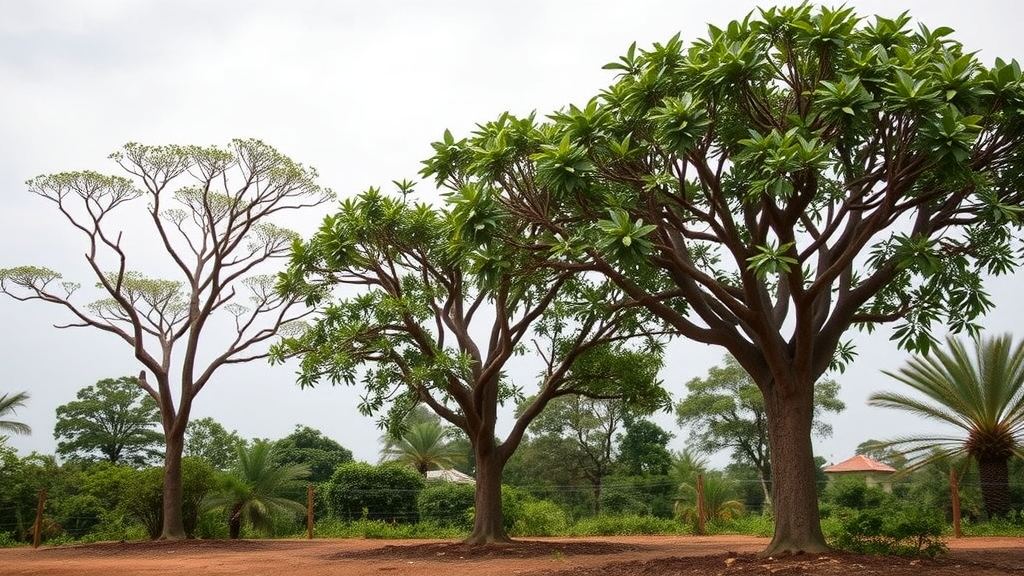
On the slopes of Mount Elgon, where Uganda’s eastern highlands meet the Kenyan border, smallholder farmers have long read the seasons not from satellite data or rainfall gauges, but from the behavior of trees. When the broad leaves of Cordia africana begin to fall, they know the dry season is approaching. When fresh buds break across Erythrina abyssinica, rain is on its way. A new cross-sectional survey published in BMC Environmental Science has now put this traditional plant-phenology knowledge to a rigorous statistical test, and the results suggest that what farmers observe in their trees converges remarkably well with formal meteorological records.
The study, led by Hellen Naigaga of Uganda Martyrs University together with Runyararo Jolyn Rukarwa of RUFORUM and Joseph Ssekandi of Uganda Martyrs University, surveyed 384 respondents across the Bulambuli and Kapchorwa districts of the Mount Elgon region. The research team deliberately restricted participation to individuals aged 40 and above who had lived in their villages for at least 20 years, ensuring that respondents possessed the accumulated observational experience on which local ecological knowledge depends. Using a multi-stage stratified sampling design that moved from districts through counties and sub-counties down to households, the researchers interviewed farmers alongside district environment officers and district agriculture officers, who served as key informants.
The findings are striking in their breadth. Fully 88 percent of respondents demonstrated familiarity with plant species used to anticipate weather changes, and nearly all of those asked about awareness of such species reported knowing them. Knowledge proved remarkably uniform across demographic lines: chi-square tests of independence found no statistically significant association between phenological knowledge and gender, marital status, or occupation. The researchers interpret this as evidence that botanical weather forecasting is deeply embedded across the community rather than confined to a particular social group, a pattern consistent with the idea that indigenous climate knowledge is socially shared because of its direct relevance to household food security.
The indicators themselves follow clear physiological logic. Leaf shedding in species such as Cordia africana, Erythrina abyssinica, Milicia excelsa, and Ficus species signals an impending dry season, reflecting the water stress that trees experience as moisture becomes scarce. The emergence of new leaves and buds marks the transition toward rainfall, prompting farmers to prepare their gardens. Flowering adds a further layer of information: blossoms on Mangifera indica and Coffea species announce the start of the rainy season, and farmers even use the abundance and quality of the flowers to gauge how intense the coming rains will be. Cordia africana was the most frequently cited predictor, mentioned by 71 percent of respondents, followed by Erythrina abyssinica at 64 percent and Coffea species at 28 percent.
To test whether these local forecasts hold up empirically, the researchers compared community-reported rainy and dry months with meteorological data drawn from the TerraClimate dataset. The convergence was substantial. Farmers identified January as the driest month, with 98.7 percent agreeing, and April as the rainiest, cited by 87 percent. Both local knowledge and meteorological records pointed to April, May, September, October, and November as the wettest months. The only divergence involved minimal rainfall of less than 50 millimeters in January and December, which the instruments detect but farmers disregard, since drizzles of that magnitude have no bearing on farming decisions.
A Pearson correlation analysis comparing locally identified dry-spell months with monthly temperature records, used as a proxy for atmospheric dryness, revealed a positive relationship, with a correlation coefficient of 0.183. Although the correlation is modest and not statistically significant, with temperature explaining only about 3.4 percent of the variability, the direction of the trend indicates that community perceptions of dry spells rise in tandem with observed heat stress. The regression model, y = 4.1011x – 70.393, reinforces this positive tendency. In practical terms, farmers’ seasonal judgments track real atmospheric conditions closely enough to suggest genuine predictive value, even if the relationship is looser than a one-to-one correspondence.
The influence of phenological forecasting on farm management is profound. Planting time is the decision most governed by tree signals, with 93 percent of farmers relying on phenological changes to determine when to sow. Garden management followed at 71 percent, while food storage and harvesting decisions were influenced at 51 and 45 percent respectively. Land preparation, at 17 percent, depends more on labor and resource availability than on botanical cues. Farmers reported that this well-timed planning translates into tangible gains: 55 percent credited phenology-based scheduling with enabling timely planting, weeding, manuring, and pest control that help escape disease cycles and maximize resource use, while 22 percent attributed higher yields to careful planning combined with the soil fertility benefits of decomposed leaf litter from the very trees they monitor.
Knowledge of these indicators travels through an intricate web of social channels. Clan meetings, evening gatherings, family assemblies, circumcision ceremonies, drinking spots, church congregations, NGO-led trainings, and agricultural extension initiatives all serve as conduits for weather information, with village saving groups acting as particularly active hubs. This dense communication network matters for adaptation policy, the authors argue, because it shows that climate information in rural communities flows through existing socio-cultural structures rather than formal channels, and any effort to deliver improved forecasts must work with these systems rather than around them.
The broader context gives the findings urgency. Respondents consistently reported that the timing and reliability of rainy seasons have shifted away from historically stable calendars, injecting uncertainty into farming schedules across the region. Mount Elgon, with its humid subtropical climate, mean annual temperature of roughly 23 degrees Celsius, and rainfall averaging around 1,500 millimeters, has been among the Ugandan regions most intensely affected by climate change impacts. In settings where access to meteorological forecasts is limited, phenological indicators function as an accessible early warning system, and similar plant-based forecasting traditions have been documented from Indonesia to Tanzania, where Erythrina abyssinica and Ficus species serve comparable roles.
The study’s conclusions point toward integration rather than replacement. The authors recommend that conservation strategies prioritize the key indicator species, recognizing their dual ecological and informational value, and that meteorological institutions formally incorporate local phenological indicators into localized forecasting services to improve relevance, timeliness, and accessibility for smallholder farmers. They also call for community-based training programs that strengthen farmers’ capacity to interpret phenological signals alongside scientific forecasts, support intergenerational knowledge transmission, and institutionalize participatory research frameworks involving farmers, scientists, and policymakers. In a warming world where seasonal predictability is eroding, the trees of Mount Elgon suggest that the most resilient forecast may be one written jointly by satellites and leaves.
Subject of Research: Indigenous plant-phenology knowledge for anticipating seasonal weather changes among smallholder farmers in Uganda's Mount Elgon region
Article Title: Integrating local plant-phenology knowledge into anticipating seasonal weather changes: evidence from smallholder farmers in Uganda’s Mount Elgon region (cross-sectional survey)
Article References: Naigaga, H., Rukarwa, R. J., & Ssekandi, J. (2026). Integrating local plant-phenology knowledge into anticipating seasonal weather changes: evidence from smallholder farmers in Uganda’s Mount Elgon region (cross-sectional survey). BMC Environmental Science, 3(1), Article 11. https://doi.org/10.1186/s44329-026-00052-y
Image Credits: AI Generated
DOI: 10.1186/s44329-026-00052-y
Keywords: plant phenology, indigenous knowledge, weather forecasting, smallholder farmers, Mount Elgon, Uganda, climate change adaptation, Cordia africana, Erythrina abyssinica, meteorological data, seasonal rainfall, agricultural decision-making
Cite Scienmag News
Sloane Callahan. (September 13, 2026). Trees as Weather Stations: Ugandan Farmers’ Plant Knowledge Matches Scientific Forecasts. Scienmag. https://scienmag.com/trees-as-weather-stations-ugandan-farmers-plant-knowledge-matches-scientific-forecasts/
Sloane Callahan. "Trees as Weather Stations: Ugandan Farmers’ Plant Knowledge Matches Scientific Forecasts." Scienmag, 13 September 2026, https://scienmag.com/trees-as-weather-stations-ugandan-farmers-plant-knowledge-matches-scientific-forecasts/. Accessed 13 September 2026.
Sloane Callahan. "Trees as Weather Stations: Ugandan Farmers’ Plant Knowledge Matches Scientific Forecasts." Scienmag. September 13, 2026. https://scienmag.com/trees-as-weather-stations-ugandan-farmers-plant-knowledge-matches-scientific-forecasts/


