


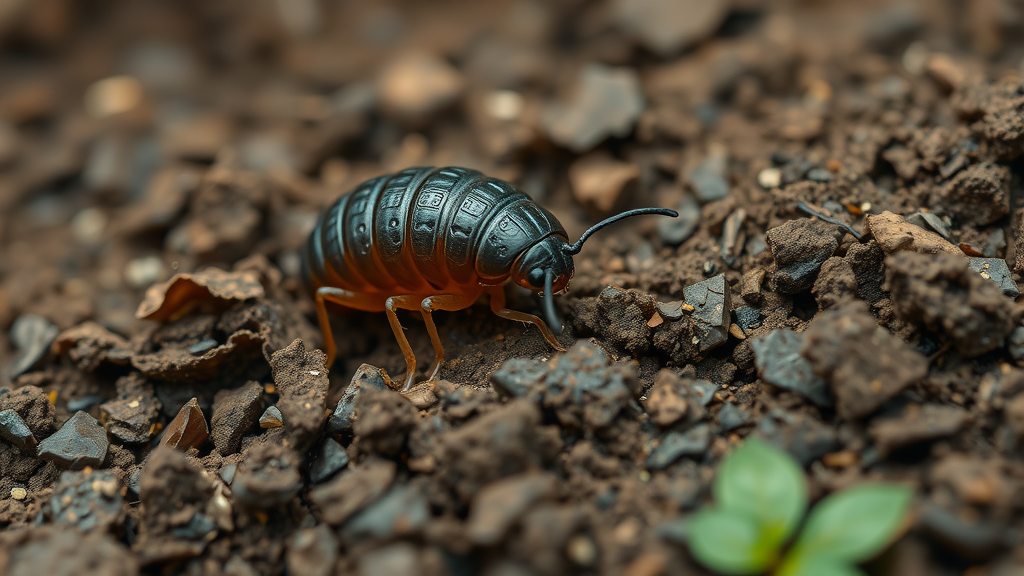
Beneath the leaf litter of forests, fields, and city parks, one of the planet’s most unassuming recyclers is quietly doing something remarkable: recording the chemical history of the soil it crawls through. Woodlice, the small crustaceans more familiar to most people as the pillbugs that curl up under garden stones, have long fascinated ecologists for their role as decomposers. Now, a comprehensive review published in Environmental Monitoring and Assessment has pulled together decades of research on how these terrestrial isopods take up, store, and tolerate heavy metals, and the picture that emerges is one of an animal that may be among the most valuable biological monitoring tools available for contaminated land.
The review, led by Yuying Zhang and Weiqin Xing of Henan University of Technology together with James A. Ippolito of The Ohio State University and colleagues, synthesizes what is known about metal accumulation, distribution within the body, physiological effects, and ecological consequences in woodlice. Its central message is that these animals are not passive victims of soil pollution but highly specialized accumulators and detoxifiers, capable of concentrating metals in their tissues at levels that dwarf the concentrations found in the environment around them. That capacity, the authors argue, makes them powerful candidates as bioindicators, living gauges of contamination that integrate exposure over time in ways that a single soil sample never can.
The technical heart of the story lies in a single organ: the hepatopancreas. In woodlice, this structure serves as the principal site of metal sequestration and detoxification, and the review confirms that the vast majority of accumulated heavy metals end up there. The hepatopancreas is packed with thiol-rich ligands, sulfur-bearing molecules that bind metal ions with extraordinary affinity. Among the metals studied, copper stands out, generally showing higher bioconcentration factors than any other element because of its strong association with these ligands inside hepatopancreatic cells. Earlier work on species such as Porcellio scaber and Oniscus asellus established that metal-binding compounds in the hepatopancreas and hemolymph differ between animals from contaminated and clean sites, and that cellular reactions within this organ can serve as biomarkers of soil toxicity.
The numbers compiled in the review are striking. Drawing on field investigations from contaminated areas, the authors report mean body concentrations of cadmium, copper, lead, and zinc in woodlice of 42.7, 295, 150, and 472 milligrams per kilogram, respectively. To put that in perspective, these are concentrations that would be considered hazardous waste in many regulatory contexts, yet the animals carrying them are often still alive and functioning. Bioconcentration factors tell a similar story: relative to soil, woodlice concentrated cadmium 4.72-fold, copper 16.4-fold, lead 2.39-fold, and zinc 2.38-fold. Relative to plant material, the factors were 9.19 for cadmium, 14.1 for copper, 1.29 for lead, and 4.54 for zinc. Copper and cadmium are clearly the metals these animals handle, and accumulate, most aggressively.
Accumulation, however, is not a simple linear process. The review emphasizes that body burdens depend on the type of metal, its concentration in the environment, and the duration of exposure. In general, tissue concentrations rise with exposure time until a steady-state equilibrium is reached, a plateau where uptake and loss processes balance. This dynamic has important implications for how woodlice can be used in monitoring. A woodlouse collected from a smelter-impacted field carries a time-integrated record of exposure, but converting that record into a precise estimate of soil concentration is complicated by the fact that the relationship between environmental and body metal levels is often nonlinear. The authors are candid about this limitation: while woodlice show real potential as bioindicators of soil heavy metal contamination, that same nonlinearity restricts their quantitative applicability, meaning they are better at signaling the presence and relative severity of contamination than at delivering exact numbers.
What happens when the detoxification machinery is overwhelmed? The review catalogs a grim progression of ecotoxicological effects. Elevated metal exposure impairs feeding, reduces growth, induces histopathological damage in the hepatopancreas, and increases mortality. Laboratory studies on species including Porcellio laevis and Porcellio scaber have documented sublethal lead toxicity, growth effects from cadmium and zinc mixtures, and the cellular disruption that precedes organ failure. At the population and community level, severe contamination can drive down woodlouse densities and simplify community structure, with surveys of metal-contaminated farmland and industrial zones in China, France, and elsewhere showing measurable losses of soil faunal diversity. Because woodlice sit at a critical junction in the decomposer food web, such losses ripple outward, slowing litter breakdown and altering nutrient cycling in affected soils.
Yet woodlice are not defenseless, and their survival strategies are part of what makes them scientifically valuable. Beyond the thiol-rich binding proteins of the hepatopancreas, evidence suggests that moulting may help shed metals bound to the cuticle and gut lining, and that some populations, such as Porcellionides sexfasciatus living in highly contaminated mine habitats, have evolved measurable copper tolerance. Genetic diversity studies in those mine populations hint at rapid evolutionary adaptation to metal stress, a phenomenon that fascinates evolutionary toxicologists. The interplay between zinc and copper handling, mediated by metallothionein-like proteins, further illustrates the sophisticated biochemical choreography these animals perform to keep toxic ions sequestered and inert.
One of the most consequential open questions the review identifies concerns trophic transfer. Woodlice are prey for a wide range of predators, including spiders such as Dysdera crocata, which earlier research showed assimilates zinc, cadmium, lead, and copper from its woodlouse diet. Whether metals biomagnify as they move from woodlice to higher trophic levels remains poorly understood, and the authors flag this as a priority for future investigation. The answer matters far beyond academic curiosity: if woodlice concentrate metals and their predators accumulate them further, contaminated soils could be exporting toxicity up food chains that ultimately include insectivorous birds and small mammals. Current understanding of this pathway, the review concludes, is too limited to support confident risk assessments.
The practical appeal of woodlice as environmental sentinels is hard to overstate. They are abundant, easy to collect, sedentary enough to reflect local conditions, and large enough to analyze individually. They inhabit exactly the environments where contamination concerns converge: urban soils, industrial peripheries, agricultural land treated with sewage sludge, and landfills. Studies from urban sites in England, Croatia, Tunisia, and China have repeatedly shown that woodlouse metal burdens track gradients of pollution from smelters, traffic, and waste disposal. Combined with the new quantitative benchmarks assembled in this review, the woodlouse may be poised to move from ecological curiosity to standard tool in the environmental monitoring toolkit, a small crustacean whose body tells the truth about the ground beneath our feet.
Subject of Research: Heavy metal bioaccumulation and ecotoxicological responses in terrestrial isopods (woodlice) as bioindicators of soil contamination
Article Title: Heavy metal uptake, accumulation patterns, and ecotoxicological responses in terrestrial isopods: a review
Article References: Zhang, Y., Xing, W., Ippolito, J. A., Wang, Y., Yang, Y., Huang, X., & Li, L. (2026). Heavy metal uptake, accumulation patterns, and ecotoxicological responses in terrestrial isopods: a review. Environmental Monitoring and Assessment, 198(10), Article 1063. https://doi.org/10.1007/s10661-026-15917-7
Image Credits: AI Generated
DOI: 10.1007/s10661-026-15917-7
Keywords: woodlice, terrestrial isopods, heavy metals, bioaccumulation, hepatopancreas, bioconcentration factor, soil contamination, bioindicators, ecotoxicology, trophic transfer, soil fauna, environmental monitoring
Cite Scienmag News
Violet Maxwell. (September 13, 2026). Woodlice Emerge as Powerful Living Sensors of Soil Heavy Metal Pollution. Scienmag. https://scienmag.com/woodlice-emerge-as-powerful-living-sensors-of-soil-heavy-metal-pollution/
Violet Maxwell. "Woodlice Emerge as Powerful Living Sensors of Soil Heavy Metal Pollution." Scienmag, 13 September 2026, https://scienmag.com/woodlice-emerge-as-powerful-living-sensors-of-soil-heavy-metal-pollution/. Accessed 13 September 2026.
Violet Maxwell. "Woodlice Emerge as Powerful Living Sensors of Soil Heavy Metal Pollution." Scienmag. September 13, 2026. https://scienmag.com/woodlice-emerge-as-powerful-living-sensors-of-soil-heavy-metal-pollution/


