


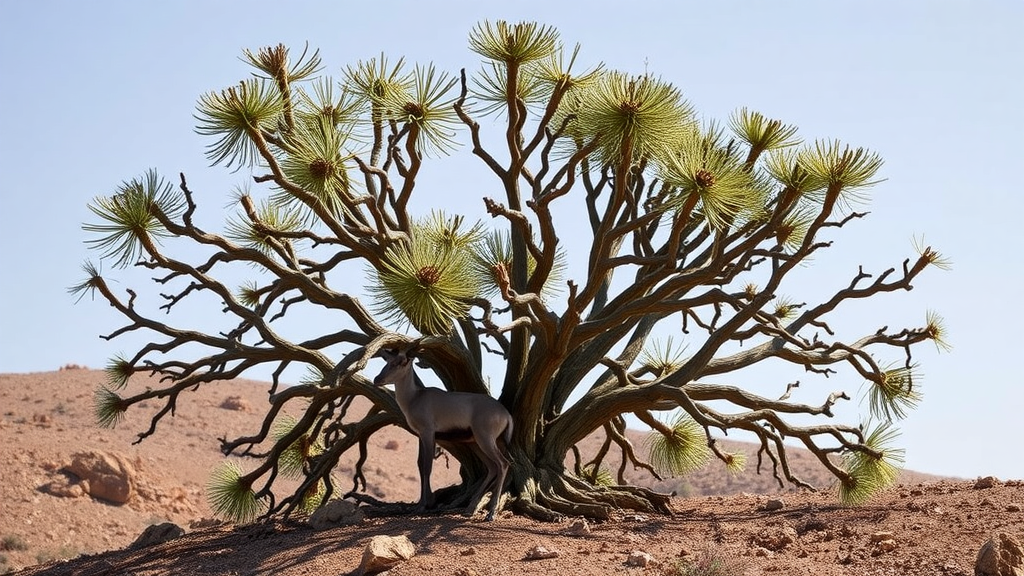
High in the Aurès Mountains of northeastern Algeria, one of North Africa’s last great cedar strongholds is running out of room. A new modeling study of Chelia National Park finds that only about one tenth of the park currently offers highly suitable conditions for the endangered Atlas cedar, and that even moderate climate warming could erase roughly a quarter of that prime habitat by 2070. The research, published in Discover Ecology, combines field surveys, bioclimatic classification, and species distribution modeling to give Algerian forest managers their first locally calibrated map of where the iconic conifer can survive now and where it may persist in the decades ahead.
The Atlas cedar, Cedrus atlantica, is an emblematic conifer endemic to the Atlas Mountains of Morocco and Algeria, growing between roughly 1,300 and 2,200 meters on well-drained limestone and siliceous soils. It is a keystone species that regulates watershed soils and local climate, supports biodiversity, and carries deep cultural and economic value through its durable, aromatic timber. Yet the species has been in serious decline for decades. Dendroecological records across Morocco and Algeria show multi-decadal growth losses and rising drought sensitivity since the late twentieth century, driven by intensifying drought, heat stress, and warming-facilitated biotic attacks such as pine processionary moth outbreaks. The International Union for Conservation of Nature now classifies the species as endangered, and Algeria’s natural cedar forests have been reduced to small, fragmented relicts in the high mountains.
Chelia National Park, centered on Mount Chelia at 2,328 meters, contains one of the largest remaining cedar stands in the country, but even here recent surveys have documented drought-induced dieback alongside human pressures including overgrazing and illegal logging. While regional modeling studies have projected significant range contractions for Atlas cedar across North Africa, and Moroccan analyses have predicted habitat losses of 21 to 41 percent by 2070 depending on emissions, comparable local-scale analyses for Algeria have been lacking. Conservation planning in Chelia had not previously incorporated model-based climate projections, leaving managers without a quantitative picture of the park’s climatic future.
To fill that gap, the research team, led by Hichem Chenaker and Rami Khoucha of the Higher National School of Forests in Khenchela with colleagues from Iraq and Egypt, compiled 107 unique occurrence points from field GPS surveys conducted between 2022 and 2026 and from official park vegetation maps. To avoid pseudo-replication, the team assigned a single presence point to each mapped cedar stand rather than populating large polygons with many points, a design that also enforced natural spacing between records. The study area spans a Mediterranean montane climate in which most precipitation falls in winter, roughly 110 millimeters in January, while summers are extremely dry with only about 10 millimeters in July, and mean annual temperature falls from around 10 degrees Celsius at low elevations to near freezing at the highest peaks.
The researchers modeled habitat suitability with MaxEnt version 3.4.4, deliberately calibrating the model only within the park boundary to align its inference space with local management needs. Environmental predictors were assembled at one-kilometer resolution from WorldClim bioclimatic variables and NASADEM elevation data, then filtered for multicollinearity using a Pearson correlation threshold of 0.7 and a variance inflation factor cutoff of five. The final predictor set included mean diurnal range, isothermality, temperature seasonality, minimum temperature of the coldest month, temperatures of the wettest and driest quarters, precipitation of the driest month, precipitation seasonality, and elevation. Model performance was evaluated with ten-fold cross-validation, achieving an AUC of 0.83, a reasonable score given the restricted environmental gradients of the park, and transferability to future climates was checked with clamping and multivariate environmental similarity surface, or MESS, analyses.
Future projections drew on the WorldClim v2.1 CMIP6 multi-model ensemble, which averages bias-corrected outputs from eight major global climate models, under two emissions pathways: the intermediate SSP2-4.5 and the high-end SSP5-8.5, for the 2050 and 2070 time windows. The team applied a single 10th-percentile training presence threshold across all projections to keep the maps comparable, and classified the continuous suitability output into four classes. Under present-day conditions, only about 10.5 percent of the park’s 326 square kilometers, or 34.2 square kilometers, qualifies as highly suitable, nearly all of it in the high-elevation core southeast of the Chelia summit. Roughly 18 percent is moderately suitable, 7 percent weakly suitable, and the remaining 64 percent is already unsuitable, meaning the cedar is confined to narrow microclimates even today.
The future looks starker. Under the moderate SSP2-4.5 scenario, highly suitable habitat declines to about 8.9 percent of the park by 2050 and 7.9 percent by 2070, while unsuitable area expands to 66.3 percent, a net loss of nearly a quarter of the current prime habitat within half a century. Under the high-emission SSP5-8.5 pathway, losses arrive faster, with unsuitable conditions covering more than 67 percent of the park by 2070 and the remaining high-quality patches few, isolated, and concentrated in the east-central highlands near the highest peaks. MESS analysis showed that future climates in the high-elevation core remained within the range of the training data under all scenarios, while novel climates appeared only in low-elevation peripheries that are already unsuitable, lending confidence to the projections for the areas that matter most. Because the model was calibrated only within the park, the authors caution that these figures are conservative estimates of habitat loss.
One of the study’s most important contributions is its careful interpretation of why winter cold emerged as the dominant predictor. The minimum temperature of the coldest month, BIO6, accounted for more than 60 percent of the model’s explanatory power, followed by elevation at 17.8 percent and precipitation seasonality at 10.5 percent. Rather than reading this as a simple preference for cold, the authors interpret BIO6 as a proxy for elevation-linked humidity, snow persistence, and reduced summer water deficit. In Supramediterranean mountain systems, altitude and terrain features such as north-facing slopes and shaded ravines function as microrefugia by buffering heat load and vapor pressure deficit, so the coolest sites are frequently the moistest sites. Field observations support this: cedar stands cluster in cool, shaded topographic positions while lower slopes and ridgelines are largely cedar-free. As warming proceeds, the model suggests that precipitation seasonality and warm-season temperatures gain weight, pointing to intensifying summer drought as the central constraint on persistence. The authors also note that biological interactions, such as pest outbreaks, can act as ultimate drivers of local extinction in marginal cedar populations, guarding against an overly climate-deterministic reading.
The findings align with regional evidence from Morocco and Algeria, where modeling and tree-ring studies consistently show Atlas cedar tracking more humid conditions and suffering under warming and aridification, and with similar patterns in other Mediterranean montane conifers such as Spanish fir and European black pine. For Chelia, the authors propose an adaptive conservation strategy that goes beyond temperature-based upslope relocation: protecting high-elevation microrefugia, restoring habitat connectivity, assisted enrichment planting within refugial sites, seed banking and genetic conservation, and managing local stressors such as overgrazing, illegal logging, and fire. Critically, they argue that hydrological buffering deserves explicit attention, since riparian corridors, spring-fed slopes, and areas with shallow groundwater access act as natural drought refuges. The projected 25 percent contraction of highly suitable habitat by 2070, even under a low-emissions pathway, speaks directly to Sustainable Development Goal targets on climate action and life on land. The team acknowledges limitations, including niche truncation from local calibration, the absence of soil and disturbance data, and coarse climate inputs, and recommends future work with ensemble models, hierarchical regional-local approaches, finer downscaling, and quantitative fragmentation metrics to refine the outlook for Algeria’s vanishing cedars.
Subject of Research: Modeling current and future climate-driven habitat suitability of the endangered Atlas cedar in Chelia National Park, Algeria
Article Title: Climate resilience of Atlas cedar: habitat suitability modeling for climate action and life on land
Article References: Chenaker, H., Khoucha, R., Al-Quraishi, A. M. F., Atalla, M. A., & Bedair, H. (2026). Climate resilience of Atlas cedar: habitat suitability modeling for climate action and life on land. Discover Ecology, 2(1), Article 14. https://doi.org/10.1007/s44396-026-00032-1
Image Credits: AI Generated
DOI: 10.1007/s44396-026-00032-1
Keywords: Atlas cedar, Cedrus atlantica, species distribution modeling, MaxEnt, climate change, Chelia National Park, habitat fragmentation, microrefugia, CMIP6, conservation planning, Mediterranean forests, Algeria
Cite Scienmag News
Sloane Callahan. (September 12, 2026). Atlas Cedar Faces Steep Habitat Loss in Algeria as Climate Warms. Scienmag. https://scienmag.com/atlas-cedar-faces-steep-habitat-loss-in-algeria-as-climate-warms/
Sloane Callahan. "Atlas Cedar Faces Steep Habitat Loss in Algeria as Climate Warms." Scienmag, 12 September 2026, https://scienmag.com/atlas-cedar-faces-steep-habitat-loss-in-algeria-as-climate-warms/. Accessed 12 September 2026.
Sloane Callahan. "Atlas Cedar Faces Steep Habitat Loss in Algeria as Climate Warms." Scienmag. September 12, 2026. https://scienmag.com/atlas-cedar-faces-steep-habitat-loss-in-algeria-as-climate-warms/


