


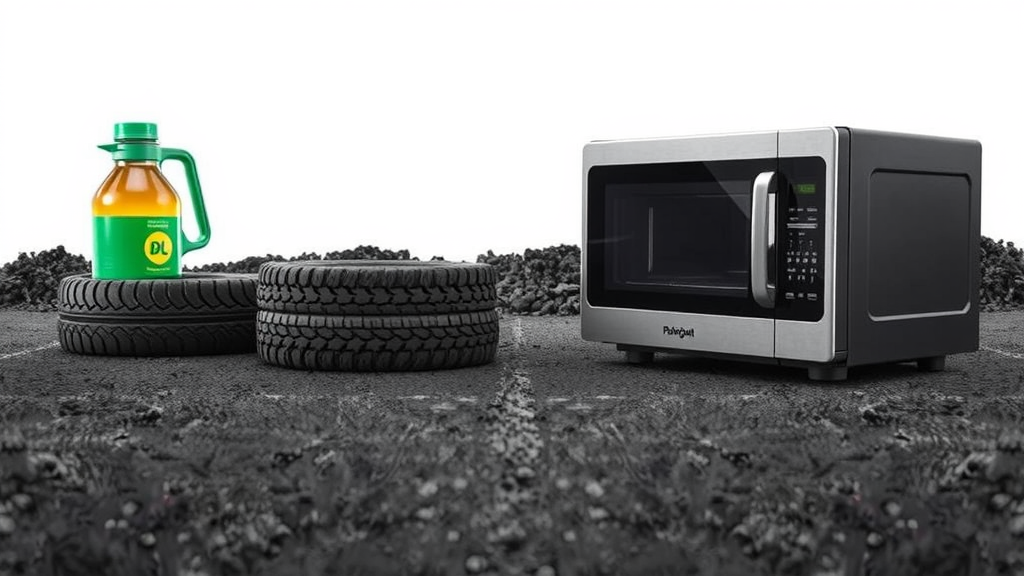
Every year, billions of tires reach the end of their service life, and engineers have long sought ways to turn this rubbery mountain of waste into something useful. One of the most promising destinations for ground-up scrap tires is asphalt: crumb rubber modifier, as it is known, can be blended into road binders to improve durability, fatigue resistance, and thermal stability across scorching summers and freezing winters. But the marriage of rubber and asphalt has always been an awkward one. Now, a research team writing in Case Studies in Construction Materials reports that a clever combination of waste cooking oil and microwave radiation can transform incompatible tire powder into a high-performance asphalt additive, while a dash of polyphosphoric acid restores the high-temperature strength that the treatment would otherwise sacrifice.
The core problem is chemistry. Rubber is a cross-linked network of natural and synthetic polymers filled with carbon black, plasticizers, and vulcanizing agents, and its surface is chemically inert. Asphalt, by contrast, is a complex colloid of asphaltenes, resins, and light oily fractions. When the two are simply stirred together, the mismatch in their physicochemical properties produces weak interfacial bonding and poor compatibility, leading to phase separation during storage. Paradoxically, rubber powder also swells by absorbing the lighter components of asphalt, which increases particle volume and interparticle friction, building a network that drives viscosity skyward. That high viscosity is a double-edged sword: it signals good deformation resistance, but it forces mixing and compaction at higher temperatures, wasting energy and releasing harmful fumes.
Researchers have attacked this problem with physical, chemical, and biological activation of the rubber surface, and microwave treatment has emerged as a favorite because it is cheap, fast, and efficient. Microwaves generate heat inside the rubber particles themselves, breaking sulfur cross-links and creating reactive surface sites. Bio-oil pretreatment offers a complementary route: aromatic-rich oils swell the rubber and introduce low-molecular-weight constituents that soften the interface. The new study, led by Xiaowei Feng, Chaocai Qin, and colleagues, goes further by combining the two approaches and then adding polyphosphoric acid, or PPA, a viscous inorganic acid that costs roughly half as much as the widely used SBS polymer modifier and is prized for improving storage stability and high-temperature deformation resistance.
The experimental design was exhaustive. The team ground waste truck tires into 40-mesh powder and tested three bio-oils as pre-swelling agents: castor oil, a bio-asphalt derived from biomass, and waste cooking oil from fried soybeans. Rubber powder was oven-dried, mixed with bio-oil at oil-to-rubber mass ratios of 0.3, 0.5, and 0.7, and left to soak for twelve hours at room temperature so the oil could fully penetrate the particles. The swollen powder then went into a household-grade microwave oven operating at 2450 megahertz and 400 watts for irradiation times ranging from two to five minutes. Preliminary gradient tests revealed sharp limits: below two minutes, insufficient energy input left the rubber under-devulcanized; beyond four minutes, excessive thermal input triggered oxidative chain scission and thermal cracking of the bio-asphalt, complete with smoke and sparks. In total, 26 activation formulations were prepared and blended into asphalt at 20 percent rubber content using high-shear mixing at 4000 revolutions per minute.
The macroscopic test results painted a nuanced picture. Penetration values of the activated rubber asphalt rose by 10 to 270 percent relative to ordinary rubber asphalt, with waste cooking oil producing the softest binders and bio-asphalt the stiffest, because the added light fractions diluted the asphaltene content and reduced viscosity. Softening points told a different story: castor oil and waste cooking oil treatments cut high-temperature deformation resistance by 14.7 to 28.4 percent, while bio-asphalt activation actually raised the softening point above that of conventional rubber asphalt in most cases, peaking at four minutes of microwave exposure. Ductility, a proxy for low-temperature performance, improved dramatically with waste cooking oil, reaching 13.80 centimeters, a 92.5 percent gain over the control, while castor oil treatments reduced ductility by as much as 52.4 percent because swelling without dissolution concentrates stress during stretching.
Viscosity and storage stability proved to be the decisive criteria. Nearly all activated formulations showed reduced viscous resistance at 135 degrees Celsius, with castor oil and waste cooking oil cutting viscosity by 49.1 to 85.6 percent, easing mixing and compaction temperatures substantially. Under the Chinese technical standard for rubber asphalt pavements, which requires viscosity below 3 pascal-seconds at 135 degrees Celsius, almost every formulation qualified. Storage stability, measured by the softening point difference after 48 hours at 163 degrees Celsius, improved by roughly half for the best waste cooking oil formulations, with values of 2.8 and 2.7 degrees Celsius representing reductions of 50 and 51.7 percent compared with conventional rubber asphalt. The mechanism, the authors suggest, is that light bio-oils help the rubber swell more fully while grafted biomolecules increase surface polarity and strengthen the bond to the asphalt phase.
To select the single best recipe from the crowded field, the team applied grey relational analysis, a multi-criteria optimization method that scores each formulation against an ideal reference across penetration, softening point, ductility, elastic recovery, viscosity, and segregation. The winner was unambiguous: waste cooking oil at an oil-to-rubber ratio of 0.3 with four minutes of microwave irradiation, designated W0.3 + 4, achieved the highest correlation degree of 0.8748. This formulation delivered the best combination of storage stability and construction workability, and it became the foundation for the next phase of the work, in which polyphosphoric acid was added at 1.2, 1.7, and 2.2 percent by mass of base asphalt to recover the high-temperature performance lost to the oily light fractions.
The PPA results were striking. Adding the acid lowered penetration and raised the softening point in proportion to dosage, and the 2.2 percent formulation reached a softening point of 63.2 degrees Celsius, actually exceeding conventional rubber asphalt by 1.3 degrees. Viscosity at 135 degrees Celsius increased by 43.5, 82.0, and 139.7 percent for the three dosages respectively, yet remained below that of ordinary rubber asphalt for dosages up to 1.7 percent, preserving workability. Storage stability improved further: the segregation index fell from 35.85 percent for conventional rubber asphalt to 25.92 percent for activated rubber asphalt, and dropped again with increasing PPA, with softening point differences of 2.0 and 1.5 degrees Celsius at 1.7 and 2.2 percent dosages, comfortably within the 2.5-degree threshold that Chinese specifications classify as exceptional phase stability.
Microscopic analysis explained why the strategy works. Scanning electron microscopy showed that untreated rubber powder has a dense, smooth surface with limited pore connectivity, which hinders bonding and allows particles to slip and segregate. After oil pre-swelling and microwave treatment, the surface loosened, pores multiplied, and a continuous biomolecular film formed, rich in amide functionalities that raise interfacial polarity. Fourier transform infrared spectroscopy confirmed real chemistry: the disappearance of the 1540 per centimeter peak indicated microwave-induced desulfurization, while new ester carbonyl and sulfone peaks showed that waste cooking oil molecules had grafted onto the rubber and oxidized during processing. In the PPA-modified binders, new hydroxyl and phosphorus-oxygen peaks revealed esterification reactions that the authors describe as chemical anchoring, with phosphorus-containing products acting as in-situ surfactants at the rubber-asphalt interface.
Gel permeation chromatography added the final molecular-level insight. Microwave desulfurization reduced the weight-average molecular weight of the binder from 2774 for conventional rubber asphalt to 2199 for the activated version, reflecting degradation of large rubber chains. PPA reversed the trend, raising the weight-average molecular weight to 2809 at 2.2 percent dosage and increasing the large molecular size fraction, evidence that the acid links polymer chains into a network that resists shear deformation at high temperature. Taken together, the findings outline a practical, low-cost route to sustainable pavements: kitchen waste oil and a microwave to make scrap tire rubber compatible with asphalt, and a modest dose of an inexpensive acid to give the resulting binder the backbone to survive the summer heat. For the billions of tires discarded annually, that could mean a far more useful afterlife beneath the wheels of the vehicles that produced them.
Subject of Research: Composite activation of crumb rubber with bio-oil and microwave radiation to improve the performance and storage stability of rubber-modified asphalt
Article Title: Preparation of bio-oil-microwave composite activated rubber powder and research on its asphalt properties
Article References: Preparation of bio-oil-microwave composite activated rubber powder and research on its asphalt properties. (n.d.). https://doi.org/10.1016/j.cscm.2026.e06418
Image Credits: AI Generated
DOI: 10.1016/j.cscm.2026.e06418
Keywords: crumb rubber asphalt, waste cooking oil, microwave activation, polyphosphoric acid, storage stability, asphalt modification, tire recycling, bio-oil, rheology, sustainable pavement, gel permeation chromatography, FTIR analysis
Cite Scienmag News
Denise Maddox. (September 12, 2026). Waste Cooking Oil and Microwaves Transform Scrap Tires Into Better Asphalt. Scienmag. https://scienmag.com/waste-cooking-oil-and-microwaves-transform-scrap-tires-into-better-asphalt/
Denise Maddox. "Waste Cooking Oil and Microwaves Transform Scrap Tires Into Better Asphalt." Scienmag, 12 September 2026, https://scienmag.com/waste-cooking-oil-and-microwaves-transform-scrap-tires-into-better-asphalt/. Accessed 12 September 2026.
Denise Maddox. "Waste Cooking Oil and Microwaves Transform Scrap Tires Into Better Asphalt." Scienmag. September 12, 2026. https://scienmag.com/waste-cooking-oil-and-microwaves-transform-scrap-tires-into-better-asphalt/


