


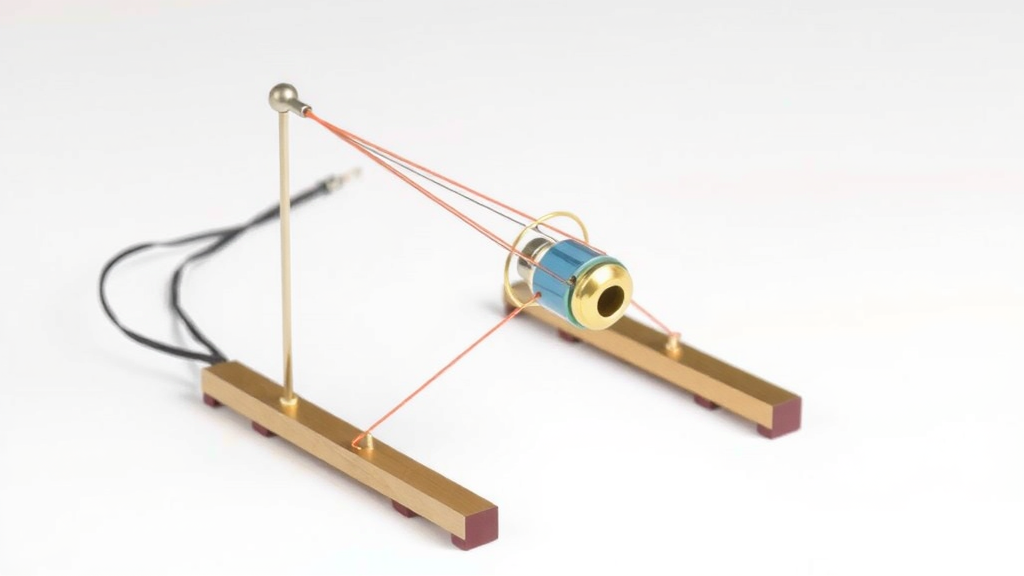
Every spacecraft that tumbles, spins, or reorients itself in orbit does so according to a property that engineers cannot afford to guess: the mass moment of inertia. For small satellites such as CubeSats and PocketQubes, where every gram of mass is packed into a volume no larger than a shoebox, knowing how that mass is distributed determines how the attitude control system is designed, how thrusters or reaction wheels are sized, and how the spacecraft will actually behave once it is free from Earth’s grip. Yet measuring this property directly has long been a luxury. Commercial inertia measurement rigs can cost far more than an entire student-built satellite, and computer models, however sophisticated, routinely miss the messy realities of fasteners, wiring harnesses, manufacturing tolerances, and late-stage hardware changes. A team at University College Dublin now believes it has a solution, and it costs about as much as a decent desk chair.
Writing in the open-access journal HardwareX, Bas Stijnen, Joseph Thompson, Ryan Paetzold, Eoghan Somers, and David McKeown present a fully open-source, camera-based trifilar pendulum system designed to measure the mass moment of inertia of CubeSat-class objects with impressive accuracy. The complete hardware and software package, from 3D-printed platform tiles to Python analysis code, is released under permissive licenses including CERN-OHL, CC-BY-4.0, and the MIT License, and the total cost ranges from roughly 55 euros for the bare pendulum platform to about 550 euros for a full setup with support frame and camera. The system has even earned open-source hardware certification under OSHWA UID IE000005, a formal stamp of reproducibility that few laboratory instruments can claim.
The trifilar pendulum itself is a beautifully simple piece of physics. A platform is hung from three equal-length wires and given a gentle twist. Because the platform’s centre of mass sits directly beneath the suspension point, it oscillates about the vertical axis with a period that depends on its rotational inertia, its mass, the suspension radius, and the length of the wires. The classical relation, derived under the assumptions of small-angle motion, rigid bodies, and negligible friction, links the measured oscillation period directly to the moment of inertia. What has traditionally made such setups expensive is not the pendulum but the instrumentation: precision rotary encoders or inertial sensors must be physically attached to the oscillating platform, adding mass, friction, and damping that corrupt the very quantity being measured.
The Dublin team’s key innovation is to remove contact entirely. Instead of sensors, they print two paper fiducial markers and tape them to the underside of the platform. These are not ordinary targets but N-fold markers, one with four-fold and one with five-fold rotational symmetry, selected using the MarkerLocator framework. The coprime symmetry orders allow the image-processing software to distinguish the two markers unambiguously and estimate rotational pose reliably from a single camera, even as the platform twists back and forth. A webcam or action camera mounted below the platform records the oscillation, and open-source Python software built on OpenCV, NumPy, and PyQt6 extracts the oscillation period, applies the trifilar equation, and reports the moment of inertia in kilogram metres squared, complete with an estimated measurement error.
The platform itself is assembled from nine triangular 3D-printed PLA tiles joined with brass threaded inserts and M4 screws, forming an equilateral triangular footprint roughly 407 millimetres on a side. The validated configuration handles test articles up to approximately two kilograms, a limit set not by the suspension hardware but by the stiffness of the printed platform, which can flex under concentrated loads and alter the effective suspension geometry. An optional support frame built from aluminium extrusion holds the pendulum and mounts the camera, making the system portable enough for ISO 8 CubeSat assembly cleanrooms, though the team found that suspending the platform directly from a rigid ceiling generally yields better results.
Validation was thorough and revealing. Using calibration masses with analytically known inertias, the researchers tested nine different moment of inertia values spanning from 0.15 to 6.1 times ten to the minus three kilogram metres squared, repeating every measurement five times. The results fell into three clear regimes. For inertias above three times ten to the minus three kilogram metres squared, errors stayed below five percent regardless of camera choice. In the intermediate range, errors ranged between five and fifteen percent, still acceptable for CubeSat characterisation. Below ten to the minus three, accuracy degraded sharply, sometimes exceeding forty percent with the support frame, because the inertia of the object becomes small compared with that of the platform itself, and the final answer emerges from subtracting two large, similar numbers.
Two practical findings stand out for anyone planning to build the system. First, the suspension material matters more than one might expect. Replacing steel cables with braided Dyneema fishing line, chosen for its negligible mass and bending stiffness, cut measurement errors dramatically, bringing even the lowest-inertia test case down to about 6.6 percent error. Second, camera quality matters mainly at the low end: a GoPro Hero 7 Black at fifty frames per second outperformed a basic Logitech C270 webcam by roughly ten percent for small inertias, thanks to better tracking resolution, while the two cameras performed nearly identically for larger objects. Camera distance, between fifteen and thirty centimetres below the platform, proved almost irrelevant, though the GoPro’s wide-angle fish-eye distortion introduced slight errors when markers drifted toward the frame edges.
The software also tackles a common experimental headache: imperfect centring. The trifilar equation assumes the test object’s centre of mass sits exactly over the platform centre, but real satellites are rarely so cooperative. The team implemented an optional correction based on the parallel axis theorem, subtracting the term mass times offset squared from the measured value. Verification tests with calibration masses displaced by five to twenty millimetres showed the software’s corrections matched theoretical predictions to within one part in a million of a kilogram metre squared. A free-decay experiment further confirmed that damping is negligible: the logarithmic decrement of 0.0162 corresponds to a damping ratio of just 0.00257, and the oscillation period shifted by only 0.38 percent over fifty seconds of decay.
The most convincing demonstration came with a representative CubeSat mock-up, an aluminium frame carrying four PCB-based solar panel simulators and integrated calibration masses. The pendulum measured a moment of inertia of 6.738 times ten to the minus three kilogram metres squared, within 3.7 percent of the CAD prediction of 6.996. The small discrepancy was attributed to exactly the kinds of details that make experimental measurement valuable in the first place: tape, fasteners, T-slot hardware, and assembly tolerances that no model captures perfectly. For university CubeSat programmes and small research groups, the message is clear. With a desktop 3D printer, a webcam, a kitchen scale, and freely downloadable design files and software, laboratory-grade mass property measurement is now within reach of virtually any team, and the era of guessing a satellite’s inertia may finally be drawing to a close.
Subject of Research: An open-source camera-based trifilar pendulum for measuring the mass moment of inertia of small satellites
Article Title: An open-source camera-based trifilar pendulum setup for measuring mass moment of inertia of small satellites
Article References: Stijnen, B., Thompson, J., Paetzold, R., Somers, E., & McKeown, D. (2026). An open-source camera-based trifilar pendulum setup for measuring mass moment of inertia of small satellites. HardwareX, Article e00821. https://doi.org/10.1016/j.ohx.2026.e00821
Image Credits: AI Generated
DOI: 10.1016/j.ohx.2026.e00821
Keywords: mass moment of inertia, trifilar pendulum, CubeSats, open-source hardware, fiducial markers, optical tracking, 3D printing, attitude control, small satellites, PocketQubes, HardwareX, low-cost instrumentation
Cite Scienmag News
Denise Maddox. (September 12, 2026). Open-Source Trifilar Pendulum Brings Low-Cost Inertia Testing to Small Satellites. Scienmag. https://scienmag.com/open-source-trifilar-pendulum-brings-low-cost-inertia-testing-to-small-satellites/
Denise Maddox. "Open-Source Trifilar Pendulum Brings Low-Cost Inertia Testing to Small Satellites." Scienmag, 12 September 2026, https://scienmag.com/open-source-trifilar-pendulum-brings-low-cost-inertia-testing-to-small-satellites/. Accessed 12 September 2026.
Denise Maddox. "Open-Source Trifilar Pendulum Brings Low-Cost Inertia Testing to Small Satellites." Scienmag. September 12, 2026. https://scienmag.com/open-source-trifilar-pendulum-brings-low-cost-inertia-testing-to-small-satellites/


