


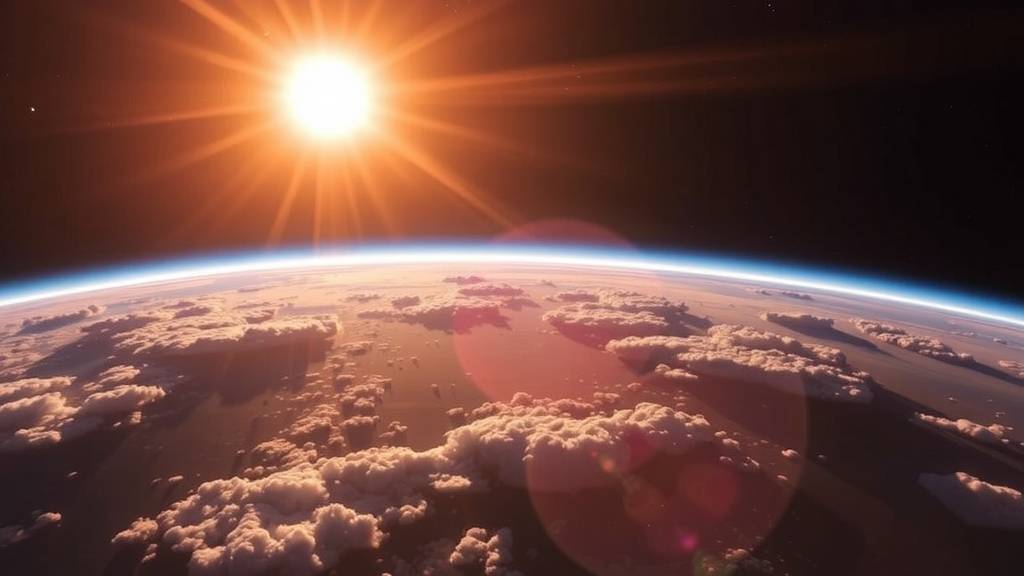
Every time a commercial aircraft climbs to its cruising altitude, it leaves behind a substantial fraction of the atmosphere that normally shields life on the ground from cosmic radiation. High above the clouds, energetic particles from deep space penetrate far more easily, and the dose a passenger or crew member receives depends on a surprisingly wide range of factors. A new study based on high-altitude balloon measurements over southern Israel has now added an important piece to this picture, showing that the radiation environment at aviation altitudes is not fixed but rises and falls with the activity of the Sun. According to the research, published in the Journal of Geophysical Research: Atmospheres, cosmic radiation at commercial flight altitudes could increase by roughly 40 to 60 percent during periods of low solar activity compared with the Sun’s most active phases.
The study was conducted by Dr. Roy Yaniv of the Hebrew University of Jerusalem and Sheba Medical Center, together with Prof. Yoav Yair of Reichman University and Prof. Colin Price of Tel Aviv University. Rather than relying solely on models or measurements taken at ground level, the team sent radiation sensors aloft on balloons launched from southern Israel on six occasions between 2014 and 2016. The balloons climbed to approximately 35 kilometres, well above the roughly 10-kilometre ceiling at which most passenger aircraft cruise, allowing the researchers to trace how atmospheric ionization and radiation change continuously from near the surface to the upper stratosphere.
The vertical structure that emerged from the measurements was strikingly clear. As the balloons ascended, radiation levels climbed steadily, reaching a pronounced maximum at around 17 to 20 kilometres above Earth before declining again at even greater heights. This peak is a well-known feature of atmospheric physics called the Regener-Pfotzer maximum. It arises because high-energy cosmic rays entering the atmosphere collide with molecules of air and generate cascades of secondary particles. Near the top of the atmosphere the incoming radiation is intense, but the air is too thin to produce many secondary particles; deeper down, the cascade is fully developed but the overlying atmosphere has already absorbed much of the primary flux. The result is an altitude band where radiation dose rates are at their highest, sitting comfortably above the cruising levels of civil aviation but close enough to influence the environment aircraft operate in.
At approximately 10 kilometres, the altitude at which commercial aircraft typically cruise, the researchers measured gamma-equivalent radiation dose rates of roughly 0.9 to 1.3 microsieverts per hour. Those numbers may sound modest, but they accumulate meaningfully over the thousands of hours that pilots, cabin crews and frequent flyers spend airborne each year. Notably, the levels recorded over Israel were relatively low compared with some higher-latitude regions, a difference the researchers attribute to the stronger geomagnetic shielding found over the Eastern Mediterranean. Earth’s magnetic field deflects charged cosmic particles, and its protective effect is strongest near the equator and weakest near the poles, so geography matters as much as altitude when estimating exposure.
Altitude, however, was only part of the story. The team also found that radiation levels varied systematically with the solar cycle. When the Sun is highly active, its magnetic field is carried outward by the solar wind and forms a protective bubble around the entire solar system, deflecting many of the galactic cosmic rays that would otherwise reach Earth. During periods of low solar activity, this shield weakens, and more of the energetic particles streaming from beyond the solar system penetrate the atmosphere. The balloon measurements reflected this modulation directly: the researchers observed higher radiation levels when solar activity was lower, quantifying the relationship with a negative correlation of r = -0.71. The authors are careful to stress that with only six balloon flights, the number of observations is limited, and the correlation should therefore be considered indicative rather than statistically definitive.
Extrapolating the observed relationship to solar-minimum conditions suggested that radiation levels at commercial aviation altitudes could rise by approximately 40 to 60 percent compared with solar-maximum conditions. The researchers caution that this estimate rests on extrapolation rather than on direct measurements taken under the most extreme quiet-Sun conditions, but the direction and rough magnitude of the effect are consistent with what is known about cosmic-ray modulation. The finding carries practical weight because the Sun is currently progressing through the declining phase of its activity cycle, and solar minima recur roughly every eleven years, meaning the aviation sector periodically operates in precisely the conditions where exposure is greatest.
We tend to think of the atmosphere above us as relatively stable, but the radiation environment at flight altitude is continuously shaped by processes taking place far beyond Earth, the researchers said. Our measurements show that the solar cycle has a measurable effect on the radiation environment experienced at aviation altitudes. By combining direct balloon observations with atmospheric radiation models, we can better understand when and where these levels change and improve the tools used to assess long-term exposure for aircrew and frequent flyers.
To test how well their observations aligned with established prediction tools, the team compared the balloon data with the EXPACS/PARMA atmospheric radiation model. The measured values closely matched the model’s predicted electromagnetic radiation component, generally agreeing within about 10 to 15 percent. The comparison also revealed an important nuance about what the instruments were actually measuring. According to the model, electromagnetic radiation represents only part of the total radiation environment at flight altitude: neutrons account for roughly 40 to 45 percent of the modeled total ambient dose, while photons, electrons and positrons contribute approximately 35 to 40 percent. The Geiger-Müller detectors carried by the balloons were primarily sensitive to photons and charged particles and had little direct sensitivity to neutrons. The reported measurements should therefore not be interpreted as the total radiation dose received by an airline passenger or crew member, but rather as a reliable indicator of the electromagnetic component of the atmospheric radiation field, one that can be used to anchor and validate broader dose assessments.
The findings have particular relevance for aviation, where flight crews and frequent flyers spend extended periods at altitudes where atmospheric protection from cosmic radiation is considerably weaker than at ground level. Occupational exposure limits apply to aircrew in many jurisdictions, and accurate assessment of cumulative dose depends on knowing how radiation varies with altitude, geographical location and solar conditions. The researchers note that continued monitoring is important for understanding long-term occupational exposure, especially as radiation levels shift over the solar cycle and differ substantially between polar and equatorial routes. Beyond aviation, the work offers a clearer picture of how radiation from space interacts with Earth’s atmosphere, and the researchers suggest that similar approaches, pairing relatively inexpensive balloon-borne measurements with established radiation models, could be used to track changes in the atmospheric radiation environment as solar conditions evolve over the coming years.
Subject of Research: Solar-cycle modulation of cosmic radiation dose rates at civil aviation altitudes measured by high-altitude balloons over Israel
Article Title: Cosmic radiation at flight altitudes rises when the sun is less active
Article References: Cosmic radiation at flight altitudes rises when the sun is less active. (n.d.). Original publication
Image Credits: AI Generated
DOI: Not provided
Keywords: cosmic radiation, solar cycle, aviation, high-altitude balloons, galactic cosmic rays, Regener-Pfotzer maximum, radiation exposure, aircrew, atmospheric ionization, EXPACS/PARMA model, geomagnetic shielding, solar minimum
Cite Scienmag News
Russell Cooper. (September 12, 2026). Sun’s Quiet Periods Raise Cosmic Radiation at Flight Altitudes. Scienmag. https://scienmag.com/suns-quiet-periods-raise-cosmic-radiation-at-flight-altitudes/
Russell Cooper. "Sun’s Quiet Periods Raise Cosmic Radiation at Flight Altitudes." Scienmag, 12 September 2026, https://scienmag.com/suns-quiet-periods-raise-cosmic-radiation-at-flight-altitudes/. Accessed 12 September 2026.
Russell Cooper. "Sun’s Quiet Periods Raise Cosmic Radiation at Flight Altitudes." Scienmag. September 12, 2026. https://scienmag.com/suns-quiet-periods-raise-cosmic-radiation-at-flight-altitudes/


