


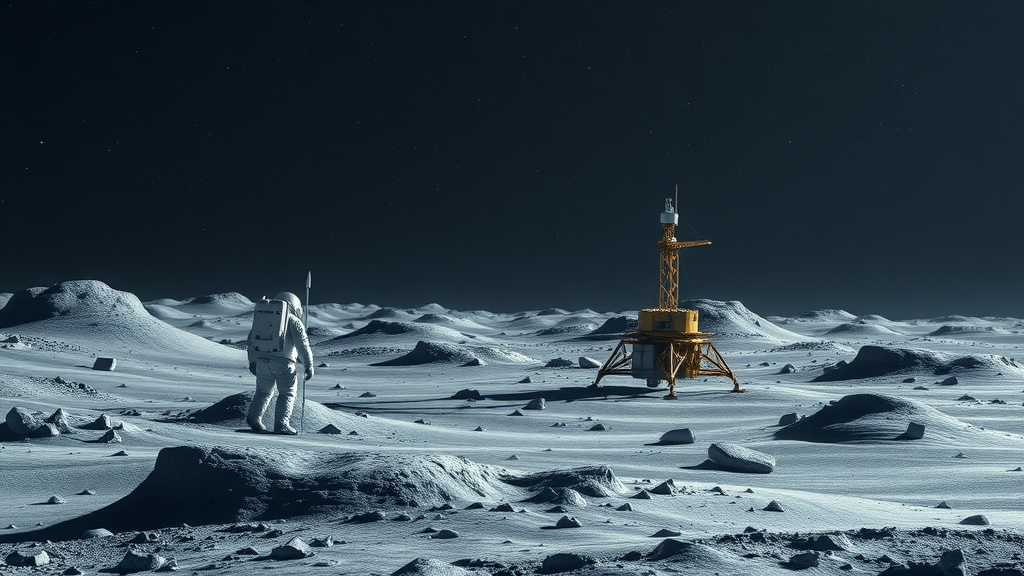
When humans return to the Moon, they will not simply plant flags and leave. Agencies including NASA are planning permanent outposts, mining operations, launch pads, and pressurized habitats that must survive one of the harshest environments in the solar system. A new review published in the journal Space and Planetary Resources argues that the success of these future lunar architectures may hinge on a technology that most people never think about on Earth: structural health monitoring, or SHM, a networked suite of sensors that continuously watches buildings for the earliest signs of damage. Caitlin Ahrens of NASA’s Goddard Space Flight Center and the University of Maryland, and Justin Hollander of Tufts University, lay out detailed case scenarios showing how SHM should be woven into lunar base design from the very first blueprint.
Structural health monitoring is already a mature discipline on Earth. Engineers define damage as any change to a structure’s material properties, geometry, or internal connectivity that degrades performance, even if the system still functions. An SHM system typically combines four elements: sensor instrumentation measuring strain, displacement, vibration, temperature, and humidity; a data acquisition system that digitizes the signals; analysis software using signal processing, statistics, and machine learning to extract meaning; and reporting tools that let engineers assess risk and schedule maintenance. On the Moon, the authors argue, these components become an early-warning platform that lets astronauts and ground controllers shut down compromised zones, isolate failures, and act before a microfracture in a pressurized habitat escalates into catastrophe.
The lunar environment makes the case urgent. Surface temperatures swing from roughly 387 kelvin in daylight to about 95 kelvin at night, while areas near permanently shadowed regions at the poles can plunge below 90 kelvin. Moonquakes and meteoroid impacts generate vibrations, and launch or landing operations impose intense acoustic and mechanical loads. Lunar dust, which is abrasive and electrostatically adhesive, coats structures and disrupts thermal balance, while volatile chemicals and space-weathering ions can alter regolith at the microscopic scale, changing porosity and diffusivity beneath foundations. Because the interactions between the dusty plasma environment, thermal cycling, and multi-material structures remain poorly characterized, the authors stress that real-time monitoring is the only practical way to track damage as it develops.
The review draws heavily on terrestrial analogs. Fiber Bragg grating sensors have protected historic churches and monitored the Geumdang Bridge in South Korea, where abnormal strain patterns prompted reinforcement before degradation spread. Acoustic emission arrays in South African gold mines and European underground laboratories detect millimeter-scale microseismic activity in rock up to 200 meters away, a capability directly relevant to lunar tunnels and subsurface habitats. Cryogenic storage tanks validated piezoelectric sensors under extreme cold, and Alaska’s Trans-Alaska Pipeline demonstrates low-power, autonomous monitoring under seasonal thermal extremes and remote, power-limited conditions that closely resemble the lunar poles. Even a cautionary tale appears: the 2004 collapse of Singapore’s Nicoll Highway, attributed partly to undetected soil movement during excavation, underscores what happens without adequate monitoring.
Space heritage matters too. The first documented SHM in a space mission came in 1997, when a McDonnell Douglas Delta rocket carried fiber Bragg grating strain sensors. NASA’s shuttle modal inspection system hunted for fatigue damage in fuselage panels, and piezoelectric wafer active sensors proved effective at interrogating bolted joints in thermal protection panels, where loosening from micrometeoroid strikes and thermal cycling could prove fatal. The International Space Station, assembled from 32 modules over 11 years, is the closest existing model of space architecture, and its modularity offers lunar builders flexibility. Yet the authors caution that the ISS operates in microgravity with very different materials, so its sensor solutions cannot simply be copied for the lunar surface.
Sensor choice will depend on facility type, power availability, and the specific failure modes anticipated. Fiber-optic sensors carry a low weight penalty, resist electromagnetic interference, tolerate wide thermal ranges, and allow many sensing points along a single cable. Piezoelectric wafer sensors offer compact, low-power ultrasonic interrogation for locating damage in composites and thin-walled structures. Wireless networks, supporting up to 15 channels and roughly eight kilometers of outdoor range, eliminate cabling that once tripped Apollo astronauts and overheated under insulating dust. Pressure sensors guard habitat integrity, vibration sensors distinguish moonquakes from machinery faults, and dust sensors track filter-clogging accumulation. Battery technology matters as much as sensing: lithium-polymer packs can run devices for up to a year, and paired with high-capacity batteries or solar panels, some systems have demonstrated potential ten-year lifetimes without human intervention.
The heart of the paper is a set of case scenarios for coordinated, site-wide monitoring. In one, a communication relay tower stands several hundred meters from a reusable launch pad; strain gauges, tilt sensors, and accelerometers on both structures let operators separate genuine tower degradation from launch-induced shaking, eventually defining safe standoff distances. In another, automated mining machinery operates within 100 meters of a pressurized underground tunnel; fiber-optic strain sensors and tiltmeters fused with mining-platform load and thermal data reveal ground settlement and fatigue before tunnels are crossed. A third places a thermal research station near a permanently shadowed region beside a waste-management facility, where cross-facility sensors guard against localized warming that could compromise ultra-cold experiments or materials.
The authors also frame SHM within a phased decision process for lunar development: site selection, master planning, site work and infrastructure installation, building construction, and long-term maintenance and rehabilitation. They recommend embedding SHM planning into the master planning stage, choosing sensors and their numbers early, especially for complex sites with multiple interacting operations. A preliminary decision framework matches sensor types to facility classes, from pressure-critical laboratories and habitats to regolith-covered tunnels, chemical processing areas, mineral extraction units, rover storage bays, and exposed solar arrays vulnerable to dust, hot spots, and micrometeoroid strikes. Damage prognosis then quantifies fatigue cycles before criticality, distinguishing gradual wear such as corrosion and dust accumulation from predictable discrete events like launch loading and unpredictable shocks like meteoroid impacts.
Deployment will evolve with mission duration. Short-term missions of up to 30 days call for rapidly deployable, surface-mounted MEMS accelerometers, strain gauges, and thermocouples with edge computing for autonomous event detection. Intermediate missions of one to twelve months shift to embedded fiber-optic and piezoelectric arrays with redundancy and hybrid power to survive lunar night. Long-term settlements will require hierarchical networks fusing distributed nodes with centralized processing, artificial intelligence for trend analysis and predictive maintenance, and modular sensor packages designed for robotic or spacewalk replacement. The trade-off between external sensors, which are easy to retrofit but vulnerable to dust and radiation, and embedded sensors, which are sensitive and protected but nearly impossible to replace, will shape construction methods themselves.
Ultimately, the authors argue, SHM should be treated as a cross-cutting infrastructure layer, as fundamental to a lunar base as power, communications, and mobility. Beyond safety, it enables condition-based maintenance that conserves scarce resources, extends facility lifespans, and lowers total mission cost, while the data it gathers feeds back into better materials, refined 3D-printing and sintering techniques, and smarter designs for the next generation of habitats. As humanity prepares for a sustained presence on the Moon, the quiet hum of a sensor network may prove to be the difference between a thriving settlement and a structural failure 380,000 kilometers from the nearest repair crew.
Subject of Research: Structural health monitoring sensor systems for future lunar base architectures
Article Title: Case scenarios for structural health monitoring for future lunar architectures
Article References: Ahrens, C., & Hollander, J. (2025). Case scenarios for structural health monitoring for future lunar architectures. Space and Planetary Resources, 1(1), Article 3. https://doi.org/10.1007/s44461-025-00003-6
Image Credits: AI Generated
DOI: 10.1007/s44461-025-00003-6
Keywords: lunar architecture, structural health monitoring, sensors, moon base, damage prognosis, fiber-optic sensors, piezoelectric sensors, lunar dust, in-situ resource utilization, space habitats, machine learning, lunar infrastructure
Cite Scienmag News
Grant Pearson. (September 12, 2026). Smart Sensors Could Keep Future Moon Bases Standing. Scienmag. https://scienmag.com/smart-sensors-could-keep-future-moon-bases-standing/
Grant Pearson. "Smart Sensors Could Keep Future Moon Bases Standing." Scienmag, 12 September 2026, https://scienmag.com/smart-sensors-could-keep-future-moon-bases-standing/. Accessed 12 September 2026.
Grant Pearson. "Smart Sensors Could Keep Future Moon Bases Standing." Scienmag. September 12, 2026. https://scienmag.com/smart-sensors-could-keep-future-moon-bases-standing/


