


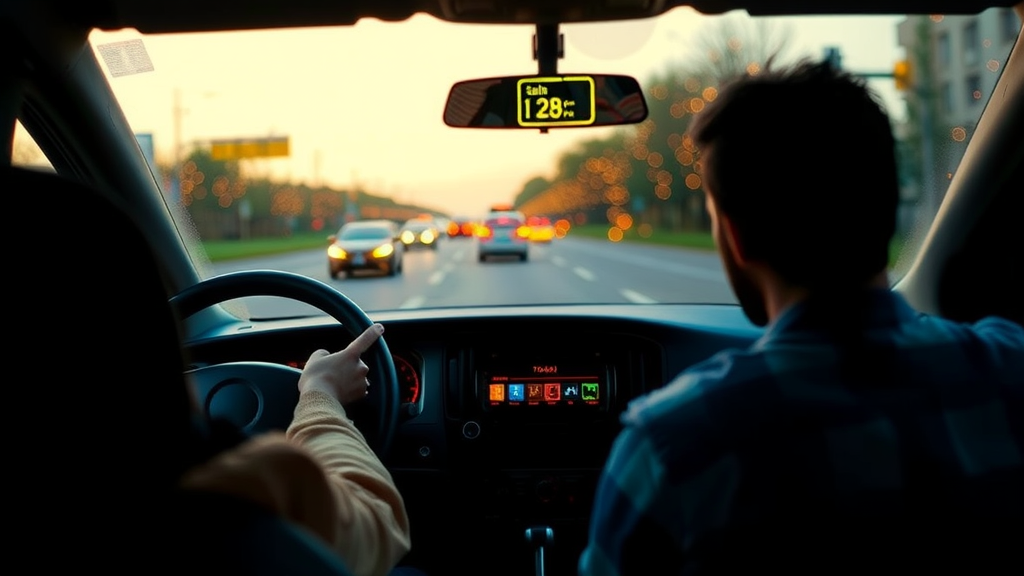
Every time a driver glances toward a hidden crosswalk or sweeps the road ahead of a curve, the eyes are carrying out a strategy that may determine whether a crash happens or not. Researchers have long known that this visual search behavior, often called a visual search strategy, underpins situational awareness, the capacity to understand the surrounding environment and anticipate what will happen next. But measuring it has been painstakingly slow, limiting studies to small groups of participants and short stretches of driving. A new study published in Behavior Research Methods offers a way out of that bottleneck by letting machine learning algorithms do the heavy lifting on raw eye-tracking data.
The research, led by Thomas Seacrist, Elizabeth E. Walshe, David Grethlein, Megan S. Ryerson, Flaura K. Winston and colleagues at the Children’s Hospital of Philadelphia and partner institutions, demonstrates that time-series clustering, an unsupervised machine learning technique, can automatically identify distinct visual search strategies from eye-tracking recordings collected during simulated driving. Instead of requiring human coders to watch hours of video and label where each driver looked, the approach compares entire streams of gaze data directly and groups drivers whose scanning patterns resemble one another.
The significance of this shift is hard to overstate for the field. Traditionally, characterizing a visual search strategy has meant video coding: trained analysts review synchronized footage of the road scene and the driver’s eyes, mark fixations on areas of interest, and translate those marks into summary measures. The process is labor-intensive, subjective at the margins, and effectively caps the size of datasets a lab can analyze. That cap matters because the consequences of insufficient visual search are severe. A driver who fails to scan far enough ahead may miss a pedestrian stepping out from behind an obstructed view, or may enter a blind curve without the anticipatory glances that experienced drivers deploy.
To test their method, the team collected eye-tracking data from 36 young drivers aged 16 to 24 as they completed a virtual driving assessment, a validated simulated driving test used to gauge performance behind the wheel. The cohort is deliberately focused on a high-risk population. Crash rates among newly licensed and teenage drivers remain dramatically elevated compared with older, experienced motorists, and errors in scanning and hazard anticipation figure prominently among the mistakes that precede serious crashes involving young novices.
At the heart of the method is a measure called dynamic localized coordinate aligned warping, abbreviated DCLAW, an extension of the well-known dynamic time warping algorithm. Dynamic time warping, originally developed for aligning spoken word recordings, allows two time series that unfold at different speeds to be compared by stretching and compressing them along the time axis. DCLAW adapts this idea to eye-tracking data, which arrive as rapidly sampled coordinates of gaze position and rarely align neatly between one driver and another. Two drivers might sweep their eyes across the same sequence of road regions but at slightly different moments or paces; a naive comparison would call them dissimilar, while DCLAW can recognize the underlying strategy as essentially the same.
Once pairwise similarities between all drivers’ raw gaze streams had been computed, the researchers applied k-medoids clustering, an unsupervised algorithm that partitions data into groups organized around actual representative examples called medoids. Because the method is unsupervised, it requires no preconceived categories of good or bad scanning behavior. The number and structure of the clusters emerge from the data itself, and the researchers then examined each cluster’s medoid, the driver whose time series sits at the center of the group, to characterize what defined that particular visual search strategy.
The results showed that time-series clustering successfully identified generalizable visual search strategies during a curved roadway scenario, one of the more demanding situations in driving. Curves demand anticipatory glances toward the tangent of the bend and disciplined checking of the lane ahead, and differences in how young drivers allocate attention there are linked to crash risk. The fact that clustering raw data recovered meaningful, generalizable strategy groups in this setting suggests the technique can capture behaviorally important variation without any manual preprocessing of the eye-tracking signal.
The practical implications extend well beyond the driving simulator. Because the method removes the need for labor-intensive manual coding, it opens the door to analyzing far larger and more diverse datasets, the kind of scale needed for findings to generalize across populations, driving environments and research questions. Larger samples could reveal how visual search strategies differ by age, experience, fatigue, distraction or neurological condition, and could support the evaluation of training interventions designed to teach novice drivers to scan more like experts. Similar approaches could prove valuable in aviation, air traffic control, construction safety, medicine and any domain where situational awareness depends on where people look and when.
The study also reflects a broader trend in behavioral science, in which methods developed in the data mining community, including time-series clustering, shapelet-based classification and related techniques, are being redeployed to make sense of rich, high-frequency behavioral recordings. Eye-trackers have become cheaper and more ubiquitous, generating torrents of gaze data that conventional analysis pipelines were never designed to handle. Techniques that operate directly on raw time series, rather than on heavily processed summaries, promise to preserve the temporal structure of behavior that those summaries often discard.
The authors have made their data and code publicly available through the Children’s Hospital of Philadelphia’s GitHub repository, lowering the barrier for other teams to adopt and extend the approach. For a research area long constrained by the slow economics of video coding, the demonstration that raw eye-tracking streams can be clustered into interpretable visual search strategies marks a genuine methodological milestone, one that could accelerate the science of how humans take in the visual world during complex, safety-critical tasks.
Subject of Research: A scalable time-series clustering method for characterizing visual search strategies from raw eye-tracking data in young drivers
Article Title: A scalable method for characterizing visual search strategies: A novel application of time-series clustering to raw eye-tracking data
Article References: Seacrist, T., Walshe, E. E., Grethlein, D., Ryerson, M. S., & Winston, F. K. (2026). A scalable method for characterizing visual search strategies: A novel application of time-series clustering to raw eye-tracking data. Behavior Research Methods, 58(10), Article 290. https://doi.org/10.3758/s13428-026-03154-2
Image Credits: AI Generated
DOI: 10.3758/s13428-026-03154-2
Keywords: eye-tracking, visual search strategy, time-series clustering, machine learning, situational awareness, young drivers, driving simulation, k-medoids, dynamic time warping, hazard perception, Behavior Research Methods, driver safety
Cite Scienmag News
Blake Davidson. (September 12, 2026). AI Clustering of Raw Eye-Tracking Data Reveals How Young Drivers Scan the Road. Scienmag. https://scienmag.com/ai-clustering-of-raw-eye-tracking-data-reveals-how-young-drivers-scan-the-road/
Blake Davidson. "AI Clustering of Raw Eye-Tracking Data Reveals How Young Drivers Scan the Road." Scienmag, 12 September 2026, https://scienmag.com/ai-clustering-of-raw-eye-tracking-data-reveals-how-young-drivers-scan-the-road/. Accessed 12 September 2026.
Blake Davidson. "AI Clustering of Raw Eye-Tracking Data Reveals How Young Drivers Scan the Road." Scienmag. September 12, 2026. https://scienmag.com/ai-clustering-of-raw-eye-tracking-data-reveals-how-young-drivers-scan-the-road/


