


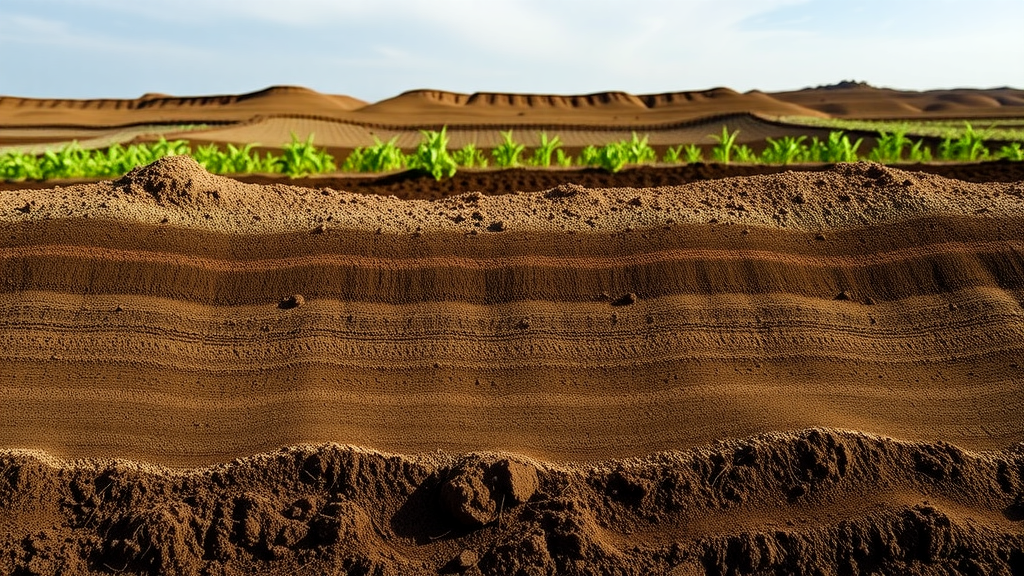
In the wheat heartland of northeastern Syria, where the Khabur and Jaghjagh rivers thread through alluvial plains near the borders with Türkiye and Iraq, the ground beneath farmers’ feet has long remained one of the region’s least studied natural resources. A new study published in Environmental Earth Sciences has now delivered the first detailed characterization of soil physicochemical properties along an elevation and precipitation gradient in the Al-Hasakah Governorate, offering a rare scientific baseline for a landscape that anchors Syria’s national grain supply yet has been largely inaccessible to systematic soil research for more than a decade.
The research team, led by Hisen Sulaiman of Al-Furat University and the Soil Science Society of Syria, together with colleagues at Damascus University and the Universidade de Vigo in Spain, examined three representative soil profiles at Al-Hasakah, Al-Qamishli, and Al-Malikiyah. These sites span an elevation range from roughly 300 to 598 meters above sea level and a precipitation gradient from about 280 to 650 millimeters per year, capturing the transition from hot semi-arid conditions at the lowest, driest site to the wetter, higher terrain near the Turkish border. Fieldwork was conducted in 2017, before the full weight of the Syrian conflict curtailed scientific access to the region, and the profiles were excavated to bedrock and described according to Food and Agriculture Organization guidelines.
The analytical program was comprehensive. The researchers measured particle-size distribution by the hydrometer method, bulk density with core samplers, and moisture content by oven-drying, alongside a chemical suite that included pH in a 1:2.5 soil-water suspension, electrical conductivity in a 1:5 extract, cation exchange capacity by the sodium acetate method, calcium carbonate by volumetric titration, organic carbon by the Walkley-Black procedure, and available phosphorus by Olsen extraction. Micronutrients, namely iron, manganese, zinc, and copper, were assessed using DTPA extraction, the standard diagnostic tool for neutral and calcareous alkaline soils, with all extractant concentrations quantified by atomic absorption spectrophotometry.
The physical results reveal a striking textural divide across the gradient. At Al-Hasakah, the driest and lowest site, the soil profile showed a clay loam texture with the lowest clay content recorded in the study, just 30.4 percent in the surface horizon, accompanied by relatively higher sand and silt fractions. By contrast, the profiles at Al-Qamishli and Al-Malikiyah were dominated by clay throughout most depths, with clay contents climbing to 57 and 59 percent respectively in deeper layers, a signature of the clay-rich calcareous vertisols typical of the region’s higher ground. The authors attribute the relative depletion of fine particles in the topsoil of the lowest site to aeolian erosion, which preferentially strips silt and clay from exposed surfaces and redistributes them downwind, while the increase of clay with depth points to eluviation, the downward migration of clay particles carried by percolating water.
Bulk density values ranged from 1.20 to 1.35 grams per cubic centimeter and increased with depth, consistent with silt-enriched subsurface horizons, diminishing organic matter, and limited structural development below the surface. Soil moisture in the topsoil remained below 6 percent at all sites, a stark indicator of the water-limited conditions that constrain rain-fed agriculture across the governorate, although moisture rose both with depth and along the elevation and precipitation gradient, suggesting that the wetter upper landscape retains measurably more plant-available water.
Chemically, the soils told a story of aridity written in carbonates and salts. All profiles exhibited neutral to slightly alkaline pH, beginning at 7.66 in the surface of the Al-Hasakah profile and exceeding 8.0 at depth, a pattern the researchers link to leaching and salt accumulation in the subsoil combined with low organic matter. Electrical conductivity in the topsoil indicated moderate salinity for clay soils, above 0.51 decisiemens per meter, but its vertical distribution differed sharply among sites. The lowest-elevation profile showed evidence of upward salt movement driven by capillary rise from deeper horizons, the mid-elevation profile at Al-Qamishli displayed the highest surface salinity with a downward leaching trend, and the highest site showed no significant change with depth, likely because its dense clay matrix slows water movement and diffuses salt concentrations. Calcium carbonate contents ranged from 22.81 to 40.23 percent, classifying the soils as extremely calcareous under FAO guidelines, with carbonate increasing with depth, particularly at the driest site where limited precipitation suppresses leaching.
Perhaps the most consequential findings concern fertility. Organic matter was uniformly low, at or below 1 percent, and soil organic carbon did not exceed 0.56 percent, declining with depth, values consistent with sparse vegetation cover, absent organic fertilization, and the hot, dry climate in which biomass production is minimal while mineralization rates remain high. Available phosphorus was critically deficient, staying below 3.62 milligrams per kilogram and concentrated in surface horizons, a limitation the authors attribute to the absence of mineral fertilization and to phosphorus fixation under alkaline conditions. Cation exchange capacity, by contrast, was a relative strength, rated medium at Al-Hasakah and high to very high at the two higher sites, dominated by exchangeable calcium and magnesium supplied by the carbonate-rich parent materials and minerals such as palygorskite, with localized basaltic intrusions near Al-Malikiyah contributing additional base cations.
The micronutrient picture was nuanced and carries direct implications for crop management. Measured against conventional critical levels developed for temperate agricultural soils, the profiles would register moderate to severe deficiencies, echoing global findings that aridity suppresses micronutrient availability in drylands. Yet when evaluated against thresholds developed specifically for arid and semi-arid regions, most soils showed adequate copper, iron, and manganese, while zinc concentrations of 0.6 to 1 milligram per kilogram fell in the low to moderate range. The researchers argue this discrepancy demonstrates the need for agroecological, climate-based thresholds for micronutrient availability rather than blanket application of standards derived from favorable environments, a point with practical weight for the region’s wheat and barley farmers.
Statistical analysis reinforced the climatic signal. Clay content correlated strongly and positively with both precipitation and elevation, each at a coefficient of 0.79, while sand content was strongly and negatively correlated with elevation at minus 0.88. Cation exchange capacity and exchangeable calcium and magnesium rose significantly with elevation and precipitation, whereas exchangeable potassium declined, and calcium carbonate showed an inverse relationship with the gradient. Soil pH and electrical conductivity, however, showed no significant variation along the gradient, which the authors suggest reflects the relatively narrow environmental range sampled, roughly 350 meters of elevation and 400 millimeters of precipitation, combined with high evaporation rates that attenuate the leaching influence of rainfall. The region’s flat relief also limits lateral water redistribution, distinguishing these patterns from the steep-topography gradients documented in mountain studies elsewhere.
The authors are candid about the limitations of a three-profile design with restricted spatial coverage, and they note that temporal soil dynamics, total nitrogen, available sulfur, and fertility management practices were not assessed. Even so, the study delivers novel baseline data for a region where published soil characterization is scarce and where the stakes are high. The Al-Hasakah Governorate remains Syria’s largest wheat-producing province, and the agricultural sector once employed nearly 22 percent of Syrians before the conflict that ran from 2011 to 2024. The researchers conclude that sustainable production in these soils will require organic amendments to rebuild carbon, phosphatic fertilization to overcome severe phosphorus deficiency, zinc supplementation, and improved drainage at the lower-elevation sites where salinity risk is greatest. As droughts intensify and temperatures rise across the eastern Mediterranean, the findings offer farmers, land managers, and researchers a technical foundation for protecting one of the Middle East’s most strategically important agricultural landscapes, and a template for soil assessment in arid regions where the ground itself may hold the keys to food security.
Subject of Research: Physicochemical soil properties along elevation and precipitation gradients in arid northeastern Syria
Article Title: Changes in soil physico-chemical properties along elevation and precipitation gradients in Northeastern Syria
Article References: Sulaiman, H., Jaafar, A. A. K., Salim, S., & Rodríguez-Seijo, A. (2026). Changes in soil physico-chemical properties along elevation and precipitation gradients in Northeastern Syria. Environmental Earth Sciences, 85(15), Article 397. https://doi.org/10.1007/s12665-026-13122-w
Image Credits: AI Generated
DOI: 10.1007/s12665-026-13122-w
Keywords: soil science, Syria, Al-Hasakah, elevation gradient, precipitation gradient, soil fertility, micronutrients, vertisols, calcareous soils, arid soils, cation exchange capacity, soil organic carbon
Cite Scienmag News
Violet Maxwell. (September 12, 2026). Soil Secrets Along Syria’s Elevation Gradient Reveal Fertility Clues. Scienmag. https://scienmag.com/soil-secrets-along-syrias-elevation-gradient-reveal-fertility-clues/
Violet Maxwell. "Soil Secrets Along Syria’s Elevation Gradient Reveal Fertility Clues." Scienmag, 12 September 2026, https://scienmag.com/soil-secrets-along-syrias-elevation-gradient-reveal-fertility-clues/. Accessed 12 September 2026.
Violet Maxwell. "Soil Secrets Along Syria’s Elevation Gradient Reveal Fertility Clues." Scienmag. September 12, 2026. https://scienmag.com/soil-secrets-along-syrias-elevation-gradient-reveal-fertility-clues/


