


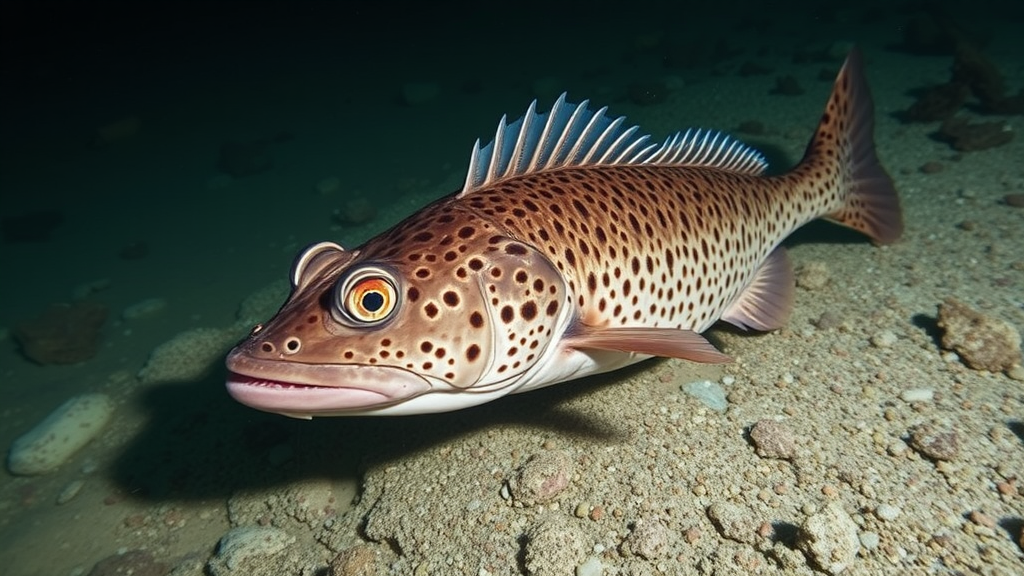
Three of the ocean’s most imperiled croaker fishes are on sharply different climate trajectories, according to a new modeling study that maps how rising temperatures will redraw the map of suitable habitat across the Indo-West Pacific. The research, published in Regional Environmental Change, used maximum entropy species distribution models to project current and future habitat suitability for three IUCN-listed Bahaba fishes: Bahaba chaptis, Bahaba polykladiskos, and Bahaba taipingensis. The results reveal a striking divergence in how closely related, geographically overlapping species can respond to the same planetary forcing, with one species poised for a massive range expansion, another swinging wildly between collapse and boom depending on emissions, and a third holding remarkably steady in the shelf seas of East Asia.
The Bahaba genus comprises large sciaenid fishes, relatives of drums and croakers, that can grow to more than two meters and once formed the basis of important coastal fisheries. Their swim bladders commanded extraordinary prices in dried seafood markets, a fact that helped drive the Chinese bahaba, B. taipingensis, to the brink of extinction. All three species examined in the study are listed as threatened on the IUCN Red List, and all depend on coastal and estuarine environments that are simultaneously being transformed by warming waters, altered salinity regimes, hypoxia, and intense fishing pressure. Understanding where their suitable habitats will persist, shrink, or emerge under climate change is therefore not an academic exercise but a matter of survival.
To build their projections, the research team, led by Yixuan Huang and Shihong Xu of the Institute of Oceanology at the Chinese Academy of Sciences and Yongshuang Xiao, compiled occurrence records for the three species and modeled their environmental niches using the maximum entropy approach, a widely applied machine learning technique that estimates the probability of species presence from occurrence points and gridded environmental layers. The models were calibrated on present-day conditions and then forced forward under four representative concentration pathways, from the stringent mitigation scenario RCP2.6 to the high-emissions business-as-usual pathway RCP8.5, for two future time horizons: the 2050s and the 2100s. Key environmental predictors included sea surface and bottom temperature, salinity, and other physicochemical variables known to constrain the physiology and distribution of coastal marine fishes.
The most dramatic result belongs to B. chaptis, a tropical croaker distributed from the Indian Ocean rim into Southeast Asian waters. The models project persistent and substantial expansion of suitable habitat for this species, with a net increase in suitable area of 59.4 percent under the 2100s RCP6.0 scenario. Even more striking is the projected movement of the species’ range centroid: a northwestward displacement exceeding 4,500 kilometers by the end of the century. A centroid shift of that magnitude implies that the geographic center of gravity of B. chaptis habitat could migrate across entire marine realms, from its current tropical strongholds toward higher-latitude waters, suggesting a high potential for climate-driven redistribution that would carry the species across multiple exclusive economic zones and national jurisdictions.
B. polykladiskos, by contrast, exhibited a deeply nonlinear response to warming that the authors characterize as threshold-like. Under intermediate emissions, the species is projected to suffer severe contraction, with a net loss of 54.9 percent of suitable area under the 2100s RCP6.0 scenario. Yet under the highest emissions pathway, RCP8.5, the same species is projected to expand strongly, gaining 58.2 percent of suitable area by the 2100s. This counterintuitive pattern indicates that the species’ habitat suitability does not decline smoothly with warming but instead pivots around critical environmental thresholds. Intermediate warming may push conditions past tolerable limits across much of the current range, while more extreme scenarios may open vast new areas whose climates come to resemble the species’ niche in unexpected ways. For conservation planners, such sensitivity means that the fate of B. polykladiskos is extraordinarily difficult to anticipate without considering the full envelope of emissions outcomes.
The third species tells a very different story. B. taipingensis, the critically endangered Chinese bahaba, is projected to maintain relatively stable suitable habitat through 2100, with centroid displacement generally remaining below 400 kilometers. This stability underscores the persistent conservation importance of the East China Sea and Yellow Sea shelf, the species’ historical heartland, where productive, seasonally variable shelf conditions appear buffered against the kind of wholesale climatic reorganization projected for tropical waters. For a species already reduced to remnant populations by decades of overfishing, the modeling result is a rare piece of good news: the environmental stage on which its recovery must play out is likely to remain, at least in broad terms, where it is today.
Beyond mapping individual ranges, the study examined how the ecological niches of the species relate to one another through time using niche-overlap analysis based on Schoener’s D, a standard metric quantifying the similarity of two species’ environmental niches. The two tropical species, B. chaptis and B. polykladiskos, showed declining niche overlap under future scenarios, with Schoener’s D falling from 0.533 under present conditions to as low as 0.405. Declining overlap signals increasing spatial and environmental differentiation between the two species, meaning that the habitats that will suit one are progressively diverging from those that will suit the other. Such niche divergence has cascading implications: it can alter patterns of interspecific competition, restructure community composition, and complicate any conservation strategy that assumes the two species can be managed as a single ecological unit.
These findings arrive at a moment when marine conservation planning is grappling with a fundamental design problem. Marine protected areas have traditionally been sited around where threatened species live now, on the implicit assumption that those locations will remain suitable. Climate-driven range shifts break that assumption. A reserve network optimized for present-day distributions may find its protected populations migrating out of bounds while unsuitable conditions move in. The study’s species-specific results translate directly into differentiated planning guidance. For expanding species such as B. chaptis, the authors argue for migration corridors, protected pathways that anticipate and accommodate the northwestward march of suitable habitat across national boundaries. For threshold-sensitive species such as B. polykladiskos, they recommend flexible buffer zones that can absorb the uncertainty inherent in a nonlinear, scenario-dependent response. For the regionally stable but critically endangered B. taipingensis, fixed core reserves anchored in the East China Sea and Yellow Sea shelf remain the appropriate instrument, paired with the captive breeding and release programs already underway for the species.
The transboundary dimension of the projections is perhaps the study’s most policy-relevant contribution. A centroid shift exceeding 4,500 kilometers for B. chaptis would traverse waters governed by numerous states with differing fisheries regimes, conservation capacities, and levels of engagement with international agreements. Species do not respect exclusive economic zones, and neither does climate change. The authors emphasize that integrating projected distribution dynamics and niche shifts into climate-adaptive marine conservation planning requires regional cooperation mechanisms capable of coordinating protected area design, harvest regulations, and monitoring across borders. Without such coordination, a species protected in one jurisdiction may simply be harvested in the next as its range shifts, a pattern well documented in fisheries that straddle national boundaries.
The study also carries methodological weight for the broader field of species distribution modeling. Maximum entropy models have become a workhorse of climate-impact biology, but their reliability depends on careful parameterization, adequate occurrence data, and honest treatment of uncertainty. By projecting multiple species across a full ladder of emissions scenarios and two time horizons, and by pairing habitat projections with formal niche-overlap analysis, the work illustrates how distribution models can move beyond single-species maps toward comparative, community-relevant insight. The contrasting fates of three congeners occupying the same region serve as a caution against one-size-fits-all climate adaptation strategies and a demonstration that even closely related fishes can occupy meaningfully different climatic niches with profoundly different futures. As ocean warming accelerates through the coming decades, the Bahaba croakers of the Indo-West Pacific may become a case study in how conservation science anticipates, rather than merely documents, the great redistribution of life in the sea.
Subject of Research: Climate-driven habitat shifts and niche divergence of three endangered Bahaba marine fishes in the Indo-West Pacific
Article Title: Projecting climate-driven biogeographic shifts and niche divergence of three endangered marine fishes in the Indo-West Pacific: implications for regional conservation priorities and transboundary management
Article References: Projecting climate-driven biogeographic shifts and niche divergence of three endangered marine fishes in the Indo-West Pacific: implications for regional conservation priorities and transboundary management. (n.d.). https://doi.org/10.1007/s10113-026-02675-y
Image Credits: AI Generated
DOI: 10.1007/s10113-026-02675-y
Keywords: Bahaba fishes, climate change, species distribution models, MaxEnt, niche divergence, Indo-West Pacific, habitat suitability, RCP scenarios, marine conservation, transboundary management, East China Sea, IUCN Red List
Cite Scienmag News
Sloane Callahan. (September 12, 2026). Endangered Giant Croakers Face Divergent Climate Futures Across the Indo-West Pacific. Scienmag. https://scienmag.com/endangered-giant-croakers-face-divergent-climate-futures-across-the-indo-west-pacific/
Sloane Callahan. "Endangered Giant Croakers Face Divergent Climate Futures Across the Indo-West Pacific." Scienmag, 12 September 2026, https://scienmag.com/endangered-giant-croakers-face-divergent-climate-futures-across-the-indo-west-pacific/. Accessed 12 September 2026.
Sloane Callahan. "Endangered Giant Croakers Face Divergent Climate Futures Across the Indo-West Pacific." Scienmag. September 12, 2026. https://scienmag.com/endangered-giant-croakers-face-divergent-climate-futures-across-the-indo-west-pacific/


