


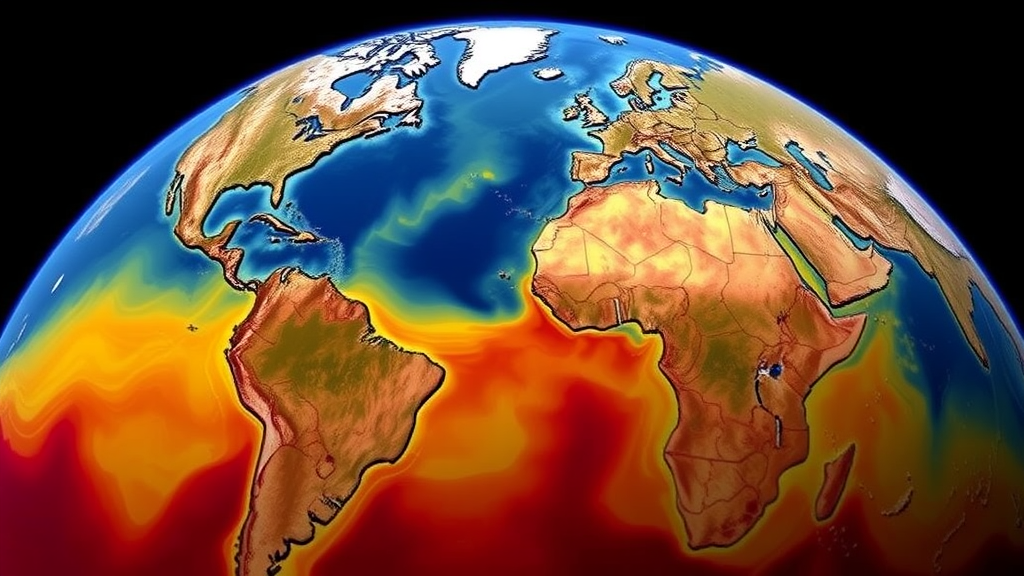
More than 20,000 years ago, as vast ice sheets smothered North America and northern Europe, the Atlantic Ocean’s great overturning circulation did something remarkable: it repeatedly sputtered, weakened, and then roared back to strength within the space of a few human lifetimes. These abrupt reorganizations of the Atlantic Meridional Overturning Circulation, or AMOC, left their fingerprints in Greenland and Antarctic ice cores as sudden temperature swings known as Dansgaard–Oeschger events. Now, new research published in Nature Geoscience reveals that these ancient current shifts did far more than shuffle heat around the globe — they fundamentally rewired the planet’s entire energy balance, acting like a planetary thermostat or heat valve that controlled how much energy Earth absorbed, stored, and radiated back to space.
The study, summarized in a research briefing by Buizert and colleagues, centers on a deceptively simple question with profound implications: when the AMOC abruptly changes state, what happens to the net flow of energy at the top of the atmosphere? The answer, according to the new analysis, is that the AMOC functions as a kind of global heat reservoir. During periods when the circulation is weak, heat accumulates in the ocean interior, particularly in the deep basins of the Atlantic and Southern oceans. When the circulation snaps back into its strong mode, that stored heat is released, and radiative feedbacks amplify the transition, altering the planetary energy budget in ways that ripple across both hemispheres.
To understand why this matters, it helps to grasp the mechanics of the overturning circulation itself. The AMOC is often described as a giant conveyor belt: warm, salty surface water flows northward in the Atlantic, cools and becomes denser in the subpolar seas near Greenland, sinks to the abyss, and returns southward at depth. This loop transports an enormous quantity of heat — on the order of a petawatt — from the Southern Hemisphere toward the North Atlantic. When the sinking branch weakens or shuts down, as it apparently did many times during the last glacial period, that northward heat transport collapses, and the ocean’s internal plumbing changes dramatically.
Paleoclimate records tell us that these transitions were astonishingly fast. Greenland ice cores record temperature jumps of 10 degrees Celsius or more within decades at the onset of Dansgaard–Oeschger interstadials, followed by more gradual cooling and then abrupt returns to cold conditions. For decades, scientists have debated what drives this seesaw behavior. One influential framework, the thermal bipolar seesaw model developed by Stocker and Johnsen, proposes that heat builds up in the Southern Ocean while the North Atlantic cools during weak AMOC phases, and that this southern warmth is gradually released as the circulation recovers. The new work builds directly on this foundation but reframes it in the language of planetary energetics.
The key insight of the new analysis is that the ocean’s heat accumulation and release must be balanced by changes in Earth’s radiation budget at the top of the atmosphere. When the AMOC is weak and heat piles up in the ocean interior, the planet’s surface in the tropics and Southern Hemisphere warms, increasing outgoing longwave radiation and altering cloud and water vapor feedbacks. When the AMOC strengthens, deep heat is brought back toward the surface and released, sea ice retreats in the North Atlantic, and the darkening ocean absorbs more sunlight. These radiative feedbacks — including changes in sea ice cover, water vapor, clouds, and surface temperature patterns — do not merely respond to the circulation change; they actively facilitate and amplify it, stabilizing each state until the next abrupt transition occurs.
This framing resolves a long-standing puzzle in paleoclimate science. Earlier modeling work by Galbraith, Merlis, and Palter had shown that AMOC disruptions carry a significant radiative impact capable of destabilizing glacial climate, but the full accounting of where the energy goes during the multi-century weak phases remained incomplete. The new study demonstrates that the weak AMOC mode is not simply a static cold state; it is a period of active energy accumulation in the ocean interior. The subsequent strong mode then acts as a discharge phase, releasing the stored energy and driving the planet toward a new radiative equilibrium. In effect, the AMOC behaves as a valve that gates the exchange of heat between the deep ocean and the climate system as a whole.
The implications extend beyond academic curiosity about the ice age. The Dansgaard–Oeschger events are the most dramatic examples of abrupt climate change in the geological record, and understanding their energetics provides a rigorous test of the climate models we rely on to project future change. Modern climate models must be able to reproduce not only the temperature patterns of these ancient events but also the associated changes in planetary energy imbalance. If a model gets the energy budget wrong during AMOC transitions, its projections of how the modern AMOC might weaken under greenhouse warming — and how such a weakening would alter global heat distribution — become far less trustworthy.
There is also a cautionary note for the present day. Observations suggest that the modern AMOC has been weakening, and climate models project further decline over the coming century as Greenland meltwater freshens the North Atlantic and warming stratifies the surface ocean. The glacial record shows that the overturning circulation can occupy distinct modes and flip between them far faster than gradual warming trends might suggest. While the ice age world, with its massive ice sheets and extensive sea ice, differed in important ways from today’s climate, the fundamental physics of ocean heat storage and radiative feedback identified in the new study applies across climate states. A weakening AMOC today would likewise redistribute heat between hemispheres, shift tropical rainfall belts, and alter the planet’s energy imbalance — the very quantity that determines how fast global warming proceeds.
The research also highlights the power of combining multiple lines of evidence. Ice core records from both poles constrain the timing and amplitude of temperature change; marine sediment cores track ocean circulation proxies and deep-water temperature; and energy budget analysis ties these observations together within a physical framework. The Southern Ocean emerges as a central player in this story, consistent with earlier observational work by Buizert and Schmittner showing that the background climate state — set in part by Southern Ocean conditions — controls the stability of the glacial AMOC and the duration of interstadial warm periods. The timing and pacing of abrupt change, in other words, are not random; they emerge from the interplay of ocean heat storage, circulation dynamics, and radiative feedback across the globe.
As scientists continue to refine estimates of Earth’s current energy imbalance — the extra sunlight the planet now traps because of greenhouse gases — the lesson from the deep past is that this budget is not a passive ledger. It is actively shaped by the ocean’s circulation, and the circulation, in turn, is shaped by the budget. Twenty thousand years ago, that feedback loop produced some of the most abrupt climate swings ever recorded. Understanding how the Atlantic’s great current once held the planet’s energy balance in its grip may prove essential for anticipating how the climate system will behave as the modern circulation faces pressures of its own.
Subject of Research: The role of abrupt Atlantic Meridional Overturning Circulation changes during the last glacial period in regulating Earth's planetary energy balance.
Article Title: Past abrupt changes in Atlantic Ocean currents controlled the Earth’s energy balance
Article References: Past abrupt changes in Atlantic Ocean currents controlled the Earth’s energy balance. (2026). Nature Geoscience. https://doi.org/10.1038/s41561-026-02086-y
Image Credits: AI Generated
DOI: 10.1038/s41561-026-02086-y
Keywords: AMOC, Atlantic Meridional Overturning Circulation, Dansgaard-Oeschger events, paleoclimate, planetary energy balance, last ice age, ocean circulation, radiative feedbacks, Southern Ocean, abrupt climate change, palaeoceanography, climate modelling
Cite Scienmag News
Violet Maxwell. (September 12, 2026). Ancient Atlantic Current Collapses Reshaped Earth’s Heat Budget, Study Finds. Scienmag. https://scienmag.com/ancient-atlantic-current-collapses-reshaped-earths-heat-budget-study-finds/
Violet Maxwell. "Ancient Atlantic Current Collapses Reshaped Earth’s Heat Budget, Study Finds." Scienmag, 12 September 2026, https://scienmag.com/ancient-atlantic-current-collapses-reshaped-earths-heat-budget-study-finds/. Accessed 12 September 2026.
Violet Maxwell. "Ancient Atlantic Current Collapses Reshaped Earth’s Heat Budget, Study Finds." Scienmag. September 12, 2026. https://scienmag.com/ancient-atlantic-current-collapses-reshaped-earths-heat-budget-study-finds/


