


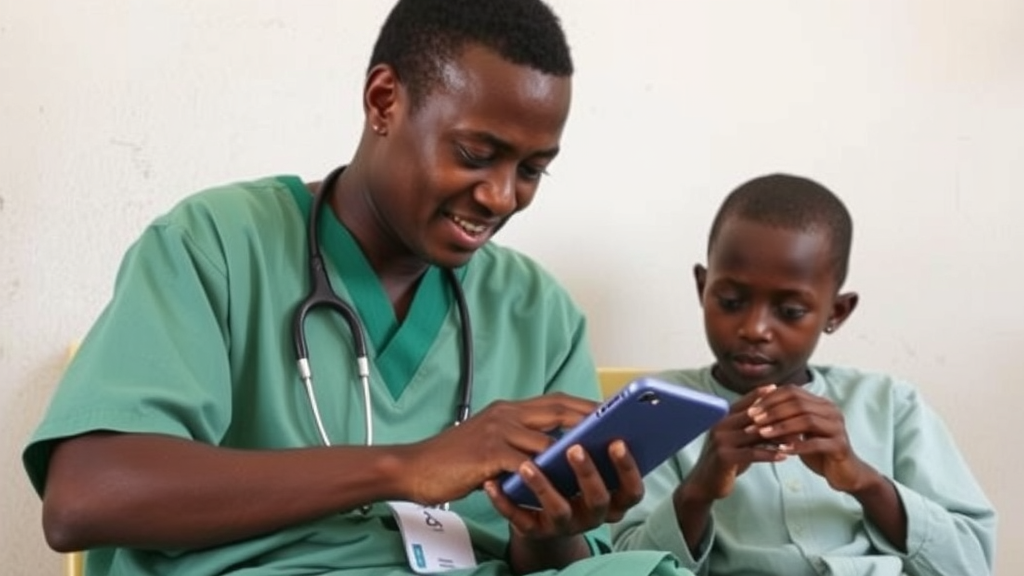
Telemedicine has been heralded as one of the most promising tools for closing the vast healthcare gaps that separate wealthy urban centers from underserved rural communities in low- and middle-income countries. In Nigeria, Africa’s most populous nation, where physician density remains far below global recommendations and millions of people live hours from the nearest functioning clinic, the appeal is obvious. A new critical policy and systems review published in SN Social Sciences, however, delivers a sobering assessment: telemedicine in Nigeria is not automatically narrowing health inequities, and in the absence of deliberate structural reform it may actually be reinforcing them.
The study, led by Moyosoluwa Dele-Dada of Miva Open University with Goddy Osimen of Covenant University and Osezua Ehiyamen of the University of Texas, applies a critical interpretive synthesis to 46 sources drawn from peer-reviewed studies, policy documents, and institutional reports published between 2015 and 2025. Rather than simply cataloguing barriers, the researchers organize their evidence through an analytical framework they call ACCESS-Q, which evaluates six dimensions: access, connectivity and infrastructure, cost and affordability, equity and inclusion, service quality, and systems and governance. This structure allows them to trace precisely where telemedicine’s equity promise breaks down along the chain from network tower to consultation room.
The headline finding is stark. Urban uptake of telemedicine in Nigeria stands at roughly 70 percent, while rural uptake lags at about 50 percent, and approximately 40 percent of attempted rural consultations fail outright because of network disruption. This failure rate is not a marginal inconvenience; it means that for the very populations telemedicine is supposed to reach first, the technology frequently does not work at all. The review points to a critical internet reliability threshold of around 40 percent, below which telehealth services for rural communities become functionally unreliable, a threshold that many rural Nigerian localities fail to meet consistently.
Beneath the connectivity problem lies a deeper pattern of stratification. The synthesis finds that willingness to pay for teleconsultation, digital literacy, and device capability are all patterned by income, education, gender, and age. Older Nigerians, women with lower educational attainment, and low-income households are systematically less able to access, afford, and effectively use digital health services. The paradox is uncomfortable: the populations that telemedicine is intended to serve, those facing the greatest geographic and financial barriers to in-person care, are also the least able to use it consistently. Without corrective policy, digital health risks becoming a premium service layered on top of an already unequal system.
Yet the review is careful not to dismiss the technology. Where telemedicine has been rigorously evaluated in Nigeria, the quality gains are real and substantial. A stepped-wedge trial known as REaCH, published in The Lancet Global Health, tested remote consulting for long-term conditions in primary health care in Nigeria and Tanzania, combining clinician training with mobile data allowances and structured implementation. The trial recorded a four-fold increase in primary care consultations without any loss of safety, demonstrating that when the enabling conditions are deliberately engineered, remote care can dramatically expand service volume without compromising patients.
Mental health care offers a second compelling proof of concept. The HAPPINESS pilot project, which integrated mental health services into primary care in Nigeria using mobile-supported task-shifting approaches, achieved significant reductions in psychiatric symptoms among patients. Task-shifting, the delegation of care to trained non-specialist health workers supported by digital supervision, is particularly well suited to a country with an acute shortage of psychiatrists. These successes share a common feature: they were designed for the realities of low-connectivity environments rather than imported from high-income settings and expected to work as-is.
The systems-level picture, however, is far less encouraging. The review finds that Nigeria’s telemedicine governance remains at a nationally uniform ‘beginner’ level of readiness. There is no dedicated telehealth law establishing standards for licensure, privacy, cross-state practice, or clinical accountability at a distance. More consequentially for patients, there is no provision for telemedicine reimbursement under the National Health Insurance Authority Act, meaning that out-of-pocket payment remains the default financing mechanism for most digital consultations. In a country where catastrophic out-of-pocket health expenditure already pushes households into poverty, expecting the poorest patients to self-fund teleconsultations is a structural barrier that no amount of app design can overcome.
The authors’ central conclusion is that telemedicine’s impact on health equity in Nigeria is conditional rather than automatic. Under the right structural conditions, reliable rural connectivity, inclusive financing, digital literacy programs, and integration with the formal health system, telemedicine can narrow both access and quality gaps. In their absence, it currently reinforces them, concentrating its benefits among digitally engaged, urban, and relatively affluent patients while leaving the underserved behind. This framing rejects both techno-optimism and fatalism; the technology is neither savior nor sham, but a tool whose equity outcomes depend entirely on the policy environment built around it.
The policy implications are correspondingly specific. The review points toward simultaneous, coordinated investment across four fronts: rural connectivity infrastructure that treats bandwidth as a health determinant; inclusive financing mechanisms that embed telemedicine within insurance coverage rather than leaving it to market forces; digital literacy initiatives targeted at women, older adults, and low-income communities; and regulatory integration that gives telehealth a firm legal footing within the national health system. Pursuing any one of these in isolation, the evidence suggests, will produce the uneven, urban-skewed adoption pattern the review documents.
For global health observers, Nigeria’s experience carries lessons well beyond its borders. Across sub-Saharan Africa and much of South Asia, governments are racing to scale digital health in the wake of the COVID-19 pandemic, often with insufficient attention to who is actually being reached. The Nigerian synthesis offers a methodological template, the ACCESS-Q framework, for interrogating whether digital health investments are advancing equity or merely digitizing existing disparities. As telemedicine markets across the continent expand rapidly, the question is no longer whether remote care can work in low-resource settings, the trials have answered that, but whether political systems will build the infrastructure, financing, and regulation that allow it to work for everyone.
Subject of Research: The impact of telemedicine and the digital divide on health equity in Nigeria
Article Title: Impact of telemedicine and digital divide on health equity: a critical policy and systems review of access and quality of health care in Nigeria
Article References: Dele-Dada, M., Osimen, G., & Ehiyamen, O. (2026). Impact of telemedicine and digital divide on health equity: a critical policy and systems review of access and quality of health care in Nigeria. SN Social Sciences, 6(9), Article 426. https://doi.org/10.1007/s43545-026-01709-w
Image Credits: AI Generated
DOI: 10.1007/s43545-026-01709-w
Keywords: telemedicine, digital divide, health equity, Nigeria, digital health, healthcare access, health policy, rural health, universal health coverage, health systems, telehealth governance, digital literacy
Cite Scienmag News
Courtney Benton. (September 12, 2026). Telemedicine in Nigeria Promises Equity but the Digital Divide Keeps It Out of Reach. Scienmag. https://scienmag.com/telemedicine-in-nigeria-promises-equity-but-the-digital-divide-keeps-it-out-of-reach/
Courtney Benton. "Telemedicine in Nigeria Promises Equity but the Digital Divide Keeps It Out of Reach." Scienmag, 12 September 2026, https://scienmag.com/telemedicine-in-nigeria-promises-equity-but-the-digital-divide-keeps-it-out-of-reach/. Accessed 12 September 2026.
Courtney Benton. "Telemedicine in Nigeria Promises Equity but the Digital Divide Keeps It Out of Reach." Scienmag. September 12, 2026. https://scienmag.com/telemedicine-in-nigeria-promises-equity-but-the-digital-divide-keeps-it-out-of-reach/


