


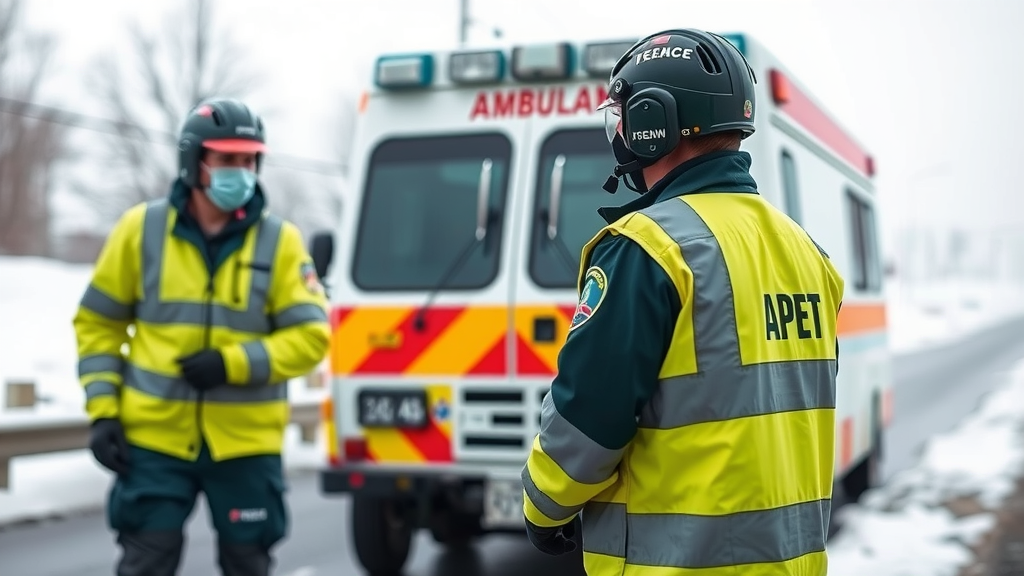
When the June 2021 heat dome settled over the Pacific Northwest and pushed temperatures in British Columbia above 40 degrees Celsius, it was not hospital physicians who reached the majority of the dying first. It was paramedics. More than 600 excess deaths were attributed to heat-related causes during that event, and ambulance crews attended to 54 percent of them. Calls to 911 doubled at the peak of the heatwave, and the burden fell overwhelmingly on people already identified as vulnerable. A new study argues that these frontline responders hold critical, largely untapped knowledge about how climate change is reshaping emergency health care, and that their perspectives demand a place in adaptation planning.
The study, published in the Journal of Emergency and Disaster Medicine, was conducted by Shannon Sherk of the University of Victoria and set out to answer two questions: what ground-level knowledge paramedics and emergency health services employees in British Columbia hold about climate hazards, and what interventions should be proposed to help pre-hospital systems adapt. The research fills a conspicuous gap. While the impacts of climate change on hospital-based clinical care have been documented extensively, the pre-hospital environment, where paramedics work in homes, on streets and along flooded highways, has been almost entirely overlooked. A recent scoping review cited in the paper concluded that no comprehensive study of strategies and solutions for pre-hospital emergency systems against climate change had yet been completed.
To gather evidence, Sherk used a mixed-methods design combining a 16-question survey with in-depth, semi-structured interviews. The survey, distributed through a British Columbia Emergency Health Service-specific Facebook group and word-of-mouth snowball sampling, ran from February 27 to March 9, 2025, and drew 109 respondents. Participants spanned all five of the province’s health regions, with Vancouver Island the most represented at 30 percent. Women comprised 54 percent of the sample, the average length of service with the ambulance service was 8.94 years, and respondents ranged from newly oriented staff to veterans with more than two decades on the road. Three interviews complemented the survey, drawing on a member of management, a union representative and a health and safety representative, all experienced paramedics.
The findings reveal a workforce that is both concerned and largely unsupported. Three-quarters of respondents believed climate change is anthropogenic, a higher proportion than the Canadian population at large, where around a third rejected human causation in 2018. More than three-quarters reported seeing a rise in climate-related hazards during their time with the service. Yet only about one in five had ever attended a climate event, workshop, protest or lecture, a disconnect the author describes as a gap between concern and educational engagement. Perceived impacts on the respondents’ own jobs scored slightly lower than perceived impacts on public health, but both were expected to worsen in the future.
Across every health region, the hazards judged most damaging to public health were the same: wildfires, in both their flames and their smoke, extreme heat, and flooding. Notably, perception did not always track mortality statistics. In 2021, fire-related deaths in the province numbered 59, while the single week of the heat dome killed more than 600. The author suggests this mismatch may indicate that slower, less quantifiable health harms, such as respiratory disease driven by smoke exposure or infectious disease linked to flooding, are being missed when systems respond only to body counts.
The interviews added texture to these numbers. All three interviewees identified hot and cold emergencies as the highest-acuity hazards. Heat deaths during the dome occurred almost exclusively indoors, while cold deaths fell primarily on people living outdoors, particularly homeless individuals whose deaths are often attributed to comorbidities such as overdose rather than exposure. Wildfire smoke emerged as a chronic threat that rarely triggers a 911 call on its own but saturates emergency departments with patients in respiratory distress, degrading capacity for the entire system. Flooding and relentless rain were linked to hypothermia and skin breakdown resembling trench foot, conditions one interviewee summarized by observing that things have gotten soggier in the last five or six years.
Paramedics themselves are far from immune. One described working the heat dome by taping bags of hospital ice to their neck and head between calls. Uniform and personal protective equipment requirements make heat harder to escape than cold, and wildfire smoke degrades respirator filters faster, raising costs and exposure. Responders described colleagues rushing from one cardiac arrest to the next during the dome, and the physical demands of the job continue regardless of air quality warnings, because, as the study puts it, no one chooses where their patient arrests. Extreme weather also severs the logistics of response: flooded roads, fallen trees and closed highways delay ambulances, strand commuting paramedics and force patients who cannot self-transport to depend entirely on ambulance service.
Perhaps the most striking statistical finding concerns politics. Consistent with earlier research, self-reported political orientation correlated with climate views in the survey. But when multiple linear regression was applied, perceived impacts on the respondents’ own jobs emerged as by far the strongest predictor of support for involving health care professionals in climate policy, with a standardized coefficient of 0.492, exceeding the next strongest variable by a margin of 0.3 and remaining significant at p less than 0.01. In other words, paramedics across the political spectrum translated lived experience of climate impacts at work into a desire for institutional action. Only five of 109 respondents rejected climate action outright.
The qualitative data exposed a workforce starved of planning. One 20-year paramedic, writing after three minor earthquakes struck in March 2025, described having no idea what the plan is for a catastrophic disaster, asking what is expected of staff on or off shift, how crews would be relieved, fed or deployed, and pleading for classroom-led rather than online training. Interviewees described management as reactionary rather than proactive, and noted that existing mental health supports rely on self-referral, leaving chronic, cumulative stress from repeated environmental emergencies unaddressed at a time when the service is already grappling with a documented mental health crisis. Interviewees also described how the decline of primary care has pushed sicker patients toward 911, compounding the load.
From these findings, the study distills a disaster-risk framework, hazard multiplied by vulnerability and exposure, divided by capacity, and derives four recommendations: commit to an organizational culture of proactivity that treats disasters as a matter of when, not if; develop region-specific hazard education and planning; integrate weather modelling and forecasting into operational management with early warnings pushed to frontline staff; and build recovery programs designed for multi-incident and chronic stress rather than single traumatic events. The author acknowledges limitations, including the self-selecting sample, the absence of a pilot phase and a scope that excluded climate mitigation topics such as electrifying the ambulance fleet. But the conclusion is pointed: for most paramedics surveyed, climate change is already harming the public, and the emergency health system absorbs that harm. Having triaged the problem, the paper suggests, the pre-hospital system can now move to treatment.
Subject of Research: British Columbia paramedics' perspectives on climate change impacts and adaptation measures for pre-hospital emergency care
Article Title: Triaging the climate crisis: An investigation into British Columbia paramedics’ perspectives on climate change impacts and evidence-based adaptation measures
Article References: Triaging the climate crisis: An investigation into British Columbia paramedics’ perspectives on climate change impacts and evidence-based adaptation measures. (n.d.). https://doi.org/10.1007/s44467-026-00015-y
Image Credits: AI Generated
DOI: 10.1007/s44467-026-00015-y
Keywords: climate change, paramedics, emergency medical services, British Columbia, extreme heat, wildfire smoke, flooding, disaster management, pre-hospital care, climate adaptation, public health, occupational stress
Cite Scienmag News
Sloane Callahan. (September 12, 2026). Paramedics on the Frontline: Survey Reveals Climate Change Is Straining Ambulance Services. Scienmag. https://scienmag.com/paramedics-on-the-frontline-survey-reveals-climate-change-is-straining-ambulance-services/
Sloane Callahan. "Paramedics on the Frontline: Survey Reveals Climate Change Is Straining Ambulance Services." Scienmag, 12 September 2026, https://scienmag.com/paramedics-on-the-frontline-survey-reveals-climate-change-is-straining-ambulance-services/. Accessed 12 September 2026.
Sloane Callahan. "Paramedics on the Frontline: Survey Reveals Climate Change Is Straining Ambulance Services." Scienmag. September 12, 2026. https://scienmag.com/paramedics-on-the-frontline-survey-reveals-climate-change-is-straining-ambulance-services/


