


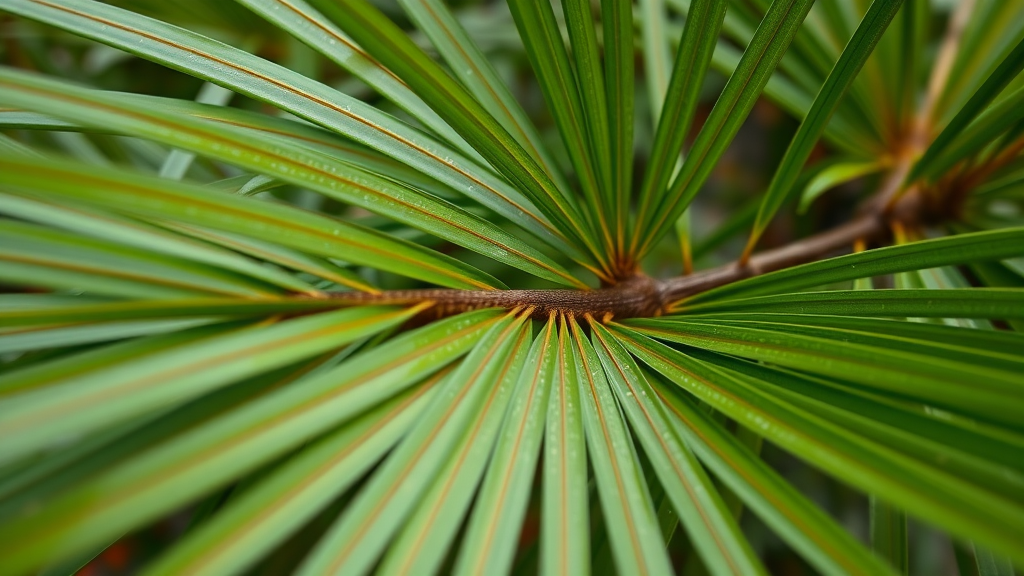
On the tropical island of Mauritius, the screw pine tree—known locally by the name Vacoas—has long been valued for the long, slender leaves that artisans weave into baskets, mats and twine. Now, a team of researchers at the University of Mauritius, working with a collaborator at the Universidade de Vigo in Spain, has found a far more ambitious use for this humble plant. In a study published in the Journal of Materials Science: Polymers, Chitatma Dabee, Enrique Casarejos and Raviduth Ramful report the development of a fully biodegradable composite material built from Pandanus utilis fibres embedded in a polylactic acid (PLA) matrix—a material engineered to match the mechanical ambitions of conventional carbon and glass fibre plastics while leaving almost nothing behind at the end of its life.
The motivation is stark. Composite materials such as carbon fibre reinforced plastics and glass fibre reinforced plastics dominate industries from aviation to wind turbine manufacturing because of their exceptional strength-to-weight ratios, yet their end-of-life story is grim. Recycling these composites is expensive and energy-intensive, and enormous volumes of decommissioned wind turbine blades already pile up in landfills worldwide. Even composites made with natural fibres typically fall short of true sustainability because their binding matrices are synthetic polymers that resist degradation. The Mauritian team set out to close that gap by making both components—the fibre and the matrix—fully biodegradable, drawing on a locally abundant plant species that also offers carbon-offsetting benefits while it grows.
The path from leaf to composite began with mechanical extraction. Fibres were harvested from Pandanus utilis leaves, stripped of their cuticle and epidermal layers using a conventional fibre decorticator, and oven dried at 60 degrees Celsius for 24 hours. The researchers then applied mercerization, an alkali treatment with sodium hydroxide at concentrations of 2.5 and 3.0 percent, to prepare the fibre surfaces for bonding with the PLA matrix. Fourier transform infrared spectroscopy confirmed that the treatment worked at the molecular level: characteristic peaks associated with lignin and hemicellulose—those at roughly 1239 and 1730 wavenumbers—flattened noticeably after treatment, while peaks tied to adsorbed water at 1640 and 3400 wavenumbers also diminished. In practical terms, the alkali bath dissolved much of the lignin and hemicellulose that interferes with adhesion, enriched the fibre in cellulose, and reduced its tendency to draw in moisture.
Composite specimens were fabricated by hand lay-up in aluminium-faced moulds, with chopped fibres of 4, 5 and 6 centimetres randomly arranged between two layers of PLA filament, then melted in an oven at 250 degrees Celsius for one hour, compressed, and cooled gradually to prevent cracking. Fibre loadings of 5, 10 and 15 percent by weight were tested against the pure polymer. Differential scanning calorimetry showed textbook PLA behaviour: a glass transition between roughly 50 and 70 degrees Celsius, crystallization peaks near 120 degrees, melting at 171.2 degrees, and thermal decomposition onset around 275 degrees—evidence that the reinforced material remains thermally stable across ordinary service conditions.
The physical tests revealed a familiar trade-off in biocomposites. Water absorption, measured over a 24-hour immersion following the ASTM D570-98 standard, was negligible for pure PLA but climbed to between 2 and 2.75 percent in the composites, rising consistently with fibre content—a statistically significant effect driven by the hydrophilic nature of natural fibres and by microscopic voids at imperfect fibre-matrix interfaces. Fibre length, by contrast, made no statistical difference. The soil burial test, in which specimens spent 30 days in open soil teeming with aerobic bacteria, told a similar story: specimens with 15 percent fibre lost up to 1.6 percent of their mass, compared with only 0.25 percent for plain PLA, confirming that the material genuinely degrades in a biological environment rather than merely fragmenting.
Mechanically, the sweet spot was unambiguous. Both tensile and flexural performance peaked at a fibre loading of 10 percent by weight, where stress distributes more evenly through the structure. The best flexural result—around 270 newtons of load capacity—came from a specimen with 4-centimetre fibres at 10 percent loading, more than double the 110 newtons that plain PLA could bear. Beyond that optimum, at 15 percent fibre content, performance dropped sharply as fibre-to-fibre crowding reduced matrix dispersion and left insufficient adhesive contact, generating stress concentrations and defects. Analysis of variance confirmed that fibre content, though not fibre length, significantly influenced the strength of the unexposed specimens.
The study’s most sobering finding concerns marine conditions, a critical consideration for a material intended for maritime applications. When a full set of reinforced specimens was submerged in seawater for 30 days before tensile testing, the pattern of results inverted: strength now fell with increasing fibre content, dropping from a high of 1400 newtons at 5 percent fibre to a low of 200 newtons at 15 percent. The researchers attribute this to capillary water penetration that progressively undermined the fibre-matrix interface, compounded by the slow hydrolytic degradation of the PLA matrix itself—a reminder that biodegradability, the material’s central virtue, is also its principal vulnerability in wet service environments.
To see failure coming before it happened, the team turned to digital image correlation, a contactless optical technique that tracks a speckled pattern on the specimen surface through a calibrated camera system during tensile loading. The resulting von Mises strain maps revealed localized hot spots of concentrated strain that reliably predicted where each specimen would ultimately fracture in a brittle mode. These hot spots traced back to manufacturing imperfections—randomized void formation, incomplete fibre-matrix adhesion and minor misalignments of the fibres—demonstrating how internal defects, invisible to the naked eye, orchestrate the failure of a composite long before its average material properties would suggest.
Finally, the researchers built a finite element model of the dog-bone tensile specimen in LS-DYNA, meshing it into nearly 75,000 elements with longitudinally aligned fibre bundles and boundary conditions mirroring the physical test. The simulation showed maximum tensile forces of 1400 newtons for the pristine composite and 600 newtons for the seawater-exposed model—at a displacement of 1.5 millimetres, figures that closely matched the experimental data for equivalent specimens. Crucially, the model confirmed that sea exposure cuts the material’s tensile load-bearing capacity roughly in half. With manufacturing defects addressed and fibre loading optimized near 10 percent, the authors conclude, Pandanus-based composites could offer a genuinely sustainable, high strength-to-weight alternative for everyday structural applications—crafted from a tree that grows, quite literally, along the shoreline where these materials may one day serve.
Subject of Research: Development and characterization of biodegradable Pandanus utilis fibre-reinforced PLA composites
Article Title: Biodegradable Pandanus Utilis fibre-reinforced PLA composites: characterization, mechanical behaviour, and fracture analysis
Article References: Dabee, C., Casarejos, E., & Ramful, R. (2026). Biodegradable Pandanus Utilis fibre-reinforced PLA composites: characterization, mechanical behaviour, and fracture analysis. Journal of Materials Science: Polymers, 1(1), Article 17. https://doi.org/10.1007/s44493-026-00019-0
Image Credits: AI Generated
DOI: 10.1007/s44493-026-00019-0
Keywords: Pandanus utilis, PLA, biodegradable composites, natural fibre composites, mercerization, tensile strength, flexural strength, water absorption, soil degradation, digital image correlation, finite element analysis, seawater exposure
Cite Scienmag News
Denise Maddox. (September 12, 2026). Screwpine Leaves From Mauritius Could Replace Carbon Fibre in Plastics. Scienmag. https://scienmag.com/screwpine-leaves-from-mauritius-could-replace-carbon-fibre-in-plastics/
Denise Maddox. "Screwpine Leaves From Mauritius Could Replace Carbon Fibre in Plastics." Scienmag, 12 September 2026, https://scienmag.com/screwpine-leaves-from-mauritius-could-replace-carbon-fibre-in-plastics/. Accessed 12 September 2026.
Denise Maddox. "Screwpine Leaves From Mauritius Could Replace Carbon Fibre in Plastics." Scienmag. September 12, 2026. https://scienmag.com/screwpine-leaves-from-mauritius-could-replace-carbon-fibre-in-plastics/


