


Pangolins hold the grim distinction of being the most heavily trafficked mammals on Earth, and the smugglers moving them are constantly refining their methods. A new study from Singapore’s Centre for Wildlife Forensics has now put one of the latest trafficking tricks to a rigorous experimental test: processing pangolin scales with high heat and acids before shipping them, apparently to make the scales harder to recognize and their DNA harder to read. The results, published in Discover Conservation, are both a warning and a reassurance. Processing does visibly transform the scales, but it fails to erase the diagnostic features that betray a scale’s pangolin origin, and it falls well short of destroying the genetic evidence hidden inside.
The research team, led by Max De Yuan Khoo, focused on the Sunda pangolin (Manis javanica), a Critically Endangered species found across Southeast Asia and a frequent victim of regional trafficking. Demand for pangolin scales is driven largely by Traditional Chinese Medicine, where they are used for ailments ranging from poor circulation to insufficient lactation. Because overexploitation has devastated Asian populations, traffickers have increasingly turned to African pangolins, shipping tonnes of scales in maritime containers disguised among legal goods. In 2019, Singapore authorities intercepted three shipments totaling 37.5 tonnes of scales hidden in containers falsely declared as frozen beef, timber, and cassia seeds.
Historically, most seizures involved raw or dried scales that retain their natural appearance and are relatively easy to identify visually. Genetic studies have long confirmed that DNA barcoding works well on such material. But recent enforcement reports, corroborated at an Interpol–NParks Pangolin Identification Workshop in Singapore in October 2024, describe a shift toward trafficking scales that have already undergone intensive processing, such as the deep-frying and sand-frying traditionally applied before scales are ground into medicinal powder. Processing earlier in the supply chain could theoretically help traffickers disguise scales as ordinary dried goods like cassava chips, while heat and chemicals are known in food and forensic science to fragment DNA and cripple PCR amplification.
To test whether that strategy actually works, the team obtained scales from four Sunda pangolins killed on Singapore’s roads and recovered by the National Parks Board between December 2024 and May 2025, along with a fifth set of decades-old surrendered scales of unknown provenance. Fifteen trunk scales per animal were air-dried for at least two weeks, then measured for width, length, thickness, and manually assessed hardness. Three scales from each set were assigned to each of four treatments, all heating scales to around 200 degrees Celsius: deep frying in vegetable oil, frying in hot sand with oil, frying in sand followed by a 48-hour quench in vinegar at roughly pH 2.0, and roasting over charcoal. Fifteen unprocessed scales served as controls, giving 75 scales in total.
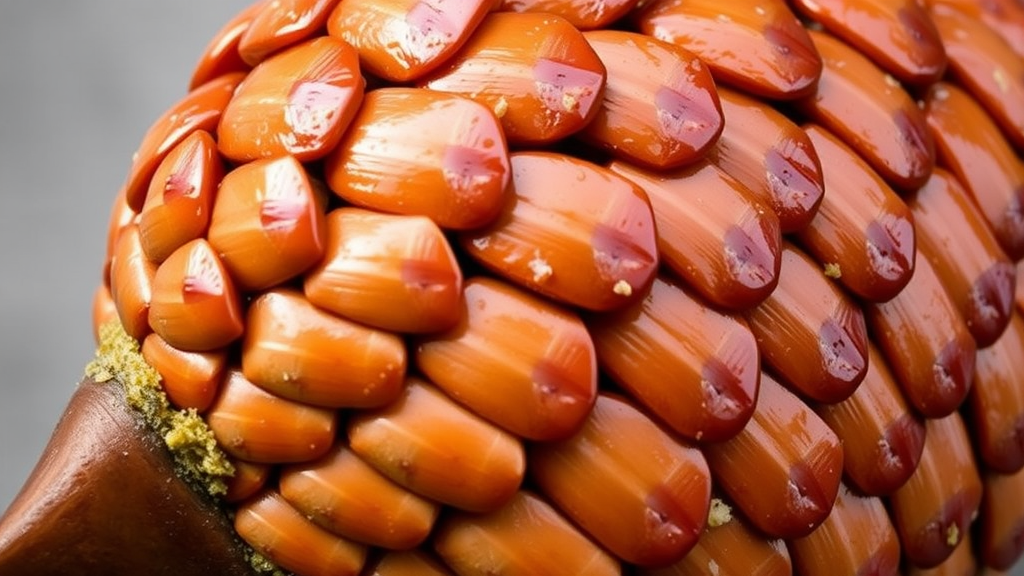
The physical transformation was dramatic. Across all treatments, scales thickened by an average of about 119 percent, with deep frying producing the most extreme swelling at nearly 206 percent. Width shrank by an average of 22.5 percent and length by 12.6 percent, and the scales turned yellow, grew brittle, blistered, curled, and occasionally developed burn marks. Yet crucially, the characteristic grooves and the scale bed—the structure where the scale attaches to the skin—survived every treatment. Because all four methods produced broadly similar appearances, the researchers compiled a visual identification guide, complete with ten common lookalike materials, that customs officers can use to spot processed pangolin scales even when they are mixed into shipments of legitimate dried goods.
On the genetic side, the team extracted DNA from tissue at the base of each scale, quantified it with a Qubit fluorometer and TapeStation instrument, and amplified a short 307-base-pair fragment of the mitochondrial cytochrome b gene, a marker short enough for degraded DNA yet variable enough to separate all pangolin species. Sequences were matched against the NCBI GenBank database, with a successful identification requiring a greater than 98 percent match to Manis javanica. Bayesian logistic regression models then estimated how DNA quantity and processing type influenced identification success, with random effects accounting for scales from the same individuals.
The findings defied expectations. DNA quantity turned out to be a weak predictor of success: even samples falling below the detection limits of the Qubit and TapeStation frequently yielded sequences good enough for definitive species assignment. The model-estimated probability of successful identification across all processing treatments averaged 89.7 percent. Roasting preserved DNA best, with a 98.9 percent identification probability, likely because uneven single-direction heating and an early stop before charring left much of the genetic material intact. Frying with sand and oil achieved 92.2 percent, deep frying 84.4 percent, and the harshest treatment—sand-frying followed by vinegar quenching, which combines thermal damage with acid-driven DNA breakage—still managed 76.3 percent. Every unprocessed control scale was successfully identified.
Even the decades-old surrendered scales offered a hopeful surprise: eight of twelve produced successful species identifications, providing preliminary evidence that DNA can persist in aged keratin despite prolonged storage. The authors attribute the overall resilience to the high copy number and protective packaging of mitochondrial DNA, and to the deliberately short PCR target, which suits fragmented genetic material. Sanger sequencing with conventional PCR remains the forensic gold standard, making this workflow practical for enforcement laboratories in resource-limited settings without requiring expensive next-generation sequencing.
Although the study used only the Sunda pangolin, the authors argue the findings generalize across all eight pangolin species, since their scales share similar keratin composition and undergo comparable processing in trade. The persistence of the scale bed after processing stands out as the single most reliable visual cue that a specimen is a pangolin scale, regardless of species. Future work should validate these patterns in African pangolins, whose scales differ somewhat in size and structure.
The takeaway for wildlife forensics is an integrative one: morphology offers a rapid, cheap first line of assessment in the field, while molecular tools provide confirmation and species-level resolution in the lab. For traffickers hoping that a hot wok and a bath of vinegar could launder their contraband into anonymity, the message from science is blunt—processed pangolin scales still look like pangolin scales, and what DNA survives is more than enough to convict them.
Subject of Research: The effects of trade-related processing treatments on the morphology and genetic identifiability of trafficked pangolin scales
Article Title: Assessing pangolin scale morphology and genetic identifiability following varied processing treatments
Article References: Khoo, M. D. Y., Yeo, D., Hiong, K. C., Ong, J., Wee, A., Chan, A. H. J., Li, S., Ping, X., Zeng, Y., Xie, R., How, C. B., Fernandez, C. J., Wong, A. M. S., & Chang, S. F. (2026). Assessing pangolin scale morphology and genetic identifiability following varied processing treatments. Discover Conservation, 3(1), Article 33. https://doi.org/10.1007/s44353-026-00103-0
Image Credits: AI Generated
DOI: 10.1007/s44353-026-00103-0
Keywords: pangolins, wildlife forensics, Sunda pangolin, illegal wildlife trade, DNA barcoding, traditional Chinese medicine, scale morphology, DNA degradation, cytochrome b, species identification, wildlife trafficking, conservation
Cite Scienmag News
Margaret Porter. (September 12, 2026). Fried, Roasted, or Quenched in Vinegar: Pangolin Scales Still Give Away Their Secrets. Scienmag. https://scienmag.com/fried-roasted-or-quenched-in-vinegar-pangolin-scales-still-give-away-their-secrets/
Margaret Porter. "Fried, Roasted, or Quenched in Vinegar: Pangolin Scales Still Give Away Their Secrets." Scienmag, 12 September 2026, https://scienmag.com/fried-roasted-or-quenched-in-vinegar-pangolin-scales-still-give-away-their-secrets/. Accessed 12 September 2026.
Margaret Porter. "Fried, Roasted, or Quenched in Vinegar: Pangolin Scales Still Give Away Their Secrets." Scienmag. September 12, 2026. https://scienmag.com/fried-roasted-or-quenched-in-vinegar-pangolin-scales-still-give-away-their-secrets/


