


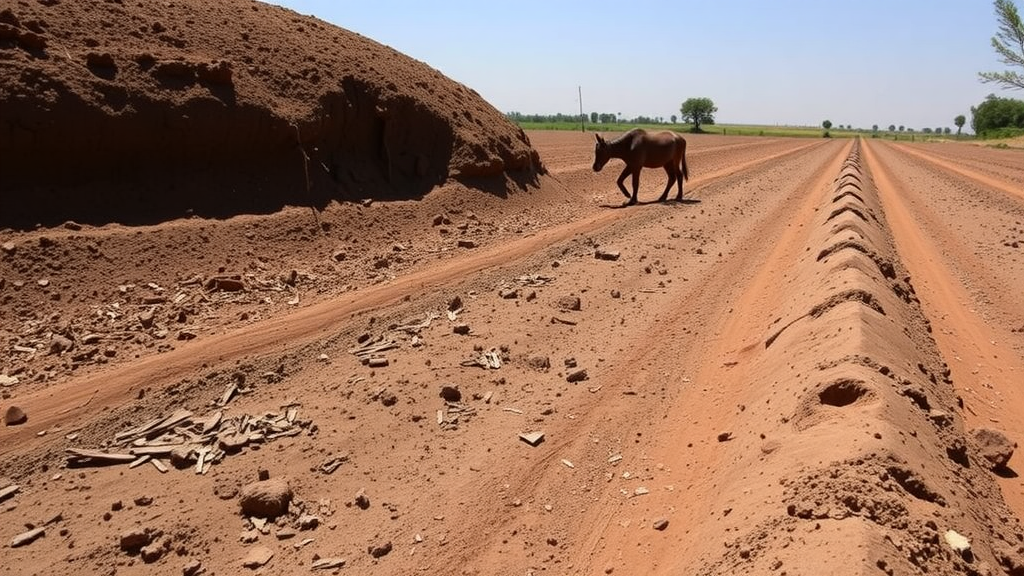
In the eroded hills above Lake Hawassa in Ethiopia’s Rift Valley, millions of dollars’ worth of labor has been poured into stone and earthen barriers designed to hold a landscape together. A new study reveals that a substantial share of these structures is quietly falling apart, dismantled by the very farmers they were meant to help, and the reasons behind that retreat are more economic than ecological. Researchers from Hawassa University surveyed 266 farm households in the western watershed of Lake Hawassa, in the Sidama regional state, and found that while soil erosion is almost universally recognized as a threat, the fate of physical soil and water conservation measures hinges on family size, farm area, livestock wealth, and the age of the household head rather than on training or credit access.
The findings arrive against a sobering backdrop. Ethiopia loses an estimated two billion tons of soil every year to erosion, roughly half of it from cultivated land, and the country’s average annual soil loss of about 30 tons per hectare far outpaces the estimated soil formation rate of 10 tons per hectare per year. In the Lake Hawassa watershed specifically, previous research has measured losses of around 37 tons per hectare per year, feeding silt into a lake whose water quality and ecosystem have visibly declined. More than half of the land in sub-Saharan Africa is considered too degraded or infertile for reliable crop production, and Ethiopia’s highlands, where most of the population and livestock are concentrated, sit at the epicenter of the crisis.
Ethiopia has responded with one of the longest-running conservation programs in Africa. Institutionalized soil and water conservation began about half a century ago, initially delivered through food-for-work schemes in the 1970s and 1980s that paid grain to farmers in drought-prone areas for building soil bunds and Fanya juu terraces. These structures are technically simple: a channel roughly 50 centimeters deep and wide is dug along the contour, with excavated soil piled downslope to form a bund, or upslope in the case of Fanya juu, creating a barrier that intercepts runoff. Yet early experience showed that technology introduced through incentives struggled to survive once the payments stopped, because participation was tied to the reward rather than to conviction. In recent decades, nationwide mass-mobilization campaigns, sustainable land management programs, the Productive Safety Net Programme, and non-governmental organizations have pushed conservation onto farmland at remarkable scale.
In the three study districts, known locally as kebeles, that scale is measurable: the district agriculture office reported that 1,138 kilometers of soil bunds and 389 kilometers of Fanya juu were constructed between 2018 and 2025 through various schemes. The researchers classified households as adopters, whose structures remained functional over five years; dis-adopters, whose bunds had been dismantled, overtaken by sediment, or allowed to collapse; and non-adopters, with no structures built in at least five years. Of the adopters, about 72 percent said the measures on their land were built through public campaigns, coordinated by local government and relying on free communal labor for roughly 30 days each year, while fewer than 9 percent attributed construction to paid projects. Nearly three-quarters of adopters had invested their own or their family’s labor in the construction, a factor the authors link to stronger stewardship of the finished structures.
The survey results expose a sharp divide in how farmers perceive the problem itself. About 82 percent of all respondents had observed soil erosion on their farmland in the past decade, describing rills cutting through maize fields, exposed plant roots, thinning topsoil, and shrinking harvests. More than 65 percent of adopters strongly agreed that erosion reduces soil fertility, soil depth, and crop yield. But among dis-adopters, nearly half strongly disagreed with those statements, a blind spot the researchers suggest may partly explain why they abandoned the structures. Erosion in its least visible form, sheet flow that peels away soil more or less evenly, is easy to underestimate, and farmers on flatter land were the least likely to perceive any threat at all: 74 percent of non-adopters rated erosion on their fields as negligible to slight, against only 8 percent of adopters.
When the researchers ran a multinomial logistic regression on the socioeconomic variables, three factors emerged as statistically significant drivers of adoption. Each additional hectare of farmland nearly tripled the odds of adoption, with an odds ratio of 2.93, an effect the authors attribute to the fact that bunds occupy between 2 and 20 percent of cultivable area depending on slope, a painful sacrifice for farmers with tiny plots. Livestock holdings, measured in tropical livestock units as a proxy for household wealth, also raised the odds of adoption significantly. Most striking was perceived erosion severity, which multiplied the odds of adoption by 3.48. Farmers who see the damage are the ones who keep the barriers standing. By contrast, education, land certificates, credit access, off-farm income, and even participation in conservation training had no significant effect, likely because public campaigns and project labor delivered structures to households regardless of these characteristics.
Dis-adoption told its own statistical story. The probability of abandoning conservation structures rose with the age of the household head, increasing by roughly 9 percent per year of age, an effect consistent with the physical demands of maintenance. Bunds require continuous repair: sediment accumulates, runoff breaches the risers, and cultivation too close to the structure causes collapse. Larger families, greater livestock holdings, and stronger perception of erosion all significantly reduced the likelihood of dis-adoption, pointing to labor availability and economic capacity as the decisive resources. Where family labor is scarce or diverted to other farming tasks, smallholders cannot afford the upkeep, and the structures decay. The authors also flag a subtler institutional problem: because most bunds are built with free campaign labor or external funding, farmers who contributed little to construction feel little obligation to maintain them, expecting that outside help will return.
The perception gap extends to the benefits. More than 80 percent of adopters agreed that the measures control runoff, improve soil fertility and moisture, boost fodder and grass supply, and raise crop yields. Yet after years of promotion and awareness campaigns, around 40 percent of dis-adopters and nearly a third of non-adopters still disputed these benefits, a skepticism the researchers connect to the slow, incremental way bunds improve soil. Among non-adopters, 30 percent said their land was not eroding enough to warrant structures, and 36 percent objected that bunds consume scarce cultivable land. Labor shortages were cited by 22 percent. Encouragingly, some resistance is pragmatic rather than stubborn: about a third of dis-adopters and non-adopters protect their fields with traditional cutoff drains and planting instead, and roughly 48 percent of dis-adopters said they intend to rebuild their structures, citing erosion control and land productivity.
The study’s conclusions carry weight well beyond one Ethiopian watershed. Physical conservation structures are expensive and labor-hungry, and where their survival depends on annual mass mobilization rather than farmer ownership, the investment is at risk of evaporating one broken bund at a time. The authors argue that sustainable management will require locally agreed bylaws and extension monitoring to enforce repair, alongside planning that accounts for the specific socioeconomic profiles of households, the age of farmers, the size of their plots, and the depth of their perception of erosion. With the pressure on land intensifying as fallow periods shrink and marginal slopes are cultivated, and with climate change delivering longer dry spells punctuated by intense rainfall, the window for keeping Ethiopia’s soil on its fields is narrowing. The evidence from Lake Hawassa suggests that the cheapest insurance for these landscapes is not another campaign, but farmers convinced enough, and resourced enough, to maintain what has already been built.
Subject of Research: Adoption and dis-adoption of physical soil and water conservation measures by smallholder farmers in the Ethiopian Rift Valley
Article Title: Physical soil and water conservation measures in the Rift Valley area of Ethiopia: adoption and management challenges
Article References: Wolka, K., Daniel, K., & Gesesse, G. (2026). Physical soil and water conservation measures in the Rift Valley area of Ethiopia: adoption and management challenges. Environmental Challenges, Article 101656. https://doi.org/10.1016/j.envc.2026.101656
Image Credits: AI Generated
DOI: 10.1016/j.envc.2026.101656
Keywords: soil erosion, soil and water conservation, Ethiopia, Lake Hawassa, soil bunds, Fanya juu, adoption, dis-adoption, land degradation, smallholder farmers, Rift Valley, watershed management
Cite Scienmag News
Sloane Callahan. (September 12, 2026). Why Ethiopian Farmers Abandon Soil Bunds Built to Save Their Land. Scienmag. https://scienmag.com/why-ethiopian-farmers-abandon-soil-bunds-built-to-save-their-land/
Sloane Callahan. "Why Ethiopian Farmers Abandon Soil Bunds Built to Save Their Land." Scienmag, 12 September 2026, https://scienmag.com/why-ethiopian-farmers-abandon-soil-bunds-built-to-save-their-land/. Accessed 12 September 2026.
Sloane Callahan. "Why Ethiopian Farmers Abandon Soil Bunds Built to Save Their Land." Scienmag. September 12, 2026. https://scienmag.com/why-ethiopian-farmers-abandon-soil-bunds-built-to-save-their-land/


