


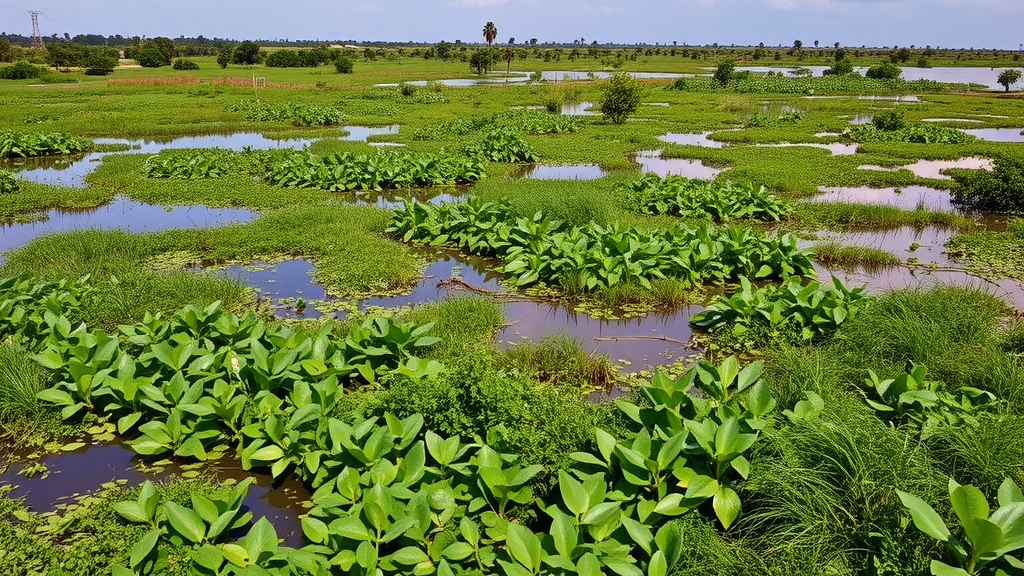
Along Ghana’s eastern coastline, where the Volta River meets the Atlantic, lies one of West Africa’s most ecologically significant wetland systems. The Ada-Songhor wetland area, a designated Ramsar site of international importance, has long sustained fishing, salt winning, farming, and grazing communities whose livelihoods are woven into its lagoons, floodplains, and mangrove stands. A new study published in the journal Environmental Management offers the most detailed picture yet of how this landscape has changed over the past three decades, and the numbers are stark. Combining satellite imagery analysis with extensive stakeholder interviews, researchers documented a 47 percent loss of vegetation cover and a 303 percent increase in bare land across the Ada-Songhor area, transformations driven overwhelmingly by human activity. Yet the research also tells a second, more hopeful story: state agencies and local communities, often cast as adversaries in conservation conflicts, have been co-producing conservation practices that are helping to safeguard what remains.
The research team, led by Louis Kusi Frimpong of the University of Environment and Sustainable Development in Somanya, Ghana, together with colleagues at the University of Memphis, the University of Pittsburgh, and the University of Ghana, set out with three aims. First, they mapped land cover changes and identified the drivers behind them. Second, they examined the conservation practices currently deployed in the wetland and how these practices affect both livelihoods and ecological protection. Third, they investigated whether commons-based governance mechanisms, including trust, participation, and institutional coordination, could improve wetland governance outcomes. The approach reflects a growing recognition in conservation science that satellite data alone cannot explain why landscapes degrade, because the trajectories of ecosystems are inseparable from the institutions, economies, and power relations that shape how people use land.
Technically, the study employed a case study research design that integrates remote sensing with qualitative social science. Satellite imagery spanning roughly thirty years was classified into land cover categories, allowing the team to quantify the conversion of vegetated areas into bare surfaces and to track the spatial pattern of these changes across the wetland complex. The 47 percent vegetation loss and the more than fourfold expansion of bare land are not uniform across the landscape; they cluster around areas of intensive anthropogenic pressure, including expanding settlement, salt mining operations, sand and stone quarrying, and agricultural conversion. The district’s population grew from about 130,795 in 2010 to a combined 152,498 in 2021 across the Ada East and Ada West districts created by an administrative split, and this demographic pressure compounds the direct exploitation of wetland resources.
The interviews, conducted with a broad range of stakeholders, reveal a governance landscape marked by conflicting rationalities. State institutions responsible for wetland protection operate under legal frameworks including Ghana’s Wetland Management (Ramsar Sites) Regulations of 1999 and the Forestry Commission Act of 1999, yet enforcement capacity is limited and land tenure in the area is governed by a complex coalescence of customary ownership and state administration. Community members, for their part, depend on the wetland for fishing, salt production, fodder, and fuelwood, and many perceive conservation restrictions as threats to survival rather than as shared stewardship obligations. Previous work by members of the same team had documented these stakeholder conflicts in detail; the new study shifts the question from who is to blame toward what forms of collective management can actually work on the ground.
The theoretical lens the researchers bring to this question is convivial conservation, an approach developed by Bram Büscher and Robert Fletcher that proposes humans and nature should thrive together rather than be separated into protected zones and sacrifice areas. Convivial conservation moves away from fortress-style protection, which fences ecosystems off from the people who live in and around them, and toward practices that weave livelihoods and biodiversity into a single, negotiated space. The concept draws intellectual roots from Ivan Illich’s notion of conviviality, from commons scholarship associated with Elinor Ostrom, and from political ecology’s insistence that conservation is never socially neutral. In the Ada-Songhor context, the study finds that convivial practices are not merely theoretical: they emerge concretely in state-community collaborations that blend formal regulation with community-based rules, allowing resource use to continue in negotiated forms while penalizing the most destructive activities.
Central to these collaborations are what the authors describe as commons-based approaches. Drawing on Ostrom’s design principles for governing common-pool resources, the study highlights the roles of trust between communities and state actors, genuine participation in decision-making rather than token consultation, and institutional coordination across the fragmented agencies with jurisdiction over wetlands, fisheries, lands, and local government. The findings show that where these elements are present, communities are more willing to monitor and report destructive practices, to participate in restoration activities, and to accept restrictions on resource extraction. Where trust is absent, enforcement collapses into confrontation, and degradation accelerates. This aligns with a broader empirical literature showing that community monitoring and co-management arrangements improve common-pool resource outcomes across diverse contexts, from forests under REDD+ programs to small-scale fisheries.
The livelihoods dimension is where the study’s findings become particularly demanding. Any conservation regime in the Ada-Songhor wetland must reckon with the fact that salt winning, fishing, and farming are not marginal activities but the economic backbone of households in one of Ghana’s poorer coastal districts. The researchers found that conservation practices succeed when they are socially attuned, meaning they protect livelihood options while excluding the practices that cause the most ecological harm, such as unregulated sand mining and vegetation clearing. This echoes evidence from elsewhere in sub-Saharan Africa that wetland degradation directly undermines the livelihoods and wellbeing of the poor, and that restoration programs affect household income and livelihood structure in complex ways. The Ada case suggests that wetland protection and poverty alleviation are not inherently opposed, but reconciling them requires institutional designs that give communities both voice and a stake in outcomes.
The stakes of getting this right extend well beyond one Ghanaian district. Wetlands rank among the planet’s most valuable ecosystems, delivering water purification, flood regulation, carbon storage, and critical habitat for migratory birds and aquatic species, yet they are disappearing faster than almost any other ecosystem type. Across the rapidly urbanizing Global South, wetlands face intense socio-ecological pressure as cities expand, land values rise, and climate change alters hydrological regimes. Ghana’s wetlands, protected on paper under the Ramsar Convention since the 1990s, illustrate a widespread gap between formal designation and effective management. The Ada-Songhor findings contribute to a growing body of scholarship arguing that this gap is best closed not through stricter top-down control alone, but through polycentric governance in which state institutions, customary authorities, and community organizations share responsibility and coordinate their efforts.
The study is not uncritical about the difficulties. The researchers emphasize the socio-ecological and governance complexities of wetland management, noting that even collaborative arrangements must continually negotiate tensions between conservation goals and immediate economic needs, between formal law and customary norms, and between national policy commitments and local realities. Spatial data show that degradation has continued despite existing protections, a reminder that institutional innovation is urgent rather than optional. The authors argue that their findings underscore the benefits of collaborative, well-coordinated, and socially attuned management practices for protecting ecologically sensitive areas, and they call for a renewed sense of ecological stewardship in endangered regions. For the Ada-Songhor wetlands, the message is clear: the landscape’s future will be decided not in a single agency’s office or a village meeting, but in the ongoing, imperfect, and essential negotiations between the people who live from the wetland and the institutions charged with protecting it.
Subject of Research: Wetland land cover change and convivial, commons-based conservation governance in the Ada-Songhor wetland area of Ghana.
Article Title: Negotiating Wetlands: Convivial Conservation and Collective Wetland Management in Ada, Ghana
Article References: Frimpong, L. K., Mensah, S. L., Okyere, S. A., Gbedemah, S. F., & Oteng-Ababio, M. (2026). Negotiating Wetlands: Convivial Conservation and Collective Wetland Management in Ada, Ghana. Environmental Management, 76(9), Article 309. https://doi.org/10.1007/s00267-026-02613-y
Image Credits: AI Generated
DOI: 10.1007/s00267-026-02613-y
Keywords: Ada-Songhor wetland, Ghana, convivial conservation, wetland governance, commons, land cover change, Ramsar site, community-based management, livelihoods, stakeholder participation, remote sensing, coastal wetlands
Cite Scienmag News
Margaret Porter. (September 12, 2026). Ghana’s Ada Wetlands Lost Half Their Vegetation, Communities Fight Back. Scienmag. https://scienmag.com/ghanas-ada-wetlands-lost-half-their-vegetation-communities-fight-back/
Margaret Porter. "Ghana’s Ada Wetlands Lost Half Their Vegetation, Communities Fight Back." Scienmag, 12 September 2026, https://scienmag.com/ghanas-ada-wetlands-lost-half-their-vegetation-communities-fight-back/. Accessed 12 September 2026.
Margaret Porter. "Ghana’s Ada Wetlands Lost Half Their Vegetation, Communities Fight Back." Scienmag. September 12, 2026. https://scienmag.com/ghanas-ada-wetlands-lost-half-their-vegetation-communities-fight-back/


