


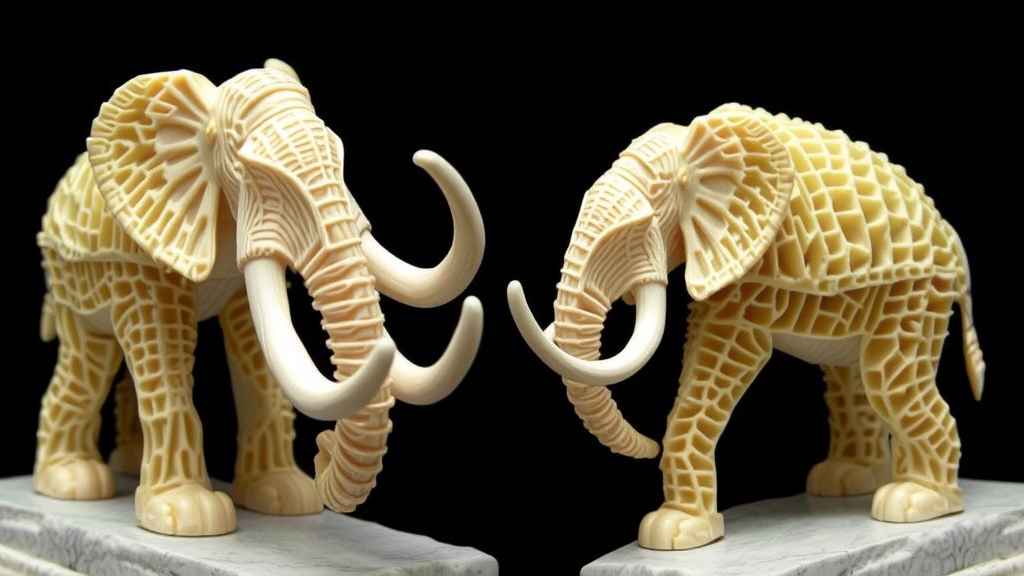
More than twenty thousand years ago, on a terrace above the Desna River in what is now northern Ukraine, the hunter-gatherers of the Upper Palaeolithic site of Mizyn, often rendered in earlier literature as Mezin, carved some of the most celebrated portable art of the Ice Age. A new study published in the journal Heritage argues that the designs of these figurines were not free inventions of the human imagination alone. Instead, the researchers propose that the internal structure of mammoth ivory itself, with its layered anatomy of cementum, dentine and pulp cavity, supplied a template that the carvers followed, adapted and translated into the geometric ornament and formal vocabulary that make the Mizyn figurines so distinctive in the record of early symbolic expression.
Mammoth ivory is not simply an ancient analogue of elephant tusk used as a passive raw material. It is a biological composite with a highly ordered internal architecture. A tusk grows from the pulp cavity outward, depositing concentric layers of dentine marked by fine incremental lines, and is sheathed in an outer rind of cementum. In cross-section the material reveals radial features known as Schreger lines, the angle of which differs between the outer and inner zones of the tusk, while in longitudinal section the growth layers run in directions dictated by the natural curvature of the tusk. Any craftsperson who worked ivory repeatedly over a lifetime would have encountered these structures: the split that follows a growth layer, the fibrous pull of the dentine, the hard, dense cementum shell that behaves differently from the interior. The new analysis suggests that the Mizyn carvers did not treat such features as obstacles but as affordances, working with the grain of the material so that the natural zoning of the tusk became part of the design itself.
The Mizyn assemblage, excavated from a well-preserved Upper Palaeolithic dwelling complex, includes several small figurines carved from mammoth ivory, most famously a group of female statuettes interpreted by many archaeologists as representations of the female form, together with decorated objects that carry dense networks of meandering lines, chevrons and bands. These ornaments have long been discussed in the archaeological literature as some of the earliest examples of complex geometric design in Europe, and competing explanations have been offered for their meaning, from calendrical notations and symbolic counting systems to purely aesthetic or social functions. The new study reframes the question by directing attention away from iconography alone and toward the interaction between carver and material, asking what the ivory itself contributed to the finished forms.
The central claim of the research is that specific anatomical zones of the tusk map onto specific elements of the figurines. The outer cementum layer, which is thin, hard and texturally distinct, is proposed to correspond to the banded and ribbed elements of the decoration, so that the carver deliberately exposed or accentuated the natural surface zone rather than removing it. The underlying dentine, with its layered and fibrous character, is linked to the smoothly modelled volumes of the figurine bodies, where the material could be shaped along its growth lines with less risk of splitting. Where the pulp cavity once lay, the carving in some cases produced hollows or depressions that were then incorporated into the design. In this reading, the sinuous ornament that covers the Mizyn figurines echoes the very layering of the tusk from which they were made, a formal echo produced by following the internal architecture rather than fighting it.
From a technical standpoint, the argument rests on the correspondence between the directional properties of ivory and the orientation of the carved features. Ivory splits predictably along and between growth layers, and it behaves differently in tangential and radial planes, so a carver who wished to avoid fracture would align cutting directions with the natural structure of the material. The study’s authors point out that the recurring placement of parallel line groups and banded ornament on the figurines is consistent with the exposure of natural layering planes, and that the overall silhouettes of several pieces can be understood as the result of detaching suitable blanks from particular zones of the tusk. The curvature of a mammoth tusk, which is strongest near the pulp cavity and gentler toward the outer wall, imposes its own geometry on any elongated object cut from it, and the figurines appear to reflect that imposed geometry in their profiles and proportions.
This material-driven interpretation has significant implications for how archaeologists read Upper Palaeolithic art more broadly. If the ornament and form of the Mizyn figurines arose in part from the structure of the raw material, then the designs should not be decoded as if they were arbitrary symbols written onto a neutral surface. Instead, they represent a dialogue between maker and material, in which the carver’s knowledge of tusk anatomy, accumulated through generations of working ivory for tools, ornaments and architecture, shaped what was visually possible and meaningful. The famous meander patterns of Mizyn, sometimes compared to painted decoration on later ceramics, may in this light be understood as design conventions that emerged from the layered appearance of ivory itself, then standardised and repeated across multiple objects because the structure of the material invited that particular visual language.
The claim also speaks to a long-standing debate about the origins of representation. Traditional accounts of Palaeolithic figurines emphasise either naturalistic imitation of the human body or symbolic abstraction, treating the choice of material as secondary. The Mizyn study belongs to a growing body of work that places the material at the centre of the creative process, a perspective sometimes described as material engagement. On this view, the properties of ivory did not merely constrain the carvers; they actively suggested forms. The natural zones of the tusk offered a ready-made differentiation of surface and interior, hard and soft, outer and inner, which the figurines appear to exploit in rendering contrast between the decorated exterior of a body and its smooth volumes. The result, the authors argue, is an art style co-authored by the biology of the mammoth and the skill of the human hand.
The research also carries implications for the study of mammoth ivory exploitation in the East European Plain, where sites such as Mizyn are famous above all for their monumental architecture built from deliberately arranged mammoth bones and skulls. Understanding how the internal structure of ivory guided the design of small carvings adds a fine-grained dimension to what is already known about how intensively these communities engaged with mammoth remains. The same anatomical knowledge that allowed a carver to predict how a tusk would split for a projectile point or an ornament blank also governed the production of figurines, suggesting a unified technological system in which subsistence technology and symbolic production shared a single body of craft expertise. In that sense, the figurines are documents not only of Ice Age belief or aesthetics but of a sophisticated practical understanding of a difficult and highly valued raw material.
For the wider public, the study offers a striking image: an Ice Age artist in Ukraine holding a fragment of mammoth tusk, reading its layered interior the way a carpenter reads the grain of wood, and finding within that ancient biological structure the lines, bands and forms that would become one of the signature styles of the European Upper Palaeolithic. If the authors are correct, the celebrated figurines of Mizyn are, in a very literal sense, portraits of the material from which they were made, and the mammoth that grew the tusk deserves to be counted among the anonymous collaborators who shaped the earliest art of the region.
Subject of Research: The influence of mammoth ivory's internal structure on the design of Upper Palaeolithic figurines at Mizyn, Ukraine.
Article Title: Internal structure of Mammoth ivory inspired the design of Mizyn (Ukraine) Upper Palaeolithic figurines
Article References: Radchenko, S., Naumenko, O., Kiosak, D., Mansrud, A., Needham, A., & Little, A. (2026). Internal structure of Mammoth ivory inspired the design of Mizyn (Ukraine) Upper Palaeolithic figurines. npj Heritage Science. https://doi.org/10.1038/s40494-026-02988-5
Image Credits: AI Generated
DOI: 10.1038/s40494-026-02988-5
Keywords: Mizyn, Mezin, mammoth ivory, Upper Palaeolithic, figurines, portable art, Ukraine, tusk structure, cementum, dentine, Ice Age art, material engagement
Cite Scienmag News
Courtney Benton. (September 12, 2026). Mammoth Ivory’s Inner Structure Inspired Ice Age Figurines from Mezin. Scienmag. https://scienmag.com/mammoth-ivorys-inner-structure-inspired-ice-age-figurines-from-mezin/
Courtney Benton. "Mammoth Ivory’s Inner Structure Inspired Ice Age Figurines from Mezin." Scienmag, 12 September 2026, https://scienmag.com/mammoth-ivorys-inner-structure-inspired-ice-age-figurines-from-mezin/. Accessed 12 September 2026.
Courtney Benton. "Mammoth Ivory’s Inner Structure Inspired Ice Age Figurines from Mezin." Scienmag. September 12, 2026. https://scienmag.com/mammoth-ivorys-inner-structure-inspired-ice-age-figurines-from-mezin/


