


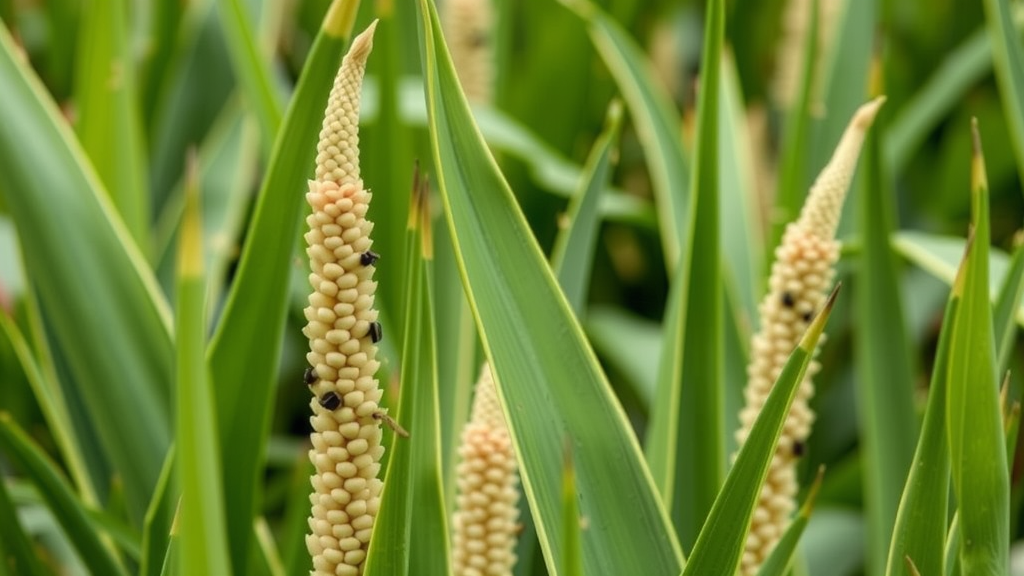
Maize is one of the most consequential crops on the planet, feeding billions of people and anchoring agricultural economies across continents. Yet even as breeders race to develop varieties that can withstand cold snaps, droughts, and degraded soils, a surprising amount of the crop’s genetic playbook has remained hidden from view. A new study published in Plant Molecular Biology pulls back the curtain on one small but critically important piece of that playbook: the 4-coumarate:CoA ligase, or 4CL, gene family, a collection of enzymes sitting at the heart of the phenylpropanoid pathway that shapes how maize builds its tissues and battles environmental stress.
The research, led by Jingbing Zhao and colleagues at the College of Agriculture of Ningxia University in Yinchuan, China, takes an approach that has become one of the most powerful ideas in modern plant genomics: the pan-genome. Rather than mapping genes against a single reference genome, the team surveyed 26 genetically diverse maize inbred lines, capturing the full spectrum of genetic variation that a single reference would miss. Out of this panoramic view, they identified 13 Zm4CL genes, of which nine were classified as core genes, present in essentially all lines, and four were near-core genes, absent from a small subset of genotypes. That distinction matters more than it might sound, because genes that vary in their presence across the species are often the very ones that help plants adapt to particular environments.
Phylogenetic analysis sorted the 13 Zm4CL genes into three evolutionary clades, hinting at an ancient history of gene duplication and divergence within the grass lineage. The team then probed the evolutionary forces acting on these genes by calculating the ratio of nonsynonymous to synonymous substitution rates, the widely used Ka/Ks metric. For most members of the family, the results pointed to purifying selection, the genomic equivalent of a strict quality-control regime in which harmful mutations are weeded out because the protein’s function is too important to compromise. But a handful of genes showed signs of relaxed evolutionary constraint, suggesting they may have been free to explore new or specialized functions during maize’s diversification, a pattern consistent with the way duplicated genes often partition ancestral roles or acquire novel ones.
Perhaps the most provocative finding came from the team’s examination of structural variations, large-scale differences in DNA sequence that include deletions, insertions, and rearrangements. Long overshadowed by single-letter changes in the genetic code, structural variants have emerged in recent years as major drivers of trait variation in crops. In this study, structural variations were significantly associated with the expression levels of two key family members, Zm4CL2 and Zm4CL3. In other words, the same gene can behave very differently in different maize lines simply because the surrounding or intervening DNA architecture differs. Sequence comparisons went a step further, revealing that in some genotypes structural variations were linked to alterations in conserved protein domains, the functional workhorses of the enzyme itself. A change of that kind could plausibly alter not just how much enzyme a plant produces, but what that enzyme can actually do.
Why does any of this matter for the plant? The 4CL enzymes occupy a pivotal junction in the phenylpropanoid pathway, the metabolic assembly line that converts phenylalanine into an astonishing array of compounds, including lignin, flavonoids, and assorted defensive molecules. Lignin, the tough polymer that stiffens cell walls, is indispensable for structural integrity and water transport, but it also influences how digestible maize stover is for livestock and how easily cellulose can be extracted for biofuels. Previous work on maize brown midrib mutants, in which 4CL1 function is disrupted, showed that tweaking this pathway can increase cell wall digestibility. Beyond development, the phenylpropanoid pathway is a first responder to stress, churning out protective compounds when the plant is attacked by pathogens or battered by harsh weather. Understanding the genetic controls over 4CL enzymes therefore opens a window onto both agronomic quality and stress resilience.
To see those controls in action, the researchers turned to transcriptome data, examining where and when the Zm4CL genes are switched on across different tissues and in response to various challenges. The picture that emerged was one of remarkable specialization. Individual genes showed distinct tissue-specific expression patterns, implying that the family members have divided the labor of phenylpropanoid production across roots, stems, leaves, and reproductive structures. Under stress, the responses diverged further: the genes displayed varied transcriptional reactions to both abiotic and biotic pressures, with cold and drought standing out as particularly potent triggers of dynamic expression changes. This kind of regulatory diversification is a hallmark of gene family evolution, allowing a plant to fine-tune its metabolism with far more nuance than a single gene could achieve.
The team did not stop at gene expression. Enzyme activity assays measured the actual biochemical output of 4CL under five different stress treatments, and the results were strikingly stress-specific. Cold stress significantly increased 4CL enzymatic activity at the twelve-hour mark, a rapid mobilization consistent with an urgent need for protective phenylpropanoid compounds when temperatures plunge. Heat, salt, and alkali stresses told a different story: activity initially dipped and then rebounded, suggesting the plant absorbs an immediate metabolic shock before restoring its enzymatic machinery. Drought, notably, had no significant effect on enzyme activity, even though it clearly altered the expression of representative Zm4CL genes in time-course RT-qPCR experiments. That dissociation between transcript levels and enzyme output is a well-recognized phenomenon in plant biology, a reminder that messenger RNA abundance and protein function do not always march in lockstep, and that post-transcriptional and post-translational regulation can shape the final phenotype.
For breeders, the study delivers a comprehensive framework that could accelerate the development of stress-tolerant maize. Knowing which Zm4CL genes are core and which are near-core tells researchers where genetic diversity is likely to harbor useful alleles. Knowing that structural variations modulate the expression of specific family members suggests that these variants could serve as molecular markers in marker-assisted selection, or even as targets for genome editing approaches that aim to rewire stress responses without introducing foreign DNA. The links between 4CL function, lignin content, and cell wall digestibility add a further incentive, since varieties optimized for both resilience and feedstock quality would carry substantial economic value.
The broader significance of the work lies in its demonstration that pan-genome analysis can transform our understanding of even well-studied gene families. Earlier cataloging efforts, constrained by single reference genomes, inevitably undercounted genes that are absent from the reference line. By embracing the full diversity of 26 inbred lines, the Ningxia University team captured the near-core genes that would otherwise have slipped through the net, and connected their variation to real differences in gene expression, protein architecture, and stress physiology. As structural variation continues to be recognized as a dominant force shaping crop genomes, studies of this kind are likely to multiply, extending the pan-genome lens to other metabolic pathways and other staple crops.
The study was supported by the General Project of the Ningxia Natural Science Foundation. All data generated during the research are included in the published article and its supplementary files, giving the wider plant science community immediate access to a resource that promises to inform functional studies and genetic improvement efforts for years to come. For a crop that must feed a growing population on a warming, increasingly unpredictable planet, every hidden layer of genetic flexibility matters, and the maize 4CL family has just revealed a good deal more of its own.
Subject of Research: Pan-genome analysis of the 4-coumarate:CoA ligase gene family in maize and its responses to abiotic stress
Article Title: Pan-genome characterization of the maize 4CL gene family and its dynamic responses to abiotic stress
Article References: Zhao, J., Ren, L., Li, L., & Shao, D. (2026). Pan-genome characterization of the maize 4CL gene family and its dynamic responses to abiotic stress. Plant Molecular Biology, 116(5), Article 96. https://doi.org/10.1007/s11103-026-01760-4
Image Credits: AI Generated
DOI: 10.1007/s11103-026-01760-4
Keywords: maize, pan-genome, 4CL gene family, phenylpropanoid pathway, structural variation, abiotic stress, lignin biosynthesis, gene expression, purifying selection, drought stress, cold stress, crop improvement
Cite Scienmag News
Juliet Wilcox. (September 12, 2026). Maize Pan-Genome Reveals Hidden Diversity in Stress-Responsive 4CL Gene Family. Scienmag. https://scienmag.com/maize-pan-genome-reveals-hidden-diversity-in-stress-responsive-4cl-gene-family/
Juliet Wilcox. "Maize Pan-Genome Reveals Hidden Diversity in Stress-Responsive 4CL Gene Family." Scienmag, 12 September 2026, https://scienmag.com/maize-pan-genome-reveals-hidden-diversity-in-stress-responsive-4cl-gene-family/. Accessed 12 September 2026.
Juliet Wilcox. "Maize Pan-Genome Reveals Hidden Diversity in Stress-Responsive 4CL Gene Family." Scienmag. September 12, 2026. https://scienmag.com/maize-pan-genome-reveals-hidden-diversity-in-stress-responsive-4cl-gene-family/


