


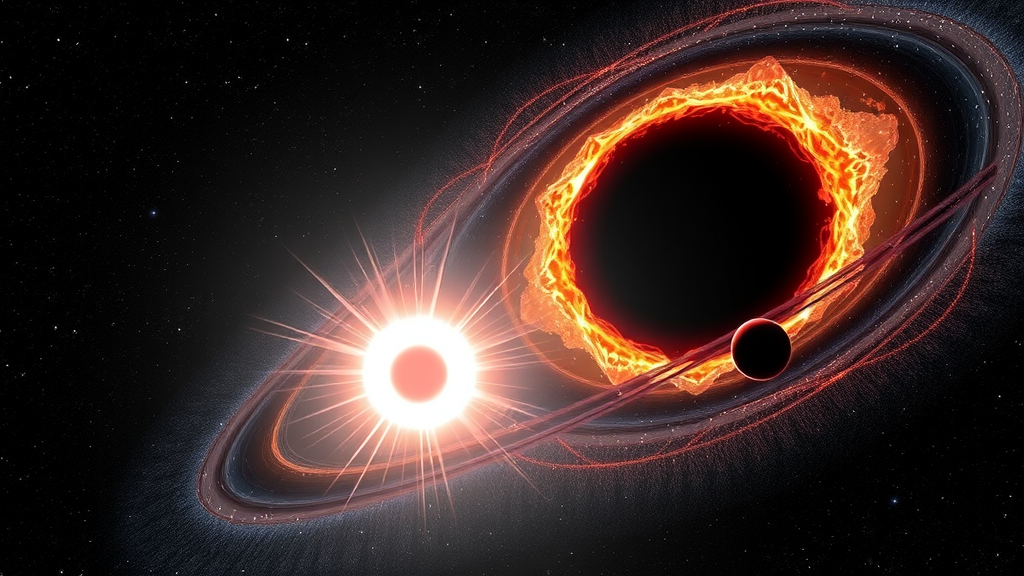
Somewhere in a nearby galaxy, a compact object no larger than a city is blasting out X-rays with a power that, on paper, should be impossible. The Eddington limit, the classic ceiling on how brightly matter can shine around a gravitating mass, sets a maximum luminosity of roughly 1.25 x 10^38 erg per second for every solar mass of the accretor. Yet observations have revealed persistent ultraluminous X-ray sources, or ULXs, that exceed this ceiling by factors of tens to thousands. A new review published in Space Science Reviews synthesizes half a century of theory, simulation and observation of super-critical accretion onto stellar-mass black holes and neutron stars, and argues that the field is now on the verge of a unified, physically grounded picture of these remarkable systems. The review, led by M. Middleton of the University of Southampton together with G. Lipunova, K. Ohsuga and M. Abramowicz, distills how matter falling onto compact objects can grow so bright that radiation itself reshapes the entire accretion flow.
The intellectual foundations of the subject were laid in the 1960s and 1970s. Salpeter and, independently, Zeldovich and Novikov recognized that radiation pressure from an accreting nucleus could push surrounding gas outward, limiting growth and luminosity. The balance between outward radiation force and inward gravity defines the Eddington luminosity, which scales linearly with mass. In 1973, Shakura and Sunyaev supplied the master framework that still governs the field: at high accretion rates, radiation pressure inflates the geometrically thin disc until, beyond a characteristic radius, the disc half-thickness becomes comparable to its radius. Inside this so-called spherisation radius, the disc can no longer hold itself together, and matter is blown off its surface in a powerful, radiation-driven wind. The self-regulating mechanism proposed by Shakura and Sunyaev, in which the outflow carries away excess mass while photons are effectively trapped in the optically thick inflow, remains the backbone of every modern super-critical accretion model.
Two further theoretical innovations shaped the modern understanding. First, Begelman showed in 1979 that in optically thick flows, photons become trapped and are advected inward with the gas, so that much of the accretion energy is swallowed by the black hole rather than radiated. Second, Abramowicz, Czerny, Lasota and colleagues developed the slim disc model in 1988, a solution in which radial advection of heat is an unavoidable cooling channel and the flow remains thermally stable even far above the Eddington rate. The signature prediction is subtle but profound: because of photon trapping and wind-driven mass loss, the bolometric luminosity grows only logarithmically with accretion rate, roughly as the Eddington luminosity multiplied by one plus the natural logarithm of the dimensionless accretion rate. A black hole fed a thousand times its Eddington supply therefore shines only a few times brighter than the classical limit, while the rest of the inflowing mass is flung back into space through the wind.
The review also traces the stranger corners of the theory, including the famous Polish doughnut, an elegant three-dimensional analytic solution for very high mass accretion rates in which a thick, low-viscosity, optically opaque torus forms around the hole. Such tori concentrate their emission into a narrow polar funnel and can geometrically collimate radiation and jets, an idea originally proposed by Lynden-Bell in 1978 to explain both active galactic nuclei and the enigmatic Galactic source SS 433. Later work showed that strong advective cooling thins and dims these doughnuts considerably, and the modern consensus favors a hybrid picture: a radiation-pressure-dominated, advective inner disc sheathed in an optically thick wind, with mass loss concentrated near the spherisation radius. For magnetized neutron stars, the auto-regulation picture acquires an extra layer, since the magnetosphere truncates the inner disc, and the maximum accretion rate onto the stellar surface depends on the magnetic dipole moment as well as the Eddington luminosity, scaling with the dipole moment to the four-ninths power.
The observational revolution arrived with the recognition that ULXs in nearby galaxies are genuine super-Eddington accretors rather than hidden intermediate-mass black holes. The decisive twist came when pulsations were discovered in several ULXs, proving that at least some of these extreme sources are powered by neutron stars with solid surfaces and strong magnetic fields. Accommodating such sources demanded new physics: magnetospheric truncation of the disc, columnar accretion along field lines onto the magnetic poles, and a reduced effective scattering cross-section in strong magnetic fields that allows the star to radiate far above the canonical Eddington limit. Accretion columns form above the surface, shocks settle within them, and radiation escapes largely through the sides of the column in a fan-beamed pattern rather than as pencil beams, consistent with the moderate pulse fractions observed in ultraluminous X-ray pulsars.
Numerical simulation has transformed the field from a collection of one-dimensional analytic models into a genuinely multi-dimensional science. Pioneering two-dimensional radiation-hydrodynamic simulations by Ohsuga and colleagues in 2005 demonstrated self-consistently how a geometrically and optically thick, radiation-pressure-dominated disc forms and launches outflows without assuming any disc configuration in advance. Photons are visibly trapped and dragged into the hole with the gas, while radiatively driven winds emerge from the disc surface with mildly collimated radiation along the rotation axis. Subsequent radiation-magnetohydrodynamic simulations removed the artificial alpha-viscosity prescription and incorporated magnetic turbulence directly, revealing radiatively accelerated, magnetically collimated jets. General relativistic versions of these calculations showed that black hole spin dramatically raises the energy conversion efficiency, from roughly five percent for a non-spinning hole to about thirty-three percent for a spin parameter of 0.9, and up to 140 percent in the magnetically arrested disc regime, where the Blandford-Znajek mechanism extracts rotational energy to power powerful jets. Simulations in this state even suggest that super-Eddington discs in a magnetically arrested configuration can spin their black holes down over time.
The simulations also predict structural features that observations can test. Disk winds fragment into clumpy gas clouds through Rayleigh-Taylor instabilities, and such clumpy, structured winds may explain both the X-ray variability of ULXs and the multiple absorption lines recently detected by the XRISM satellite in ultrafast outflows from a distant quasar. Large-domain simulations show that outflows are launched across the entire region within the photon trapping radius, with the highest mass-loss rates occurring not closest to the black hole but somewhat farther out, and with failed outflows that stall and fall back near the trapping radius. The outflow mechanical power inferred for ULXs, in the range of 10^39 to 10^41 erg per second, is comfortably consistent with the energetics of the vast bubble nebulae inflated around some of these sources. Even the puzzling X-ray weakness of the so-called Little Red Dots in the early Universe has been explained using simulation-based spectra of mildly super-Eddington, slowly spinning black holes viewed at moderate inclinations.
Observationally, the broadband X-ray spectra of ULXs now split naturally into components that map onto the theory: a soft, outflow-modified disc component peaking near the spherisation radius that violates the standard luminosity-temperature relation expected of thin discs, and a harder component that is comparatively insensitive to accretion rate. Because the thick wind obscures the innermost regions from most viewing angles, the apparent luminosity of a super-critical source depends strongly on inclination, giving rise to a geometric unification model in which face-on systems appear ultraluminous while edge-on ones look comparatively modest or even supersoft. Resonant absorption lines resolved in high-resolution X-ray spectra have confirmed powerful winds across the ULX population, and related ultrafast outflows have now been detected in tidal disruption events and quasi-periodic eruption sources, suggesting a common physics spanning eight orders of magnitude in accretor mass. Polarization measurements with IXPE have even revealed the predicted funnel geometry in the Galactic source Cygnus X-3, while NuSTAR phase-resolved spectroscopy showed that SS 433, viewed more face-on, would radiate at super-Eddington levels.
Substantial puzzles remain. Whether the inner flow is magnetically arrested or not, how much mass actually reaches the compact object, and how advection competes with wind-driven mass loss all remain contested, and different feeding prescriptions in simulations yield divergent answers. Timing features such as quasi-periodic oscillations in ULXs, possibly produced by Lense-Thirring precession of the tilted super-Eddington disc, still lack definitive confirmation, and recent work proposes that quasi-periodic eruptions in galactic nuclei may be the high-mass cousins of the same precessing flows. The path forward, the review argues, lies in the tight coupling of longer-duration general relativistic radiation-magnetohydrodynamic simulations running on modern GPU-based codes with the next generation of instruments: XRISM’s high-resolution spectroscopy of structured winds, the Vera Rubin Observatory’s harvest of tidal disruption events, NewAthena’s sensitivity to faint pulsating neutron star ULXs, and the SKA’s ability to chart the jets. Together these efforts promise to convert super-Eddington accretion from a beautiful theoretical curiosity into a precision tool for understanding how black holes grow, how neutron stars survive impossible feeding rates, and how radiation-hungry monsters across the cosmos regulate themselves.
Subject of Research: Super-Eddington accretion onto stellar-mass black holes and neutron stars
Article Title: Super-Critical Accretion onto Stellar Mass Black Holes and Neutron Stars: A Short Review
Article References: Middleton, M., Lipunova, G., Ohsuga, K., & Abramowicz, M. (2026). Super-Critical Accretion onto Stellar Mass Black Holes and Neutron Stars: A Short Review. Space Science Reviews, 222(6), Article 71. https://doi.org/10.1007/s11214-026-01318-2
Image Credits: AI Generated
DOI: 10.1007/s11214-026-01318-2
Keywords: super-Eddington accretion, Eddington limit, ultraluminous X-ray sources, black holes, neutron stars, accretion discs, disk winds, photon trapping, slim disc model, GR-RMHD simulations, ULX pulsars, Space Science Reviews
Cite Scienmag News
Grant Pearson. (September 12, 2026). Black Holes and Neutron Stars Shatter the Cosmic Speed Limit on How Bright Matter Can Shine. Scienmag. https://scienmag.com/black-holes-and-neutron-stars-shatter-the-cosmic-speed-limit-on-how-bright-matter-can-shine/
Grant Pearson. "Black Holes and Neutron Stars Shatter the Cosmic Speed Limit on How Bright Matter Can Shine." Scienmag, 12 September 2026, https://scienmag.com/black-holes-and-neutron-stars-shatter-the-cosmic-speed-limit-on-how-bright-matter-can-shine/. Accessed 12 September 2026.
Grant Pearson. "Black Holes and Neutron Stars Shatter the Cosmic Speed Limit on How Bright Matter Can Shine." Scienmag. September 12, 2026. https://scienmag.com/black-holes-and-neutron-stars-shatter-the-cosmic-speed-limit-on-how-bright-matter-can-shine/


