


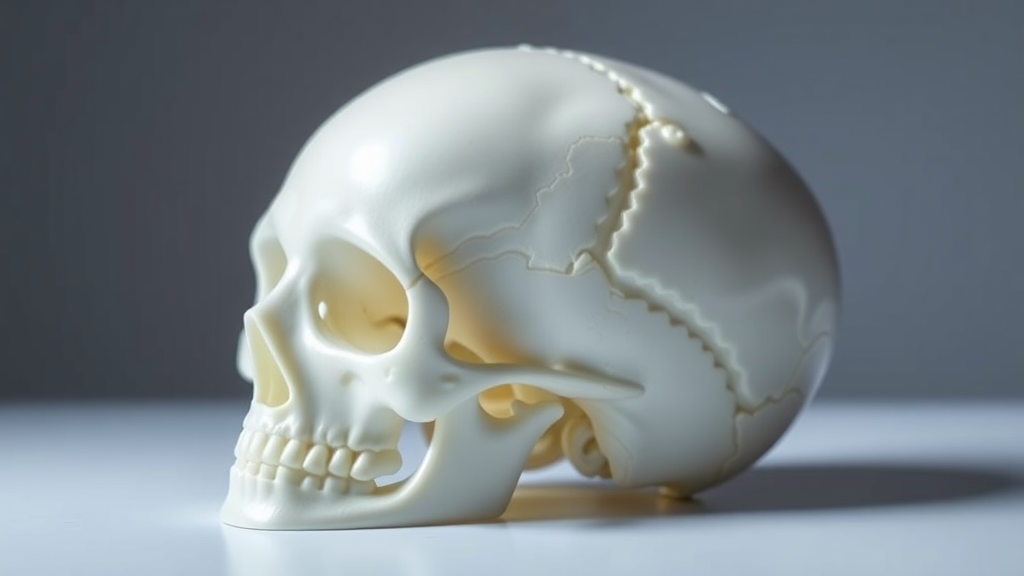
When a baby is born with craniosynostosis, the fibrous sutures that normally allow the skull to expand with the growing brain have fused prematurely, forcing the head to develop in abnormal shapes and, in severe cases, placing dangerous pressure on the developing brain. Correcting the condition demands delicate cranial surgery performed on some of the thinnest, most compliant bone in the human body. Increasingly, surgical teams rehearse these operations on three-dimensional printed replicas of the patient’s own skull, generated from CT scans. But a new study suggests that the plastic in those models may be teaching surgeons the wrong mechanical lessons, and it identifies which printing material comes closest to the real thing.
The research, published in the journal 3D Printing in Medicine, was conducted by a team from the Regional Hospital in Liberec, the Motol Faculty Hospital in Prague, the Faculty of Medicine in Hradec Kralove and the Technical University of Liberec in the Czech Republic. Led by Lukas Capek of the Department of Clinical Biomechanics, the group set out to answer a deceptively simple question: how well do the materials commonly fed into desktop fused deposition modeling printers actually mimic the mechanical behavior of pediatric cranial bone? The answer, distilled through mechanical testing and computer simulation, is that most of them do not, and that even the best candidate carries trade-offs that anyone building surgical training models needs to understand.
The team compared six widely available fused deposition modeling materials: polylactic acid, better known as PLA; acrylonitrile styrene acrylate, or ASA; PET-G; a commercial filament marketed under the name Simu Bone specifically for anatomical models; polypropylene, or PP; and thermoplastic polyurethane, or TPU. These were benchmarked against genuine ex vivo specimens of pediatric calvarial bone, the skull cap bone harvested with ethical approval from Motol University Hospital. The mechanical yardstick was the three-point bending test, a standard technique in which a sample is supported at both ends and loaded in the middle until it deflects, allowing researchers to extract the Young’s modulus, a measure of stiffness that describes how much a material resists elastic deformation.
The numbers revealed a striking spread. Native pediatric cranial bone exhibited a mean Young’s modulus of 375 plus or minus 204 megapascals, a value that reflects both the intrinsic softness of infant skull bone and considerable biological variability between specimens. Simu Bone, the filament explicitly designed to imitate bone, turned out to be dramatically too stiff, measuring 3380 plus or minus 14 megapascals, roughly nine times stiffer than the real tissue it is meant to emulate. At the opposite extreme, TPU was far too compliant at just 61 plus or minus 11 megapascals, behaving more like a flexible rubber than a cranial plate. Polypropylene emerged as the closest match to native bone mechanics, although the researchers note that printing with it posed practical challenges, since PP is notoriously prone to warping and poor bed adhesion on consumer printers.
Between those extremes sat the everyday workhorse filaments. PLA, ASA and PET-G, the materials most hobbyists and hospital makerspaces reach for first, all landed well above the stiffness of pediatric calvarial bone, meaning models printed from them will feel rigid and unyielding where a real infant skull would flex and give under surgical instruments. That discrepancy matters more than it might appear. In craniosynostosis procedures, surgeons rely on tactile feedback, feeling how bone bends, springs and fractures as it is cut, contoured and reshaped. A model that is nine times too stiff invites the trainee to apply far more force than would ever be safe in the operating room, while one that is too soft fails to convey the resistance that guides instrument handling.
The researchers also explored a popular workaround: tuning the infill density of the print. Fused deposition modeling builds parts as hollow shells filled with internal lattice patterns, and reducing the infill percentage is the easiest way to soften a printed part without changing material. The experiments showed that infill reduction does modestly decrease stiffness, offering a degree of tunability. But the effect is limited and gradual, and it cannot bridge the enormous gap between, say, a 3380 megapascal filament and 375 megapascal bone. Infill tuning, in other words, is a fine adjustment tool, not a substitute for choosing the right polymer in the first place.
Perhaps the most conceptually important finding came from the finite element analysis, the computational half of the study. The team built numerical simulations of the bending tests to explore whether matching a single global property such as overall elasticity is enough to make a printed model behave like bone. The simulations indicated that it is not. Regional deformation patterns, the way strain distributes across the geometry of a skull segment during loading, are critical for realistic simulation, and a material can match the average stiffness of bone while still deforming in the wrong places and in the wrong way. This finding pushes the field beyond the naive goal of hitting one target number and toward the harder challenge of replicating the spatial mechanical behavior of layered, heterogeneous cranial bone.
The implications reach well beyond the laboratory. Patient-specific three-dimensional printed models have become a mainstay of preoperative planning and surgical rehearsal for complex craniofacial cases, and they are increasingly central to training the next generation of neurosurgeons and craniofacial surgeons. Hospitals around the world have installed banks of desktop printers precisely because printed skulls are cheap, fast to produce and anatomically faithful, derived directly from patient imaging. This study adds a crucial caveat to that enthusiasm: anatomical accuracy without mechanical fidelity produces a model that looks right but feels wrong, and in surgery, feel is often what counts. The authors emphasize that anyone selecting materials for cranial training models must balance mechanical fidelity against printability, since the most mechanically faithful option, polypropylene, is also among the most difficult to print reliably.
There are also broader lessons for the growing field of medical simulation. The wide scatter in the native bone measurements, with a standard deviation of more than half the mean modulus, is a reminder that pediatric cranial bone is not a single well-defined material but a biological structure whose properties vary with donor age, skull location and the layered architecture of inner and outer cortical tables separated by diploë. Any single polymer, however well tuned, will be an approximation. The Czech team’s work, supported by the Ministry of Health of the Czech Republic under grant NW25-08-00228, provides the quantitative baseline that material scientists and biomedical engineers will need as they develop next-generation bone-mimicking filaments, and it gives surgical educators an evidence-based ranking for the materials they can buy today. For now, the practical takeaway is clear: if the goal is to rehearse surgery on an infant skull, polypropylene is the closest thing to bone that a standard fused deposition modeling printer can deliver, provided the printer operator is prepared to wrestle with its temperamental printing behavior.
Subject of Research: Comparative mechanical assessment of 3D printed skull materials versus pediatric cranial bone for craniosynostosis surgical training
Article Title: Comparative assessment of 3D printed skull materials and ex vivo bone for craniosynostosis training: a finite element analysis
Article References: Capek, L., Celisova, S., Taborsky, J., Vitvar, J., Benes, V., & Solfronk, P. (2026). Comparative assessment of 3D printed skull materials and ex vivo bone for craniosynostosis training: a finite element analysis. 3D Printing in Medicine. https://doi.org/10.1186/s41205-026-00347-5
Image Credits: AI Generated
DOI: 10.1186/s41205-026-00347-5
Keywords: craniosynostosis, 3D printing, fused deposition modeling, surgical training, finite element analysis, Young's modulus, pediatric cranial bone, polypropylene, Simu Bone, three-point bending, patient-specific models, surgical simulation
Cite Scienmag News
Ophelia Keating. (September 12, 2026). 3D Printed Skull Models Fall Short of Real Bone Mechanics in Craniosynostosis Surgery Training. Scienmag. https://scienmag.com/3d-printed-skull-models-fall-short-of-real-bone-mechanics-in-craniosynostosis-surgery-training/
Ophelia Keating. "3D Printed Skull Models Fall Short of Real Bone Mechanics in Craniosynostosis Surgery Training." Scienmag, 12 September 2026, https://scienmag.com/3d-printed-skull-models-fall-short-of-real-bone-mechanics-in-craniosynostosis-surgery-training/. Accessed 12 September 2026.
Ophelia Keating. "3D Printed Skull Models Fall Short of Real Bone Mechanics in Craniosynostosis Surgery Training." Scienmag. September 12, 2026. https://scienmag.com/3d-printed-skull-models-fall-short-of-real-bone-mechanics-in-craniosynostosis-surgery-training/


