


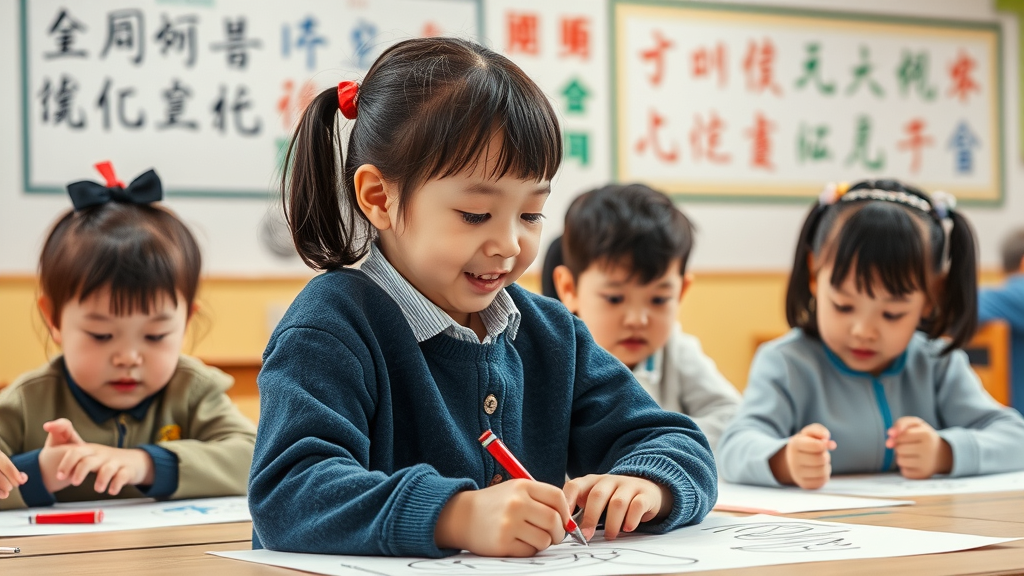
A new study from researchers at Universiti Kebangsaan Malaysia offers a rare window into what young children actually take away from drama-based lessons, and the answer is far richer than simple imitation. Yuexin Duan, Kamariah Abu Bakar and Nurul Khairani Ismail examined how five- and six-year-old children in a mainland Chinese kindergarten internalised their experiences of Drama in Education, a pedagogy that originated in the West and has been increasingly adopted in Chinese early childhood settings. Their findings, published in the International Journal of Early Childhood, suggest that children do not merely replay what happened in a drama session. Instead, they actively rebuild and extend it, weaving in their own memories, knowledge and imagination in ways the researchers describe as creative understanding.
Drama in Education, often abbreviated as DiE, is a process-oriented approach in which children and teachers step into imagined roles and explore a story or problem from within. Pioneered by educators such as Dorothy Heathcote and Gavin Bolton, the method treats the classroom as a shared fictional world where learning emerges through participation rather than instruction. In China, where early childhood classrooms have traditionally been shaped by Confucian-influenced norms of teacher authority and structured repetition, imported pedagogies of this kind have often been viewed with scepticism. Previous scholarship has suggested that Western-originated approaches may encounter resistance or superficial adoption in Chinese contexts, raising the question of whether children genuinely engage with such methods or simply comply with them outwardly.
To answer that question, the research team turned to Ochs and Phillips’s educational policy borrowing theory, a framework that traces what happens when educational ideas travel across borders. The theory describes a cycle of borrowing that includes justification, translation, and, crucially, internalisation, the stage at which an imported practice becomes embedded in local understanding. Most studies of policy borrowing focus on teachers, administrators or official documents. This study is unusual in that it asks whether internalisation can be observed in the children themselves, treating five- and six-year-olds as capable interpreters of a borrowed pedagogy rather than passive recipients of it.
The researchers adopted a qualitative case study design centred on a single Drama in Education activity in a mainland Chinese early childhood classroom. Rather than relying solely on adult observation, they used a draw-and-tell approach, a well-established technique in early childhood research in which children produce drawings and then explain them verbally. Because young children’s thinking often exceeds their writing ability, drawing combined with self-narration provides a developmentally appropriate channel for them to express how they understood an experience. After the drama activity concluded, the children drew pictures related to what they had experienced and talked through their drawings with the researchers, offering accounts of what the drama had meant to them.
The resulting dataset, consisting of children’s drawings alongside their verbal explanations, was subjected to thematic analysis, a systematic method for identifying recurring patterns of meaning across qualitative data. The analysis revealed several distinct forms of creative understanding among the participating children. Some children revisited the drama by depicting key moments and characters, demonstrating that they had retained the narrative structure of the experience. Others went further, interpreting the events of the drama and connecting them to situations from their own lives. A third pattern involved reconstruction and extension: children added new characters, altered outcomes, or invented scenes that had never occurred in the classroom drama, effectively continuing the story on their own terms.
This last finding carries particular weight for the debate over pedagogical transfer. If the children had merely reproduced the drama, their drawings would have mirrored the classroom activity closely, suggesting surface-level engagement. Instead, the evidence points to a deeper cognitive process. The children integrated their personal experiences, prior knowledge and imaginative capacities into their retellings, transforming the drama into something partly their own. In the language of the study, they did not simply reproduce the drama but reconstructed and extended it. That behaviour is precisely what theories of creative learning would predict when a pedagogy genuinely takes hold, and it suggests that Drama in Education can be meaningfully enacted within a local Chinese classroom rather than remaining an imported ritual.
The study also contributes an exploratory conceptualisation of children’s internalisation within educational policy borrowing theory. By treating children’s creative understanding as evidence of internalisation, the researchers extend a framework normally applied at the level of institutions and systems down to the level of individual learners. This move has practical implications. Policymakers and curriculum designers who import Western pedagogies into East Asian contexts often measure success through teacher training, curriculum documents or observable classroom behaviours. The present study suggests that children’s own artefacts and narratives, such as drawings and accompanying explanations, can serve as an additional and arguably more direct indicator of whether an imported approach has genuinely been absorbed.
The findings arrive at a moment of heightened policy interest in creativity across China. National education outlines issued over the past fifteen years have repeatedly emphasised innovation and creative talent, and recent scholarship has debated why Chinese schooling has historically struggled to cultivate creative thinking alongside strong foundational skills. Drama in Education has been promoted in Chinese early childhood literature as a vehicle for developing language, emotional understanding, peer interaction and creativity, and several recent case studies have explored its use with picture books in kindergartens. However, much of this literature evaluates outcomes from the adult perspective. By centring children’s voices, the new study addresses a methodological gap and provides the children’s perspective on how a Western-originated pedagogy may be internalised in Chinese early childhood education.
The researchers are careful to frame the work as a single qualitative case study rather than a generalisable experiment. The data, which are not publicly available due to ethical restrictions but can be requested from the authors, come from one classroom and one drama activity, and the study was approved by the institutional ethics committee of Universiti Kebangsaan Malaysia with informed consent obtained from all participants and their parents or legal guardians. Nevertheless, the case offers a counterexample to the assumption that Confucian-influenced classrooms inevitably resist Western pedagogies. The children’s responses indicate that when a drama activity is enacted locally, young learners can engage with it in ways that support creative understanding, revisiting, interpreting and rebuilding the experience through their own symbolic and narrative resources.
For educators, the study underscores the value of listening to children after an activity, not just during it. The draw-and-tell method demonstrates that even five-year-olds can articulate sophisticated understandings of a learning experience when given an accessible medium. For researchers of educational transfer, it suggests that the internalisation stage of policy borrowing is visible at the classroom floor level, in crayon drawings and children’s spoken explanations, and not only in ministry documents or teacher interviews. And for advocates of Drama in Education, the evidence provides reassurance that the approach can travel: transplanted into a Chinese kindergarten, it did not lose its essence but was taken up by children who made the drama their own, extending its storylines with the raw material of their own lives and imaginations.
Subject of Research: How five- to six-year-old children in a Chinese kindergarten internalise Drama in Education experiences through creative understanding, examined via a draw-and-tell qualitative case study.
Article Title: Children’s Creative Understanding in Drama in Education: Evidence from Draw-and-Tell in a Chinese Early Childhood Context
Article References: Children’s Creative Understanding in Drama in Education: Evidence from Draw-and-Tell in a Chinese Early Childhood Context. (n.d.). https://doi.org/10.1007/s13158-026-00551-8
Image Credits: AI Generated
DOI: 10.1007/s13158-026-00551-8
Keywords: Drama in Education, creative understanding, early childhood education, educational policy borrowing, draw-and-tell method, China, kindergarten, qualitative case study, children's drawings, pedagogy transfer, creativity, thematic analysis
Cite Scienmag News
Courtney Benton. (September 12, 2026). Children Reconstruct Drama Lessons Through Drawings in Chinese Kindergartens. Scienmag. https://scienmag.com/children-reconstruct-drama-lessons-through-drawings-in-chinese-kindergartens/
Courtney Benton. "Children Reconstruct Drama Lessons Through Drawings in Chinese Kindergartens." Scienmag, 12 September 2026, https://scienmag.com/children-reconstruct-drama-lessons-through-drawings-in-chinese-kindergartens/. Accessed 12 September 2026.
Courtney Benton. "Children Reconstruct Drama Lessons Through Drawings in Chinese Kindergartens." Scienmag. September 12, 2026. https://scienmag.com/children-reconstruct-drama-lessons-through-drawings-in-chinese-kindergartens/


