


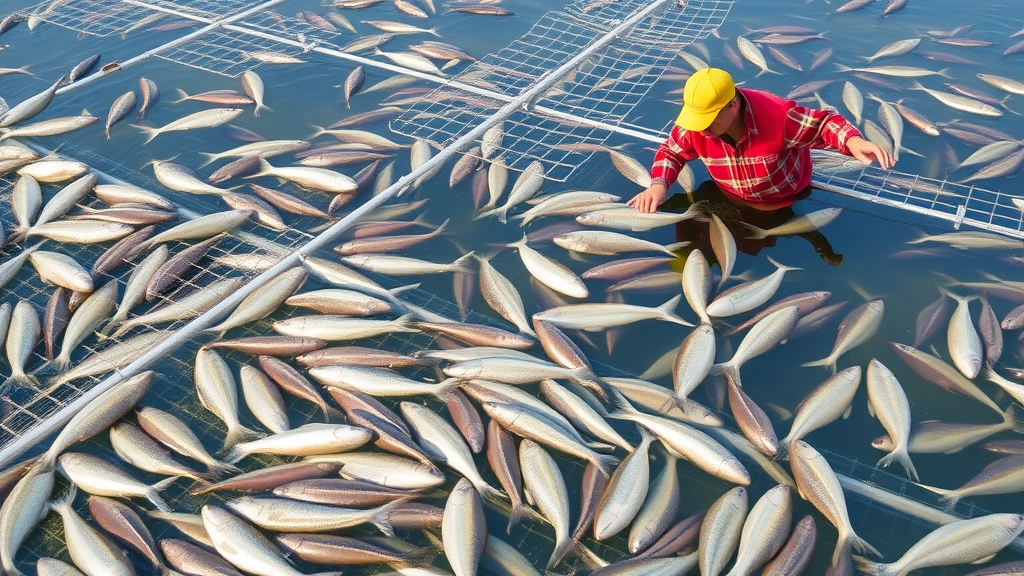
Inland fish farming has quietly become one of the planet’s most important food systems. Ponds, cages, rice paddies and reservoirs across Asia, Africa and Latin America now supply a substantial share of the fish that billions of people eat, often providing affordable protein and micronutrients in regions where nutrition security remains fragile. Yet a new systematic review published in Nature Food warns that the same freshwater systems underpinning this quiet revolution are increasingly vulnerable to a changing climate, and that the farmers, processors and governments who depend on them are struggling to adapt at anything like the pace required.
The review, led by Jie Su of Xiamen University and the University of Tokyo together with Alexandros Gasparatos of the University of Tokyo, brought together an international team including researchers from WorldFish, Michigan State University and the Stockholm Resilience Centre. In a deliberate departure from most earlier assessments, the team searched the literature in both English and Chinese, recognizing that a large fraction of the world’s inland aquaculture production occurs in China, where much of the relevant research is published in Mandarin and rarely reaches global synthesis efforts. From the screening process, 84 peer-reviewed publications met the review’s criteria and formed the evidence base for the analysis.
What emerges from this body of work is a picture of climatic stress that is remarkably diverse, geographically uneven and frequently compounded by non-climatic pressures. The studies document climatic impact drivers ranging from slow-onset changes such as warming water temperatures, altered precipitation regimes and salinity intrusion, to abrupt shocks including floods, droughts, storms and heat extremes. These hazards interact with the biology of farmed species in ways that can cascade through entire production cycles. Elevated temperatures alter fish metabolism, feeding rates, growth and disease susceptibility, while also stratifying ponds and degrading water quality. Extreme rainfall and flooding can physically destroy ponds and cages, wash away stocked fish and contaminate production water; droughts shrink pond volume, concentrate waste and heighten the risk of mass mortality.
The review emphasizes that the impacts do not stop at the farm gate. Climate-related stressors ripple across the entire aquaculture value chain. Hatcheries and seed suppliers suffer when extreme events disrupt broodstock and larval survival, as documented in studies from Bangladesh and the Indian state of Assam, where floods and storms have repeatedly damaged fish seed production. Feed supply chains are exposed through their dependence on agricultural commodities whose prices and availability fluctuate with climatic conditions. Post-harvest processing, storage and transport can be interrupted by flooding and damaged infrastructure, preventing farmed fish from reaching markets even when ponds survive. For the smallholder households that dominate inland aquaculture in much of the Global South, these off-farm disruptions translate directly into lost income, depleted assets and reduced access to nutrient-rich food.
Against this catalogue of risks, the authors mapped an equally diverse set of responses. Across the 84 studies they identified 53 distinct adaptation options, which they organized along the value chain and into broad categories spanning management practices, technological interventions and governance measures. On-farm options include adjusting stocking calendars to align with shifting seasons, deepening or reinforcing ponds, installing aeration and water-exchange systems, switching to more tolerant species or strains, diversifying production through polyculture and integrated rice-fish systems, and adopting improved site selection to avoid flood-prone or saline-affected ground. Off-farm measures include climate-resilient seed production, cold-chain and processing improvements, and market and financial instruments such as insurance and microcredit designed to buffer climate shocks.
By mapping which options were reported at which stage of the value chain, and linking each climatic impact driver to the responses documented in the literature, the review constructed adaptation pathways that reveal both the breadth of the toolkit and its gaps. Technological and farm-management responses dominate the on-farm segment, while governance-oriented measures cluster around the off-farm segments, where collective action, regulation and institutional support matter most. Notably, many adaptation options remain at the stage of proposals or pilots rather than widespread implementation, a finding the authors underscore through their analysis of implementation status across the reviewed studies. The heterogeneity of impacts and contexts, the authors conclude, means that uniform, one-size-fits-all solutions are unlikely to work; effective adaptation must be targeted to specific climatic drivers, production systems and socio-economic settings.
The starkest message of the review concerns why so few of these options are actually being adopted. The researchers systematically catalogued adaptation barriers and found a persistent trio at the top: restrictive or poorly aligned government policy environments, insufficient financial resources, and limited access to actionable, usable information. Many countries’ national adaptation plans give aquaculture, if it appears at all, only a marginal place, in sharp contrast to crop agriculture. Small-scale producers, who constitute the majority of inland fish farmers, often lack collateral, credit histories or formal insurance products that would let them invest in ponds, aeration, better seed or risk protection. Extension services, where they exist, rarely deliver climate information in forms that farmers can act upon, and early-warning systems for floods and droughts frequently fail to reach pond operators in remote areas.
The authors argue that unlocking adaptation requires enabling institutional and financial conditions rather than simply promoting more technologies. Their recommendations include mainstreaming aquaculture within national adaptation planning so that freshwater fish farming is explicitly represented alongside crops and livestock; enhancing policy coherence across fisheries, agriculture, water, disaster-risk and climate ministries, since fragmented governance undermines coordinated responses; strengthening information-sharing platforms so that climate forecasts, best practices and market signals flow reliably to producers; and increasing investment in adaptation finance tailored to the realities of smallholder aquaculture. Examples cited in the underlying literature, from community-based collective action among smallholders in Pakistan to climate mainstreaming efforts in Thai aquaculture policy, illustrate that progress is possible when institutions, finance and information align.
The stakes could hardly be higher. Global aquaculture has been the fastest-growing food production sector for decades, and inland farming accounts for the majority of farmed aquatic food by volume, with production increasingly concentrated on land rather than at sea. Aquatic foods deliver protein, omega-3 fatty acids and essential micronutrients to populations where malnutrition remains widespread, and the FAO’s Blue Transformation agenda has positioned sustainable aquaculture growth as central to future food security. If climate change erodes the productivity and reliability of inland fish farming faster than adaptation can keep up, the nutritional consequences will fall hardest on low-income consumers in South and Southeast Asia and sub-Saharan Africa, precisely the regions where the review finds both high vulnerability and the weakest adaptive capacity.
Conducted as part of the CGIAR Sustainable Animal and Aquatic Foods Science Program, and drawing on funders ranging from the Moore Foundation to the Government of Canada’s International Climate Finance Initiative, the review offers a rare bilingual, value-chain-wide synthesis of a sector that global climate assessments have long treated as an afterthought. Its central conclusion is both sobering and actionable: the knowledge of what needs to be done already exists in scattered pockets around the world, but without deliberate policy reform, targeted finance and better information flows, the adaptive capacity of the world’s inland fish farms will continue to lag behind the mounting climatic pressures they face. For a food system feeding billions, that gap is one the world cannot afford to leave open.
Subject of Research: Climate change impacts and adaptation in inland aquaculture systems
Article Title: A systematic review of the climatic impacts, diverse adaptation pathways and multiple adaptation barriers for inland aquaculture
Article References: Su, J., Tigchelaar, M., Belton, B., Wang, Q., Rossignoli, C. M., Allison, E. H., Troell, M., & Gasparatos, A. (2026). A systematic review of the climatic impacts, diverse adaptation pathways and multiple adaptation barriers for inland aquaculture. Nature Food. https://doi.org/10.1038/s43016-026-01410-4
Image Credits: AI Generated
DOI: 10.1038/s43016-026-01410-4
Keywords: inland aquaculture, climate change adaptation, food security, aquatic food systems, systematic review, adaptation barriers, value chain, smallholder farmers, freshwater fish farming, Nature Food, policy coherence, adaptation finance
Cite Scienmag News
Sloane Callahan. (September 12, 2026). Climate Change Is Squeezing the World’s Fish Farms, but Adaptation Is Stalling. Scienmag. https://scienmag.com/climate-change-is-squeezing-the-worlds-fish-farms-but-adaptation-is-stalling/
Sloane Callahan. "Climate Change Is Squeezing the World’s Fish Farms, but Adaptation Is Stalling." Scienmag, 12 September 2026, https://scienmag.com/climate-change-is-squeezing-the-worlds-fish-farms-but-adaptation-is-stalling/. Accessed 12 September 2026.
Sloane Callahan. "Climate Change Is Squeezing the World’s Fish Farms, but Adaptation Is Stalling." Scienmag. September 12, 2026. https://scienmag.com/climate-change-is-squeezing-the-worlds-fish-farms-but-adaptation-is-stalling/


