


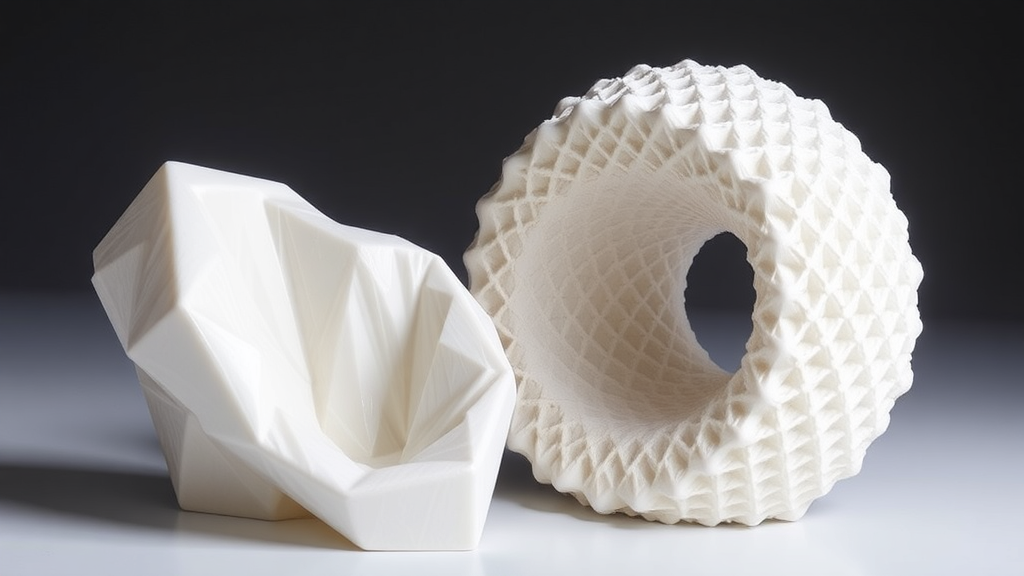
A class of materials that can survive conditions hot enough to melt most metals is getting a manufacturing makeover. Zirconium diboride, a compound prized for its extraordinary tolerance of extreme heat, has long been constrained by the limits of conventional ceramic processing: it is difficult to machine, expensive to sinter, and nearly impossible to shape into anything more sophisticated than simple blocks or coatings. New research published in npj Advanced Manufacturing demonstrates that direct ink writing, an extrusion-based additive manufacturing technique, can transform this notoriously stubborn material into complex three-dimensional architectures, opening a pathway to hypersonic vehicle components, rocket propulsion hardware, and nuclear applications that were previously impractical to fabricate.
Ultra-high temperature ceramics, often abbreviated as UHTCs, are defined by their melting points, which exceed 3000 degrees Celsius. Zirconium diboride sits at the heart of this family, melting above 3200 degrees Celsius while maintaining substantial strength at temperatures where nickel-based superalloys lose all structural integrity and even silicon carbide begins to soften. The material also conducts both heat and electricity remarkably well for a ceramic, a combination of properties that makes it attractive for leading edges and nose tips of hypersonic craft, where heat must be shed quickly to prevent localized thermal failure. Yet these same qualities have historically been the source of its manufacturing difficulties.
Zirconium diboride powders are hard, refractory, and resist densification. Traditional processing relies on hot pressing or spark plasma sintering, techniques that squeeze and heat powder compacts in rigid dies. The result is dense material, but only in shapes the die allows. Machining the sintered ceramic afterward requires diamond tooling and considerable patience, and internal channels, lattices, or curved cooling passages are effectively out of reach. For engineers designing thermal protection systems, the inability to shape the material has been as limiting as the cost of making it, forcing conservative designs that overuse material and add mass exactly where mass is most penalizing.
Direct ink writing offers a fundamentally different approach. In this technique, ceramic particles are dispersed into a concentrated paste-like ink that is extruded through a fine nozzle, layer by layer, following a digital design. The trick lies in formulating an ink that flows smoothly under shear stress as it passes through the nozzle, yet solidifies immediately afterward to hold its printed shape. This shear-thinning behavior, familiar from everyday examples such as ketchup or toothpaste, depends on finely tuning the solids loading, the dispersant chemistry, and the interactions between particles in the liquid carrier. For a dense, hard powder like zirconium diboride, achieving the right rheology is a serious formulation challenge.
The new study addresses this challenge by systematically developing printable inks loaded with high fractions of zirconium diboride powder, supported by organic binders and rheology modifiers that give the extruded filaments the mechanical stiffness needed for self-supporting structures. High solids loading matters because the printed green body must survive drying and burnout of the organic phase without cracking or collapsing. Too much binder, and the part shrinks dramatically and develops defects during firing; too little, and the structure slumps under its own weight before it ever reaches the furnace. Balancing these competing requirements is the central craft of the method.
Once printed, the parts undergo a carefully staged thermal schedule. Low-temperature steps remove water and burn out organic additives, generating gases that must escape slowly to avoid blistering or fracture. Sintering then follows at temperatures high enough to fuse the particles into a coherent solid. Boride ceramics pose a specific difficulty here: covalent bonding and low self-diffusion rates make conventional pressureless sintering inefficient, so densification often requires sintering additives such as silicon carbide or metallic phases, or applied pressure. The researchers report that printed components can be consolidated to useful densities while retaining the geometric complexity imparted during printing, a result that establishes the viability of the entire processing chain from digital model to refractory ceramic part.
What makes this work compelling beyond the laboratory is the design freedom it unlocks. Hypersonic flight vehicles experience aerodynamic heating that scales steeply with speed, and their leading edges must survive repeated thermal cycling at temperatures above 2000 degrees Celsius. Sharp leading edges reduce drag but concentrate heat, and cooling them from within is one of the most promising strategies for reusable systems. Internally channeled structures in zirconium diboride, impossible to produce by hot pressing and machining, could carry coolant directly through the hottest zones of the vehicle. Similar logic applies to scramjet combustor liners, rocket nozzle throats, and heat exchanger cores for advanced propulsion concepts.
The technique also speaks to broader trends in manufacturing economics. Additive approaches reduce material waste, since powder is deposited only where needed rather than machined away from an oversized billet. They compress the path from design iteration to physical prototype, allowing engineers to test geometric variations of thermal protection components in days rather than months. And they enable graded and lattice architectures that tailor heat flow and mechanical compliance in ways monolithic ceramics cannot match. For a material class in which every kilogram matters and every degree of margin counts, those advantages compound quickly.
Significant hurdles remain before printed ultra-high temperature ceramics fly on operational vehicles. Dense, defect-free consolidation at scale is not yet routine, and the mechanical properties of printed parts must be demonstrated to match or exceed those of conventionally hot-pressed equivalents under the extreme thermal gradients of flight. Reproducibility of ink rheology from batch to batch, shrinkage control during sintering, and qualification standards for safety-critical aerospace hardware are all active fronts. Nonetheless, the demonstration that zirconium diboride can be formed into complex shapes by direct ink writing converts a long-standing materials limitation into an engineering problem of the solvable kind.
The significance of the work extends past aerospace. Zirconium diboride and its relatives are candidates for plasma-facing components in fusion devices, control rod materials in high-temperature reactors, molten salt containment, and electrodes in extreme electrochemical environments. Each of these applications rewards shapes and internal structures that traditional ceramic processing cannot deliver. As printing formulations, sintering schedules, and characterization methods mature, the family of ultra-high temperature ceramics may move from being admired for what they can withstand to being designed around what they can enable, with the nozzle of a printer replacing the diamond saw as the defining tool of the trade.
Subject of Research: Additive manufacturing of zirconium diboride-based ultra-high temperature ceramics by direct ink writing
Article Title: Direct Ink Writing of ZrB2-based ultra-high temperature ceramics
Article References: Mor, M., Gardini, D., Failla, S., Sciti, D., & Vinci, A. (2026). Direct Ink Writing of ZrB2-based ultra-high temperature ceramics. npj Advanced Manufacturing. https://doi.org/10.1038/s44334-026-00113-9
Image Credits: AI Generated
DOI: 10.1038/s44334-026-00113-9
Keywords: zirconium diboride, ultra-high temperature ceramics, direct ink writing, additive manufacturing, hypersonic vehicles, thermal protection systems, ceramic sintering, rheology, refractory materials, aerospace materials, 3D printing, advanced ceramics
Cite Scienmag News
Denise Maddox. (September 12, 2026). 3D-Printed Zirconium Diboride Ceramics Push Ultra-High Temperature Materials Into New Shapes. Scienmag. https://scienmag.com/3d-printed-zirconium-diboride-ceramics-push-ultra-high-temperature-materials-into-new-shapes/
Denise Maddox. "3D-Printed Zirconium Diboride Ceramics Push Ultra-High Temperature Materials Into New Shapes." Scienmag, 12 September 2026, https://scienmag.com/3d-printed-zirconium-diboride-ceramics-push-ultra-high-temperature-materials-into-new-shapes/. Accessed 12 September 2026.
Denise Maddox. "3D-Printed Zirconium Diboride Ceramics Push Ultra-High Temperature Materials Into New Shapes." Scienmag. September 12, 2026. https://scienmag.com/3d-printed-zirconium-diboride-ceramics-push-ultra-high-temperature-materials-into-new-shapes/


