


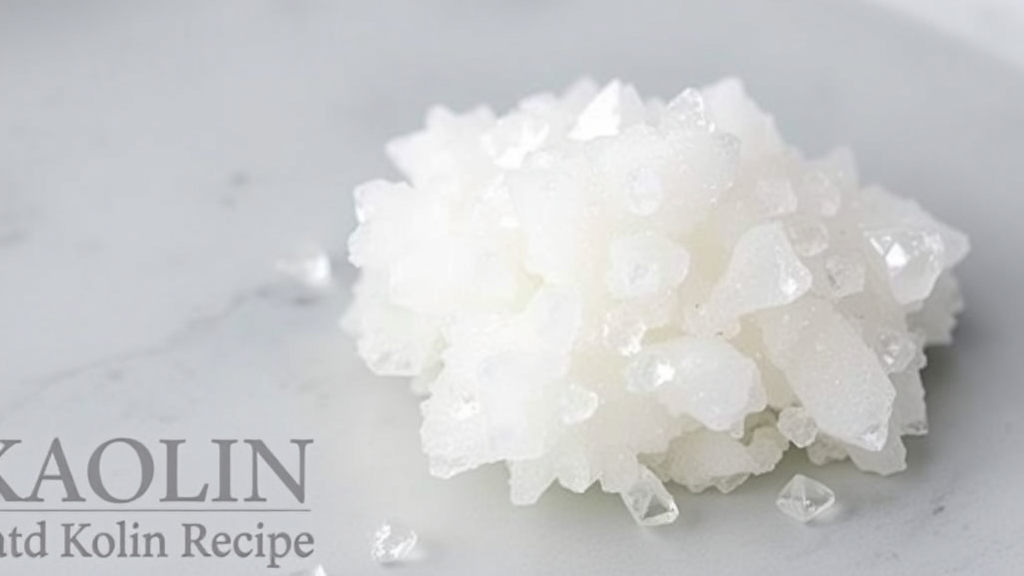
Researchers in Cameroon have shown that a deceptively simple change in a well-known chemistry recipe—how much metakaolin powder is stirred into a fixed volume of sodium hydroxide solution—can dramatically reshape the internal architecture of the silica gel that emerges at the end. The finding, published as an open-access study in Discover Industrial Chemistry and Materials, matters because silica gel is one of the world’s workhorse desiccants: the porous, moisture-hungry material tucked into electronics packaging, pharmaceutical bottles and food containers. If the ratio of clay to alkali determines how many water-grabbing hydroxyl groups the final gel carries, manufacturers may gain a new, low-cost lever for tuning desiccants without exotic reagents or expensive processing.
The team, led by Cyrill Joël Ngally Sabouang and Jean Aimé Mbey and drawn from the University of Yaoundé I, the University of Bamenda and the University of Ngaoundere, started with kaolin clay from the Mayouom locality of Cameroon. Kaolinite, the dominant mineral in this clay, is a layered silicate made of one tetrahedral silica sheet stacked on one octahedral alumina sheet, with an ideal formula of Al2Si2O5(OH)4. That structure means kaolinite contains roughly 46.5 percent silicon dioxide by mass, making it an attractive and abundant feedstock for producing amorphous silica, the reactive form of the material prized for adsorption applications. Prior to synthesis, the raw clay was wet-sieved at 45 micrometers, dried, and characterized as containing more than 80 weight percent kaolinite with good structural organization.
The first critical transformation was thermal. Heating the kaolin in a muffle furnace to 650 degrees Celsius at 5 degrees per minute, holding for one hour, and then cooling converted the crystalline kaolinite into amorphous metakaolinite. X-ray diffraction confirmed the change: the characteristic kaolinite reflection at 7.16 angstroms vanished, replaced by a broad diffraction halo between 20 and 35 degrees two-theta that signals a disordered, glass-like atomic arrangement. Infrared spectroscopy told the same story from a different angle. The sharp O-H stretching bands of kaolinite at 3691 and 3620 inverse centimeters disappeared after calcination, evidence that the structural hydroxyls had been driven off and the crystal lattice disrupted. Thermal analysis added a third confirmation, showing the expected dehydroxylation event near 546 degrees with a 10.8 percent mass loss, and a later exothermic event near 1013 degrees marking the onset of mullite formation if the material were heated further.
Before gel synthesis, the metakaolin was purified by dispersing it in excess 3 molar hydrochloric acid for one hour under constant stirring, a treatment that dissolves metallic impurities such as iron oxide and calcium or magnesium compounds. After decantation and repeated washing with distilled water—until a silver nitrate test confirmed the supernatant was free of chloride ions—the cleaned solid was dried and stored airtight. The synthesis itself followed a classic sol-gel route: batches of 5, 10, 15 and 20 grams of treated metakaolin were dispersed in 100 milliliters of 8 molar sodium hydroxide, stirred for 20 minutes, and left for 24 hours. During this alkaline digestion, hydroxide ions attack the silicate network of the metakaolin, dissolving silicon species into solution as sodium silicate. The supernatant was filtered off, and the pH was dropped to 3 with hydrochloric acid, triggering the hydrolysis and condensation reactions that precipitate silica gel. The gels were collected by centrifugation, dried at room temperature, and labeled GS1:20 through GS4:20 according to their clay-to-solution ratios.
X-ray diffraction of the finished gels revealed a broad amorphous silica halo between 15 and 40 degrees two-theta in every sample, but the details differed in ways that turned out to be scientifically revealing. All gels contained crystalline reflections from halite—ordinary sodium chloride—formed either when excess sodium hydroxide reacted with the hydrochloric acid during the pH adjustment step, or when sodium silicate was directly neutralized during precipitation. Crucially, the intensity of the halite peak at 2.82 angstroms shrank as the metakaolin fraction increased, indicating that the dominant source of salt contamination was leftover alkali rather than the silicate itself. The researchers suggest that a post-centrifugation washing step could strip out much of this by-product, and note that the brief 3-minute spin at 2000 rpm may have left enough liquid in the cake for salt to precipitate during drying.
The highest metakaolin loading, GS4:20, produced the most distinctive mineralogy. Its halite peaks were faintest, its amorphous halo strongest, and its pattern showed traces of hydroxysodalite, an ordered aluminosilicate framework that the authors interpret as the beginning of crystallization from the silica oligomers in the gel. They attribute this to the mixture approaching a stoichiometric balance, leaving less free sodium available to form salt. The halo intensity ranked GS3:20 below GS2:20, below GS1:20, below GS4:20, consistent with more silica gel forming as more metakaolin was dissolved into the alkali.
Infrared spectroscopy then exposed how the ratio sculpted the gel’s molecular structure. All gels showed a broad band near 3385 inverse centimeters from O-H stretching of terminal silanol groups and adsorbed water, a Si-OH vibration near 930, an H-O-H bending band near 1640 from physically adsorbed water, and Si-O-Si stretching modes near 1010, 780 and 420. In GS4:20, the silanol and water bands were strongest, pointing to a network built from short oligomeric chains. Shorter chains mean more chain ends, and more chain ends mean more exposed hydroxyl groups available to hydrogen-bond with water molecules—an outcome directly beneficial for a desiccant. By contrast, gels made with less metakaolin, such as GS1:20, showed enhanced Si-O-Si bands without equivalent silanol signals, indicating longer polymer chains with fewer terminal hydroxyls, and trapped structural water instead.
Thermal analysis corroborated the spectroscopic picture. All samples lost physisorbed water below 100 degrees, but the temperature of that event increased in the order GS2:20, GS3:20, GS1:20, GS4:20, implying progressively stronger water-gel bonding forces. Only GS1:20 and GS2:20 showed additional water evaporation between 100 and 210 degrees, attributed to water trapped inside the growing silica network when more effective dissolution allowed optimal chain growth. Total mass loss rose with metakaolin content, again consistent with short-chain, hydroxyl-rich structures adsorbing more water. A thermal event near 800 degrees marked halite melting, weakest in GS4:20, matching the diffraction evidence of minimal salt in that sample.
The overall mechanistic narrative is one of competing interactions. When metakaolin is scarce, the abundant hydroxide solution interacts strongly and effectively with each silicate unit, dissolving species thoroughly and allowing silica particles to grow into extended chains that incorporate structural water. When metakaolin is plentiful, solid-solid interactions between particles stabilize them and limit their contact with the alkali, curtailing particle growth and freezing short oligomers rich in terminal hydroxyls into the network. Meanwhile, excess sodium hydroxide left over after sodium silicate formation reacts with the hydrochloric acid added for precipitation, generating the halite by-product that contaminates low-ratio gels.
The authors are careful to flag a limitation: the study did not specify sodium-to-silicon ratios in a normalized way, which may restrict how directly the conclusions transfer to metakaolins from other natural sources with different purities and reactivities. Even so, the practical takeaway is striking. By simply adjusting how much clay is loaded into the alkali bath, a producer can bias the product toward either long-chain gels with structural water or short-chain gels dense with adsorption-ready hydroxyl groups—tunable moisture retention from one of the cheapest raw materials on Earth. For a material that quietly protects everything from medicines to microchips against humidity, that kind of formulation control, derived from Cameroonian kaolin and conventional laboratory reagents, could reshape how low-cost desiccants are designed.
Subject of Research: Effect of metakaolin mass fraction in sodium hydroxide on sol-gel silica gel structure and water retention
Article Title: Influence of the metakaolin mass fraction in sodium hydroxide solution on the synthesis of silica gel from metakaolin
Article References: Influence of the metakaolin mass fraction in sodium hydroxide solution on the synthesis of silica gel from metakaolin. (n.d.). https://doi.org/10.1007/s44508-026-00015-w
Image Credits: AI Generated
DOI: 10.1007/s44508-026-00015-w
Keywords: metakaolin, silica gel, sol-gel, kaolinite, sodium hydroxide, amorphous silica, X-ray diffraction, FTIR, thermal analysis, desiccant, hydroxysodalite, materials chemistry
Cite Scienmag News
Bethany Barker. (September 12, 2026). Kaolin Recipe Tweak Controls the Water-Trapping Power of Silica Gel. Scienmag. https://scienmag.com/kaolin-recipe-tweak-controls-the-water-trapping-power-of-silica-gel/
Bethany Barker. "Kaolin Recipe Tweak Controls the Water-Trapping Power of Silica Gel." Scienmag, 12 September 2026, https://scienmag.com/kaolin-recipe-tweak-controls-the-water-trapping-power-of-silica-gel/. Accessed 12 September 2026.
Bethany Barker. "Kaolin Recipe Tweak Controls the Water-Trapping Power of Silica Gel." Scienmag. September 12, 2026. https://scienmag.com/kaolin-recipe-tweak-controls-the-water-trapping-power-of-silica-gel/


