


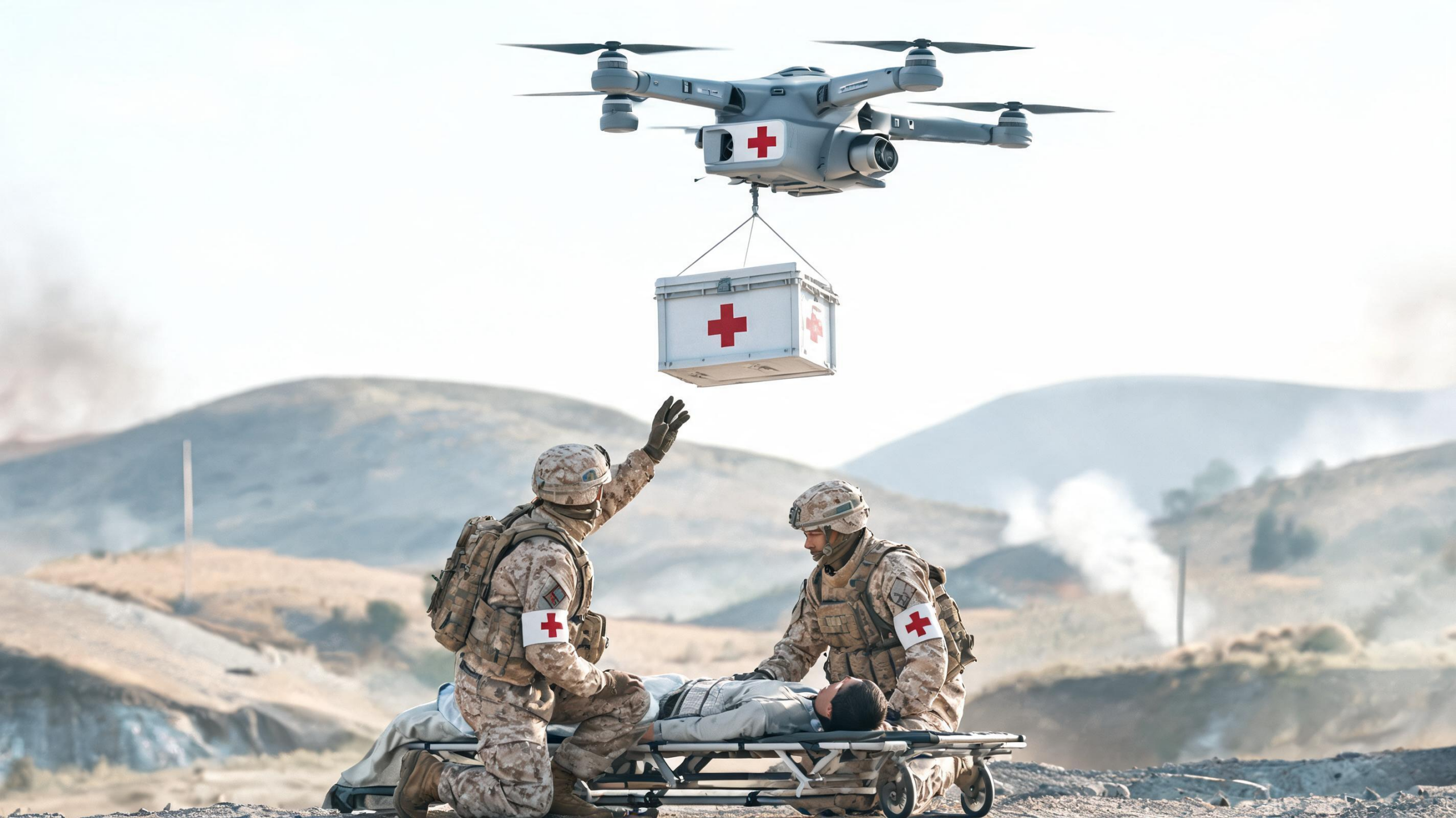
A sweeping new analysis of medical research on modern warfare has arrived at a conclusion that is as stark as it is counterintuitive: although unmanned systems now dominate the battlespace and are transforming the very way soldiers and civilians are wounded, the peer-reviewed medical literature contains almost no rigorous evidence on how these same technologies could be harnessed to save lives. A scoping review published in the Journal of Emergency and Disaster Medicine examined how unmanned aerial, ground, and maritime platforms influence trauma care in large-scale combat operations, and found that across seven qualifying studies, not a single one evaluated drones or robots as tools for medical evacuation, resupply, or clinical care delivery. Instead, the literature consistently described unmanned systems in offensive roles, shaping injury patterns and disrupting medical operations from the other side of the equation.
The review, led by Chloé Waters of Beth Israel Deaconess Medical Center and Harvard Medical School together with Attila J. Hertelendy, Fadi Issa, Williams Lopez Vidal, Amalia Voskanyan, and Gregory Ciottone, was conducted using the Arksey and O’Malley scoping review framework and reported according to the PRISMA-ScR checklist. The team searched four major databases, OVID MEDLINE, Embase, Web of Science, and CINAHL, for studies examining unmanned systems in conflict environments. Of 1,134 papers initially identified, 102 were duplicates and 1,008 were excluded at title and abstract screening, leaving 22 for full-text review. Only seven studies ultimately met the inclusion criteria, spanning conflicts in Ukraine, Gaza, Ethiopia, and one non-specific operational context. The small yield itself is a finding: research on the medical consequences of unmanned warfare remains thin, fragmented, and largely retrospective.
To understand why the review matters, it helps to trace the collapse of a foundational military medicine doctrine: the Golden Hour. During the Global War on Terrorism, coalition forces generally enjoyed air superiority and reliable evacuation platforms. In 2009, U.S. Secretary of Defense Robert Gates directed that critically wounded casualties be transported to definitive care within sixty minutes when feasible. Implementation of that policy cut average transport times from roughly 90 minutes to 43 minutes and was associated with improved survival in Afghanistan, a result consistent with earlier data showing that most battlefield deaths occur in the prehospital phase, many from hemorrhage that is potentially survivable with timely intervention. Rapid evacuation worked hand in hand with Tactical Combat Casualty Care, the doctrine emphasizing immediate hemorrhage control, and with expanding availability of blood products near the front lines.
Contemporary peer and near-peer conflicts have shattered those assumptions. Front-line responders in Ukraine, Gaza, Sudan, and the escalating Middle East conflicts now operate under persistent drone surveillance, contested airspace, degraded communications, and deliberately targeted healthcare infrastructure, including verified attacks on medical facilities and supply chains. Under these conditions, the review’s authors note, evacuation within the Golden Hour has been described as a luxury. Casualty movement is dictated by dynamic threat conditions rather than clinical timelines. The predictable consequence is a doctrinal shift toward prolonged casualty care, defined by the Joint Trauma System as the extended management of casualties at the point of injury or Role 1 level when evacuation is delayed or denied, sometimes for hours or days. The review is careful to distinguish this from prolonged holding, the extended postoperative care that occurs after a casualty has already reached surgical capability at Role 2 or higher, a distinction that matters because much of the published literature actually describes the latter while claiming the former.
The clinical consequences of delayed evacuation are well characterized in the studies the review captured. Ongoing hemorrhage, prolonged tourniquet use, wound contamination progressing to infection and sepsis, environmental exposure, and mounting cognitive burden on caregivers all follow when casualties cannot be moved. Modern conflicts are also producing distinct injury signatures. A retrospective multicenter study from Ukraine documented blast-related maxillofacial injuries in both civilian and military populations, with delayed evacuation associated with higher rates of wound contamination and infection. In Gaza, retrospective studies of drone-attack victims found a striking burden of traumatic limb amputations, with more than half of the injuries in one cohort attributed to drone-associated mechanisms, and these drone-related injuries proved consistently more severe than those from non-drone mechanisms. Research on gunshot abdominal trauma in Ukraine reported a high prevalence of thoracoabdominal injuries involving the mesentery, colon, and retroperitoneum, carrying heightened contamination risk, and found that evacuation delays correlated with higher complication rates. A study from the Tigray conflict in Ethiopia documented substantial civilian casualties from airstrikes in a resource-limited setting, though with less detailed injury characterization.
The operational picture that emerges from the included studies is one of improvised resilience under duress. Qualitative work from Ukraine described evacuation timelines stretching from hours to days, often beginning with manual carry from the point of injury before any vehicle transfer, with aeromedical evacuation inconsistently available at best. That same study documented reliance on prolonged casualty care at or near the point of injury, the clearest example of true PCC in the literature, along with the use of walking blood banks and direct transfusion in austere settings when evacuated blood was unavailable. In Ukraine’s Role 2 facilities, the introduction of additional diagnostic and surgical capabilities such as ultrasound and laparoscopy was linked to reductions in complications and mortality. In Gaza, researchers emphasized the necessity of immediate surgical decision-making for severe extremity trauma and described the cumulative system burden imposed by repeated surgical interventions on an already strained healthcare network.
Against this backdrop, the review highlights a striking paradox. Outside of active conflict, unmanned aerial systems have been successfully integrated into humanitarian and prehospital medical logistics. In Rwanda, a retrospective analysis published in The Lancet Global Health found that drone delivery improved blood product availability, and civilian studies have compared drone and ground delivery of simulated blood products to urban trauma centers. Operational reports from Ukraine describe drones delivering blood and medical supplies directly to frontline positions when evacuation was impossible, and accounts from the war describe unmanned ground vehicles evacuating casualties from areas where human access is not survivable. Yet almost none of this has entered the peer-reviewed clinical literature. The seven included studies assessed unmanned systems only as causes of injury or sources of operational disruption, never as enablers of care. The review identifies this as a critical disconnect between demonstrated technological capability and evaluated medical application.
The authors argue that unmanned systems now sit on both sides of the casualty care equation. On one side, drone saturation has created an environment in which movement is continuously monitored and rapidly targeted, fundamentally altering survivability patterns and driving the shift from evacuation-centric models to sustained forward care. On the other side, the same platforms could plausibly mitigate the constraints they impose, extending the reach of forward providers through evacuation, blood product delivery, medication transport, and telemedicine support, capabilities that have been described conceptually in the literature since at least 2019 but rarely tested in conflict settings. Specific capability gaps persist: no scalable and reliable unmanned evacuation platforms have been validated under battlefield conditions, with real-world systems limited by communication vulnerabilities, payload constraints, and susceptibility to electronic warfare and GPS denial; systematic unmanned resupply remains undocumented in peer-reviewed studies despite clear relevance to prolonged casualty care; and unmanned surface vehicles, despite emerging maritime applications, are entirely absent from the medical literature.
The review acknowledges its own constraints. With only seven heterogeneous studies, no quantitative synthesis was possible, and the exclusion of non-English publications and conference abstracts may have omitted relevant evidence. Reliance on peer-reviewed sources, the authors note, likely underrepresents real-world applications documented in military reports, defense analyses, and operational publications, a gap that is itself diagnostic of how slowly formal research tracks wartime innovation. Prolonged holding was represented far more often than point-of-injury prolonged casualty care, probably because casualties who reach surgical facilities are easier to study than those treated under fire. None of the included studies measured survival, morbidity, or functional outcomes related to unmanned systems. The authors conclude that future work must prioritize the integration of unmanned systems into trauma care pathways, the development of supporting doctrine, and above all outcome-based evaluation of clinical and system-level results. As conflicts in Ukraine, the Middle East, and beyond continue to demonstrate, the technologies that wound may also be the ones best positioned to save, but only if medicine begins studying them with the rigor the battlefield now demands.
Subject of Research: The role and integration of unmanned systems in trauma care and prolonged casualty care during large-scale combat operations
Article Title: Unmanned systems in large-scale combat operations: a scoping review of their impact and integration in prolonged casualty care
Article References: Waters, C., Hertelendy, A. J., Issa, F., Vidal, W. L., Voskanyan, A., & Ciottone, G. (2026). Unmanned systems in large-scale combat operations: a scoping review of their impact and integration in prolonged casualty care. Journal of Emergency and Disaster Medicine, 2(1), Article 19. https://doi.org/10.1007/s44467-026-00022-z
Image Credits: AI Generated
DOI: 10.1007/s44467-026-00022-z
Keywords: unmanned systems, drones, prolonged casualty care, large-scale combat operations, battlefield medicine, military trauma, medical evacuation, Tactical Combat Casualty Care, Ukraine, drone warfare, blood product delivery, scoping review
Cite Scienmag News
Ophelia Keating. (September 10, 2026). Drones Are Rewriting Battlefield Medicine, Yet Science Has Barely Caught Up. Scienmag. https://scienmag.com/drones-are-rewriting-battlefield-medicine-yet-science-has-barely-caught-up/
Ophelia Keating. "Drones Are Rewriting Battlefield Medicine, Yet Science Has Barely Caught Up." Scienmag, 10 September 2026, https://scienmag.com/drones-are-rewriting-battlefield-medicine-yet-science-has-barely-caught-up/. Accessed 10 September 2026.
Ophelia Keating. "Drones Are Rewriting Battlefield Medicine, Yet Science Has Barely Caught Up." Scienmag. September 10, 2026. https://scienmag.com/drones-are-rewriting-battlefield-medicine-yet-science-has-barely-caught-up/


