


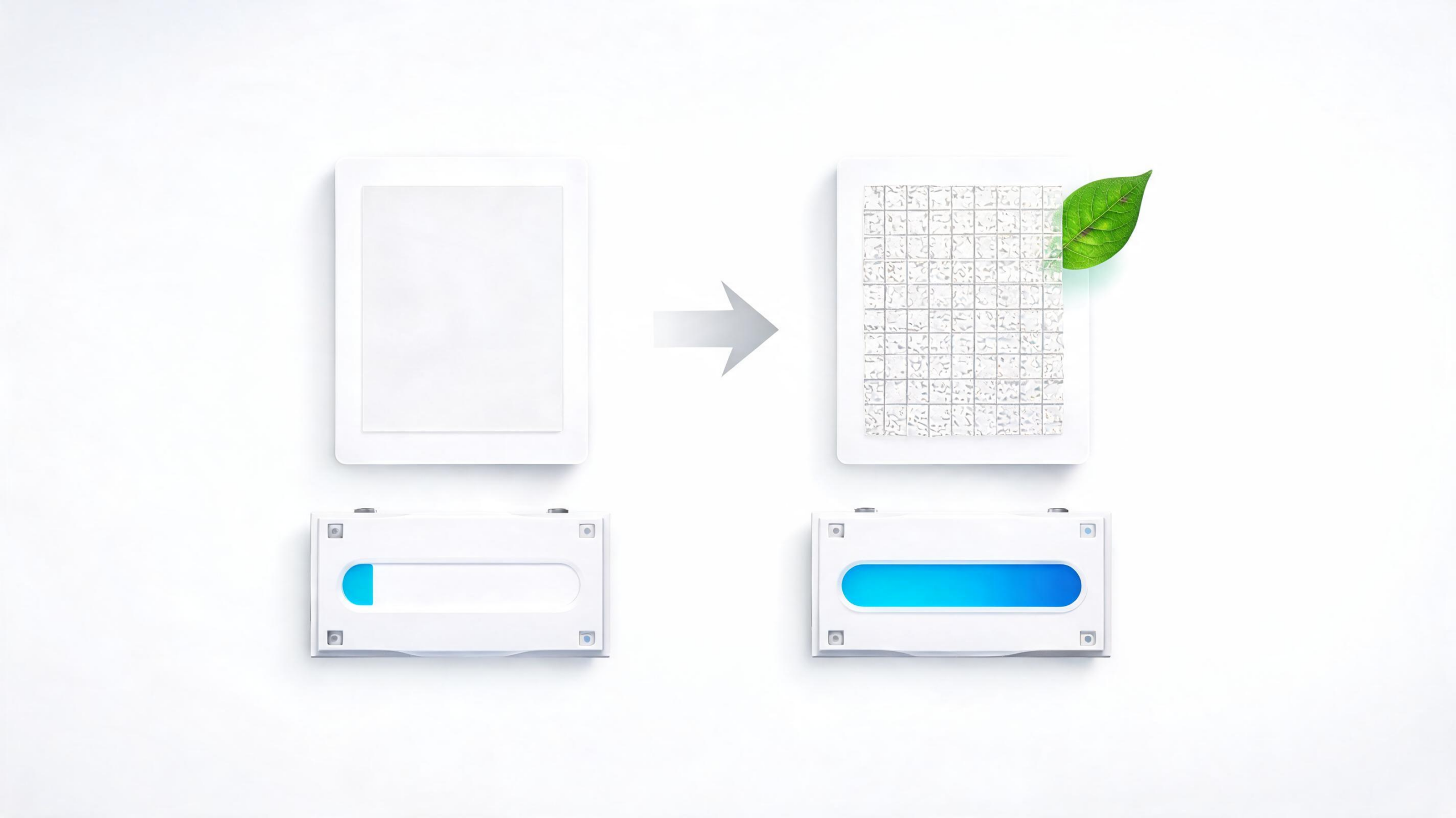
Researchers have unveiled a lithium-ion battery separator that pairs the workhorse durability of polypropylene with the rapid biodegradability of poly(butylene adipate-co-terephthalate), better known as PBAT, and manufactured it using an industrial gravure printing process. The study, published in the Journal of Materials Science: Polymers, reports that the printed, chain-extended PBAT–polypropylene membrane achieves an ionic conductivity of 2.86 millisiemens per centimeter, a striking 633 percent increase over conventional polypropylene separators. For an industry projected to demand roughly 4700 gigawatt-hours of lithium-ion batteries by 2030, a separator that performs better than the fossil-based incumbent while dramatically reducing end-of-life plastic pollution is a finding with immediate environmental and commercial resonance.
The separator is one of four core components of every lithium-ion battery, sitting between the graphite anode and the oxide cathode. Its job is deceptively simple: physically keep the electrodes apart so electrons cannot short the cell, while its pores must admit liquid electrolyte and let lithium ions shuttle back and forth during charge and discharge. Polypropylene has long dominated this role because of its mechanical strength, chemical resistance, low cost and easy processability. Yet it is entirely petroleum-derived and non-biodegradable, meaning that as the battery fleet swells, so will a stream of durable plastic waste. The research team, led by Sajad Rasouli of the Research Institute of Petroleum Industry in Tehran with colleagues from Islamic Azad University, the Institute for Color Science and Technology and the University of Garmsar, set out to answer a question that has been largely neglected: could a biodegradable polymer actually beat polypropylene at its own game?
The answer hinged on two chemical interventions. First, the team chain-extended the PBAT using maleic anhydride activated by a dicumyl peroxide initiator. In this reaction, the anhydride ring opens and couples with the hydroxyl end groups of PBAT chains, forging covalent bridges between individual molecules. The result is a higher molecular weight polymer with reduced chain mobility, which translates into improved thermal and mechanical stability. Second, because PBAT is slightly polar and polypropylene is completely nonpolar, the two polymers would normally refuse to mix. The researchers solved this by blending in polypropylene-grafted-maleic anhydride as a compatibilizer: its polypropylene backbone merges with the pure polypropylene phase while its anhydride groups interact with PBAT macromolecules, knitting the two immiscible materials into a coherent whole.
Manufacturing relied on a four-step gravure printing route rather than conventional film blowing or electrospinning. Chain-extended PBAT was compounded with a polypropylene–polypropylene-grafted-maleic anhydride mixture in a single-screw extruder, with 30 percent by weight of dioctyl phthalate oil fed in as a liquid porogen and plasticizer. The molten compound was deposited onto a rotating gravure cylinder, compressed between impression cylinders into a uniform film of roughly 100 micrometers, then uniaxially stretched at 65 degrees Celsius to a final thickness of just 20 to 30 micrometers. The critical chemistry came afterward: the film was soaked in ethanol for two days, leaching out the dioctyl phthalate and leaving behind an interconnected network of nanoscale cavities. The team confirmed by Fourier-transform infrared spectroscopy that extraction efficiency reached about 99.3 percent, with the characteristic fingerprint peaks of the plasticizer vanishing completely after treatment.
The resulting microstructure is remarkable. In the pure chain-extended PBAT membrane, the extraction produced spherical, uniformly distributed cavities averaging just 68 nanometers in diameter with a standard deviation of 45.64 nanometers, a number density of 16.7 holes per square micrometer and a porosity of 42.9 percent. By comparison, most polyolefin-based separators reported in the literature exhibit oval cavities on the micrometer scale. The researchers attribute this morphology to the affinity between the ester-rich, aromatic dioctyl phthalate and the similarly structured PBAT, which allows the plasticizer to disperse homogeneously before removal. When the PBAT content was cut in half to 50 weight percent, the average cavity size swelled 204 percent to 208 nanometers, while pore density fell by 86 percent and porosity dropped to 34.2 percent. Below that ratio, at 25 weight percent PBAT, the compatibilizer could no longer prevent phase separation, yielding a heterogeneous, irregular pore structure unsuitable for ion transport.
Wettability measurements told a complementary story. Water contact angles of roughly 80 to 82 degrees for the high-PBAT membranes sit comfortably in the hydrophilic regime, meaning the pores will readily draw in the polar carbonate electrolyte. Reducing PBAT to 50 weight percent left the surface wettability essentially unchanged, and because its larger pores encouraged capillary penetration over time, the contact angle actually fell from 81.3 to 78.6 degrees during measurement. Bulk wettability, quantified through electrolyte uptake, told a similar tale: pure PBAT absorbed 128.7 percent of its weight in electrolyte, while the 50 percent PBAT formulation still absorbed 94.3 percent. Increasing polypropylene further degraded both uptake and surface wettability, pushing the contact angle toward the hydrophobic zone that battery engineers consider disastrous for ion transport. Balancing microstructure, wettability and mechanical reinforcement from the polypropylene fraction, the team identified the 50 weight percent chain-extended PBAT formulation, labeled BP50, as the optimum.
Electrochemical testing put the claims to the test in a CR2032 coin cell built with a graphite anode and a lithium nickel-cobalt-manganese oxide cathode. Electrochemical impedance spectroscopy yielded resistances of 2.84 ohms for the electrolyte and 36.82 ohms against lithium-ion penetration, with an estimated solid electrolyte interface thickness of 81.27 micrometers. The computed ionic conductivity of 2.86 millisiemens per centimeter dwarfs the 0.34 millisiemens per centimeter reported for polypropylene separators under comparable conditions, and the authors’ radar-chart comparison shows BP50 outperforming separators made from ultra-high molecular weight polyethylene, poly(vinylidene fluoride) variants, cellulose nanocrystals, collagen-chitosan hybrids, zeolite-coated polypropylene and other published polymer membranes. Linear sweep voltammetry confirmed reversible lithiation and delithiation with negligible side reactions up to 1.8 volts, delivering capacities of 69.10 and 63.52 milliampere-hours per gram during delithiation and lithiation respectively.
The team argues that PBAT’s biodegradability does not compromise safety inside the cell. Practical lithium-ion batteries normally operate below 45 degrees Celsius, and even aggressive high-rate use rarely pushes well-controlled cells past 60 degrees, whereas thermal or hydrolytic degradation of PBAT requires substantially higher temperatures along with moisture, oxygen and biological activity. The non-aqueous electrolyte also does not chemically corrode the polyester, and the chain-extension step further stabilizes the polymer by raising molecular weight and curbing chain mobility. Compared with electrospun separators that often suffer from weak mechanical strength and thermal shrinkage despite high porosity, the gravure-printed membranes combine safety, mechanical integrity and electrochemical stability in a single roll-to-roll-compatible process.
The broader implications are significant. A separator that can be printed at industrial speeds, using a blend in which half the polymer decomposes in soil within two months thanks to PBAT’s biodegradation rate of 2.16 per day, offers the battery industry a credible route away from persistent fossil plastics without sacrificing performance. Because the gravure printing route is already a mature printing-industry technology, scaling the process may require less reinvention than entirely novel fabrication schemes. If the printed BP50 membrane can be validated at commercial scale and over long cycle life, the humble separator, often an afterthought in battery design, could become a showcase for how sustainable materials science turns one of electrification’s biggest waste liabilities into an environmental advantage.
Beyond the headline numbers, the study offers a useful lesson in polymer blend physics. Immiscible polymer pairs typically form coarse, disconnected phases because the thermodynamic penalty of mixing their segments is high, and the interfacial tension drives the minor component into large droplets. A graft compatibilizer lowers this penalty by anchoring at the interface, reducing surface tension between the phases and stabilizing a fine, dispersed morphology. In this system, that interfacial engineering is what allows a nano-porous structure to survive the stretching and extraction steps: without well-dispersed PBAT domains, the leached porogen would leave behind irregular, micron-scale voids rather than the uniform 68-nanometer cavities that govern ion transport.
The choice of gravure printing also deserves attention from a manufacturing standpoint. Gravure coating is a high-throughput, roll-to-roll technique already ubiquitous in packaging and printed electronics, capable of depositing controlled film thicknesses at speeds far exceeding batch methods. Demonstrating that a functional battery separator can be patterned this way suggests a pathway in which separator fabrication could be integrated into existing printing infrastructure, potentially lowering capital costs and enabling thickness control at the micrometer scale that is difficult to achieve with conventional dry or wet stretching of polyolefin films.
The work also highlights how formulation trade-offs shape separator design. Porosity, pore size, mechanical strength and electrolyte uptake are coupled variables: raising the biodegradable fraction improved wettability and conductivity but relied on the polypropylene fraction for fatigue resistance and dimensional stability. The authors’ systematic sweep of blend ratios, tracking cavity size, pore density and absorption capacity across compositions, illustrates the kind of compositional mapping needed before any new separator chemistry can be considered commercially credible.
Finally, the environmental argument rests on quantified biodegradation rather than vague green claims. PBAT’s reported soil decomposition within two months, and its biodegradation rate exceeding that of polylactic acid, give the blend a defined end-of-life pathway, though real-world battery recycling streams, separator recovery and lifecycle emissions would need assessment before the sustainability benefit can be fully claimed.
Subject of Research: Development of a biodegradable chain-extended PBAT/polypropylene lithium-ion battery separator fabricated by gravure printing
Article Title: Novel high-performance lithium-ion battery separator made of chain-extended-poly(Butylene Adipate-co-terephthalate)/modified-polypropylene using gravure printing
Article References: Rasouli, S., Arshadi, M., Ataeefard, M., Ghamarpoor, R., & Salehi, M. M. (2026). Novel high-performance lithium-ion battery separator made of chain-extended-poly(Butylene Adipate-co-terephthalate)/modified-polypropylene using gravure printing. Journal of Materials Science: Polymers, 1(1), Article 20. https://doi.org/10.1007/s44493-026-00016-3
Image Credits: AI Generated
DOI: 10.1007/s44493-026-00016-3
Keywords: lithium-ion battery, battery separator, PBAT, polypropylene, gravure printing, biodegradable polymer, ionic conductivity, maleic anhydride, chain extension, porosity, electrolyte wettability, energy storage
Cite Scienmag News
Faith Mcneil. (September 10, 2026). Printed Biodegradable Battery Separator Boosts Lithium-Ion Performance by 633 Percent. Scienmag. https://scienmag.com/printed-biodegradable-battery-separator-boosts-lithium-ion-performance-by-633-percent/
Faith Mcneil. "Printed Biodegradable Battery Separator Boosts Lithium-Ion Performance by 633 Percent." Scienmag, 10 September 2026, https://scienmag.com/printed-biodegradable-battery-separator-boosts-lithium-ion-performance-by-633-percent/. Accessed 10 September 2026.
Faith Mcneil. "Printed Biodegradable Battery Separator Boosts Lithium-Ion Performance by 633 Percent." Scienmag. September 10, 2026. https://scienmag.com/printed-biodegradable-battery-separator-boosts-lithium-ion-performance-by-633-percent/


