


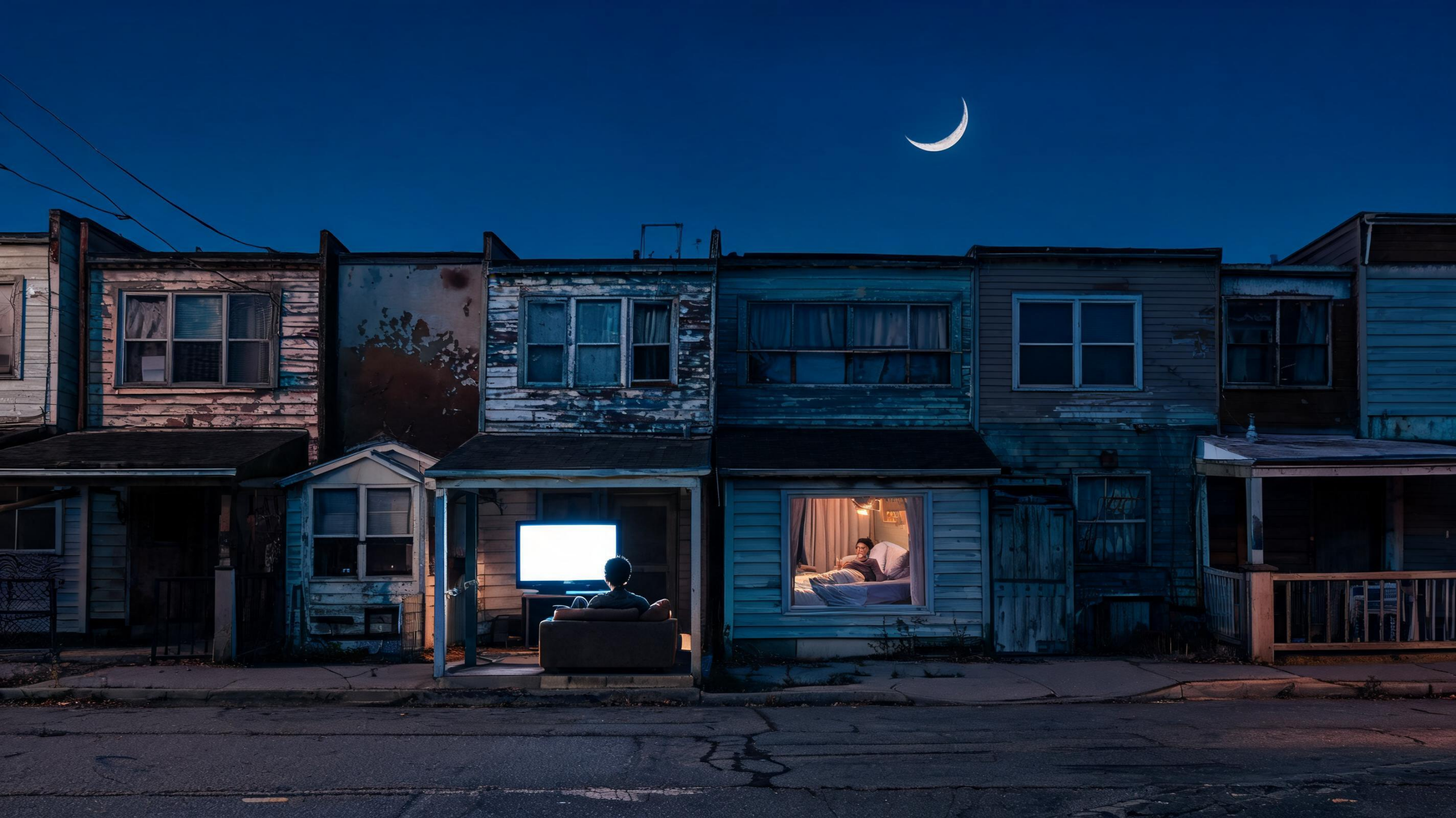
Where you live may shape how you sleep, and a massive new study suggests that the connection runs partly through the habits that neighborhoods quietly encourage. In an analysis of more than 233,000 American adults, researchers found that people living in neighborhoods with lower socioeconomic status were more likely to report unhealthy sleep patterns—sleeping too little, sleeping too much, or taking long daytime naps—and that lower levels of physical activity and higher amounts of television viewing appeared to explain part of that link. The findings, drawn from the NIH-AARP Diet and Health Study and published in the Journal of Activity, Sedentary and Sleep Behaviors, offer some of the clearest evidence yet that the sleep disparities etched into the American landscape are not simply a matter of individual choice, but of the environments in which people build their daily routines.
Sleep has increasingly been recognized as a pillar of public health, as central to long-term wellbeing as diet or exercise. Chronic short sleep has been tied to obesity, type 2 diabetes, cardiovascular disease, and impaired immune function, while excessively long sleep and prolonged daytime napping have been associated in prior research with inflammation, metabolic disturbance, and elevated mortality risk. Yet the reasons why sleep quality varies so dramatically across communities have remained elusive. Scientists have long observed that residents of disadvantaged neighborhoods sleep worse on average, but identifying the behavioral machinery behind that association has proven difficult. The new study set out to test whether two of the most consequential daily behaviors—moderate-to-vigorous physical activity and sedentary time spent watching television—act as pathways connecting neighborhood conditions to sleep outcomes.
To do so, the research team, led by Kosuke Tamura of the National Institute on Minority Health and Health Disparities, tapped one of the largest prospective cohort studies ever assembled in the United States. Their analytical sample included 233,335 participants from the NIH-AARP Diet and Health Study, a collaboration between the National Institutes of Health and AARP that has followed hundreds of thousands of older American adults for decades. Participants self-reported their nightly sleep duration, allowing the researchers to classify short sleep as less than seven hours, optimal sleep as seven to eight hours, and long sleep as nine or more hours. They also reported how much time they typically spent napping during the day, with long napping defined as an hour or more, and how much time they devoted to moderate-to-vigorous physical activity and television viewing.
Neighborhood socioeconomic status was measured using a standardized index derived from census variables, a composite that captures the economic and social resources of the areas where participants lived. The researchers then applied formal mediation analysis, a statistical technique that partitions the total association between an exposure and an outcome into direct and indirect components. In this case, the question was whether the relationship between lower neighborhood socioeconomic status and poor sleep traveled through physical activity or television viewing. Because conventional confidence intervals can be unreliable in mediation settings, the team used bootstrap-generated bias-corrected confidence intervals, a resampling method that provides more robust estimates of statistical uncertainty. All models were adjusted for age, sex, racial and ethnic group, education, and marital status, helping to isolate the contribution of the neighborhood itself from individual-level characteristics.
The results were consistent and telling. Lower neighborhood socioeconomic status was associated with short sleep, long sleep, and long napping, and both physical activity and television viewing emerged as significant mediators of all three associations. The mediated odds ratios were modest in magnitude—ranging from 1.002 to 1.011 for the physical activity pathway and from 1.003 to 1.033 for the television pathway, all statistically significant at the five percent level—but the sheer scale of the cohort lends the pattern considerable weight. The strongest mediated effect appeared for long napping through television viewing, hinting that sedentary screen time may be an especially important behavioral link between disadvantaged surroundings and disrupted sleep rhythms. The logic of the mechanism is intuitive: residents of lower-income neighborhoods often have fewer safe parks, sidewalks, gyms, and recreational facilities, which discourages physical activity, while the same environments may encourage more time spent indoors in front of the television—a pattern of behavior that, in turn, displaces sleep, fragments rest, and promotes daytime drowsiness.
Perhaps the most striking aspect of the study, however, was its exploratory examination of racial and ethnic differences. When the researchers stratified their mediation analyses by group, the pathways diverged in revealing ways. Among White adults, lower neighborhood socioeconomic status was associated with short sleep, long sleep, and long napping, mediated through both physical activity and television viewing—the full pattern seen in the overall sample. Among Black adults, the associations were narrower: lower neighborhood socioeconomic status related to long sleep through television viewing, and to long napping through both physical activity and television viewing. Among Hispanic adults, lower neighborhood socioeconomic status was linked to long sleep, mediated through physical activity, while among adults in other racial and ethnic groups, the association appeared only for long napping, mediated through television viewing. These subgroup findings, which the authors describe cautiously as suggestive rather than definitive, underscore that the same neighborhood disadvantage can translate into different behavioral and sleep consequences depending on the population and its social context.
The authors emphasize that the study is cross-sectional, meaning that neighborhood characteristics, behaviors, and sleep were all measured at the same point in time. That design limits causal inference: it is possible, for instance, that poor sleep reduces energy for physical activity or increases time spent passively watching television, rather than the reverse. Self-reported sleep and activity measures also introduce the possibility of misclassification, since people are notoriously imprecise at estimating their own habits. The cohort, moreover, consists predominantly of older adults, and sleep architecture and activity patterns change with age, so the findings may not generalize to younger populations. Residual confounding—by shift work, chronic illness, caregiving responsibilities, or unmeasured neighborhood features such as noise, light pollution, and crime—cannot be ruled out entirely, even with the study’s careful statistical adjustments.
Even so, the scale and consistency of the results make a compelling case that neighborhood disadvantage operates on sleep through modifiable daily behaviors. If the pathways identified here hold up in longitudinal and interventional research, they point to concrete targets for public health action. Investments in safe recreational infrastructure, walkable streets, and community exercise programs could raise physical activity levels in disadvantaged areas, while initiatives to reduce sedentary screen time—particularly prolonged evening television viewing—might simultaneously protect sleep. The authors conclude that efforts to improve lower socioeconomic status neighborhoods in ways that encourage physical activity and reduce sedentary time are warranted to improve sleep health, framing sleep not as a private matter of personal discipline but as an environmental outcome that communities can shape.
The broader significance of the work lies in its reframing of sleep inequality. For years, public health campaigns have urged individuals to sleep more and sit less, as if behavior occurred in a vacuum. This study, leveraging one of the largest cohorts in American epidemiology, demonstrates that the places people live exert a measurable pull on the routines that govern rest. The behavioral chain from neighborhood to activity to sleep offers a mechanism, and mechanisms are the raw material of policy. As cities grapple with entrenched disparities in chronic disease, the humble hours of sleep—and the neighborhood conditions that quietly erode them—may deserve a far more prominent place on the agenda.
Beyond its behavioral findings, the study contributes to a growing literature on social determinants of sleep by treating neighborhood socioeconomic status as an exposure in its own right, distinct from individual income or education. The standardized index drawn from census variables reflects shared community resources rather than personal finances, aligning the work with a broader research movement that examines place-based influences on cardiometabolic and behavioral health.
The use of the NIH-AARP cohort also situates the results within a particularly valuable data resource, one that has enabled investigators to examine how lifestyle and environmental factors relate to disease outcomes across very large samples of older adults. The intramural support from the National Institute on Minority Health and Health Disparities and the National Heart, Lung, and Blood Institute reflects federal interest in understanding how structural conditions shape health behaviors. As an open-access publication, the article allows other researchers to scrutinize the mediation methods and subgroup analyses in full.
Subject of Research: How neighborhood socioeconomic status influences sleep health through physical activity and television viewing in a large U.S. cohort.
Article Title: The association between lower neighborhood socioeconomic status and sleep health mediated by physical activity and TV viewing: Findings from a large U.S. cohort
Article References: Tamura, K., Xiao, Q., Moniruzzaman, M., Deng, Y., Liao, L. M., Jones, R. R., & Powell-Wiley, T. M. (2026). The association between lower neighborhood socioeconomic status and sleep health mediated by physical activity and TV viewing: Findings from a large U.S. cohort. Journal of Activity, Sedentary and Sleep Behaviors. https://doi.org/10.1186/s44167-026-00114-1
Image Credits: AI Generated
DOI: 10.1186/s44167-026-00114-1
Keywords: neighborhood socioeconomic status, sleep health, physical activity, television viewing, sedentary behavior, daytime napping, health disparities, NIH-AARP Diet and Health Study, mediation analysis, racial and ethnic differences, association, between
Cite Scienmag News
Glenn Wilkins. (September 10, 2026). Poor Neighborhoods May Damage Sleep Through Exercise and TV Habits. Scienmag. https://scienmag.com/poor-neighborhoods-may-damage-sleep-through-exercise-and-tv-habits/
Glenn Wilkins. "Poor Neighborhoods May Damage Sleep Through Exercise and TV Habits." Scienmag, 10 September 2026, https://scienmag.com/poor-neighborhoods-may-damage-sleep-through-exercise-and-tv-habits/. Accessed 10 September 2026.
Glenn Wilkins. "Poor Neighborhoods May Damage Sleep Through Exercise and TV Habits." Scienmag. September 10, 2026. https://scienmag.com/poor-neighborhoods-may-damage-sleep-through-exercise-and-tv-habits/


