


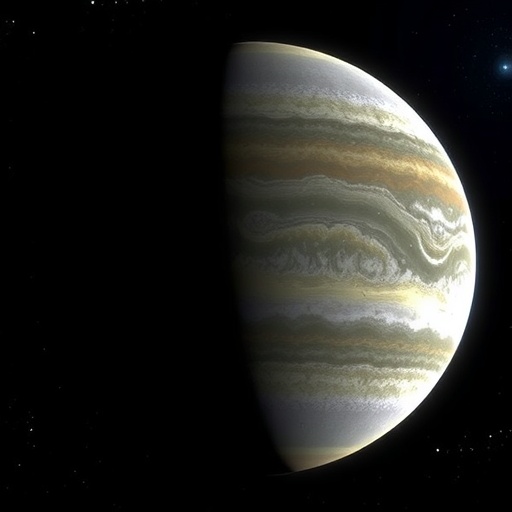
Mercury, the smallest planet in our solar system and the closest to the Sun, has been quietly shrinking for billions of years. Now, a new study suggests that the planet has contracted far more dramatically than scientists previously believed, with its radius potentially decreasing by more than 10 kilometers over its geological history. The finding, led by researchers at Hokkaido University in collaboration with the German Aerospace Center (DLR) and The University of Tokyo, challenges long-standing estimates of Mercury’s contraction and offers a fresh perspective on how rocky planets cool and evolve over time.
The surface of Mercury tells a remarkable story of planetary contraction. Like a grape transforming into a raisin, the planet has wrinkled as its interior slowly cooled. When a planet’s interior loses heat, its rocky outer shell is forced to accommodate the shrinking volume beneath it. The crust responds by crumpling, forming dramatic geological features such as ridges, cliffs, and steep scarps that scar the planet’s surface. These features, known to scientists as shortening structures, are direct evidence of the immense compressive forces that have acted on Mercury’s crust as the planet gradually lost its internal heat.
For decades, planetary scientists have relied on mapping these shortening structures to estimate exactly how much Mercury has shrunk. The logic is elegant: the more the crust has crumpled and folded, the more the planet’s radius must have decreased. By measuring the total accumulated strain expressed in these tectonic features, researchers can work backward to calculate the planet’s loss of radius. Previous estimates based on this method, informed by data from NASA’s MESSENGER mission, suggested that Mercury’s radius had decreased by approximately 8.3 kilometers since the planet’s early history.
However, the new research reveals a fundamental flaw in that approach. According to the study, published in the journal Geophysical Research Letters, the visible record of Mercury’s tectonic activity is far from complete. The planet’s rough and pockmarked surface, bombarded by impacts over billions of years, has obscured many of the very structures scientists use to measure its contraction. In essence, the planet’s own violent history has hidden the evidence of its shrinkage.
“Mercury’s surface preserves a record of how the planet has cooled and contracted, but we found that this record is incomplete,” explains Gaku Nishiyama, lead author of the study and a researcher at Hokkaido University. “We compared a global map of Mercury’s surface roughness with maps of shortening structures and contraction. Once we account for the effect of rough terrain, Mercury appears to have shrunk considerably more than what the visible tectonic record alone suggested.”
The research team’s methodology centered on a systematic comparison between surface roughness and the distribution of tectonic features across the entire planet. By overlaying global maps of surface texture with maps documenting the locations of ridges and scarps, the researchers identified a striking pattern: shortening structures were far more likely to be identified in smooth terrain than in rough regions. This correlation was too strong to be coincidental. Instead, it pointed to a systematic bias in the geological record, where the roughest terrain was concealing tectonic structures from view.
A particularly compelling piece of evidence emerged when the researchers examined areas surrounding relatively young impact craters. When a large asteroid or comet strikes a planetary surface, the explosion excavates material from beneath the crust and throws it outward in a debris field known as ejecta. These rough, jumbled deposits can blanket the surrounding landscape, burying older geological features beneath layers of impact debris. Around the Rachmaninoff crater, a prominent impact basin on Mercury, the researchers observed that shortening structures were noticeably less common in areas covered by rough ejecta. Additionally, the structures became progressively less visible closer to the crater itself, suggesting they were partially buried under impact-related material. This spatial pattern provided a natural experiment, demonstrating exactly how impact debris can erase tectonic evidence from the scientific record.
By mathematically correcting for this obscuration effect, the researchers recalculated Mercury’s total radial contraction. The revised estimate increased from the previously accepted value of 8.3 kilometers to approximately 11.6 kilometers, an increase of roughly 10 to 30 percent compared to earlier figures. Importantly, the team acknowledges that even this new number may still represent an underestimate. Because the relationship between surface roughness and hidden tectonic structures cannot be perfectly quantified, the true magnitude of Mercury’s shrinkage could be even greater than the revised calculation suggests.
The implications of this finding extend far beyond Mercury itself. The same principle—that rough surfaces can obscure tectonic records and lead scientists to underestimate planetary contraction—could apply to other rocky worlds in our solar system. The Moon, whose surface is even rougher than Mercury’s due to its long history of impacts, is a prime candidate for similar reassessment. If the lunar tectonic record has been similarly compromised by impact ejecta and rough terrain, scientists may need to revise estimates of how much the Moon has contracted as its interior cooled. The finding could also influence our understanding of other airless, cratered bodies such as Mars, whose ancient surface preserves billions of years of geological history buried under layers of impact debris.
The timing of this research is particularly significant given the upcoming BepiColombo mission, a joint endeavor between the European Space Agency and the Japan Aerospace Exploration Agency (JAXA). Currently en route to Mercury, the spacecraft carries a sophisticated instrument called the BepiColombo Laser Altimeter, or BELA, which will measure the planet’s surface topography with unprecedented precision. BELA is expected to characterize surface roughness at much finer scales than previous instruments, potentially revealing subtle relationships between younger geological events and tectonic structures that have been difficult to detect. The new findings from Hokkaido University provide a conceptual framework that will help scientists interpret the data BepiColombo sends back, ensuring that the mission’s measurements can be used to build a more complete picture of Mercury’s thermal evolution.
The study also touches on deeper questions about planetary cooling processes. All terrestrial planets—Mercury, Venus, Earth, and Mars—have been losing heat since their formation roughly 4.5 billion years ago. The rate and magnitude of that cooling, expressed through planetary contraction, provides crucial insights into a planet’s internal structure, its thermal history, and even its potential for past geological activity such as volcanism. Mercury, lacking a substantial atmosphere and plate tectonics, preserves its tectonic record with exceptional fidelity, making it an ideal laboratory for studying how rocky planets evolve. But as this study demonstrates, even the best-preserved records contain gaps, and accounting for those gaps can fundamentally change our understanding of a planet’s history.
For the scientific community, the research serves as a cautionary tale about the limitations of surface observation. When scientists estimate planetary contraction from visible tectonic features, they are essentially reading an incomplete book. Pages have been torn out by impacts, buried by ejecta, and hidden by rough terrain. The Hokkaido University team’s approach—systematically comparing terrain characteristics with tectonic feature distribution—offers a template for identifying and correcting such biases on other worlds. As missions to Mercury, the Moon, and Mars continue to return increasingly detailed data, methods like this will be essential for transforming raw observations into accurate reconstructions of planetary history.
Mercury, it turns out, has been hiding its true transformation in plain sight. The little planet that has shrunk so dramatically over billions of years has done so even more extensively than anyone realized. With future observations from BepiColombo poised to refine these measurements further, scientists are now one step closer to understanding the full story of how Mercury—and potentially other rocky worlds—cooled, contracted, and evolved into the planets we see today.
Cite Scienmag News
Grant Pearson. (September 10, 2026). Mercury may have shrunk over 10 kilometers throughout its history. Scienmag. https://scienmag.com/mercury-may-have-shrunk-over-10-kilometers-throughout-its-history/
Grant Pearson. "Mercury may have shrunk over 10 kilometers throughout its history." Scienmag, 10 September 2026, https://scienmag.com/mercury-may-have-shrunk-over-10-kilometers-throughout-its-history/. Accessed 10 September 2026.
Grant Pearson. "Mercury may have shrunk over 10 kilometers throughout its history." Scienmag. September 10, 2026. https://scienmag.com/mercury-may-have-shrunk-over-10-kilometers-throughout-its-history/


