


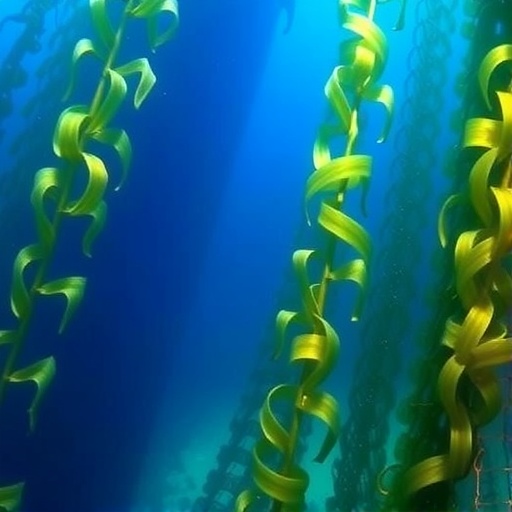
The rocky coast of Maine holds one of the most productive marine ecosystems in the temperate North Atlantic, and hidden within its swaying fronds of sugar kelp lies a trove of genetic diversity that could shape the future of coastal conservation and aquaculture. A new study led by researchers at Bigelow Laboratory for Ocean Sciences has delivered the most comprehensive assessment to date of the genetic diversity and population structure of Saccharina latissima—commonly known as sugar kelp—along Maine’s coast, revealing a landscape of genetically distinct populations sculpted by the region’s complex oceanography.
The findings, published in the Journal of Phycology, come at a pivotal moment. Sugar kelp is one of the dominant species in Maine’s kelp forests, providing food, habitat, and clean water that support a rich marine ecosystem. It is also the biological bedrock of the state’s burgeoning kelp aquaculture industry, the largest of its kind in the United States, which relies on the annual harvest of reproductive tissue from wild kelp populations. As ocean warming continues to drive the steady decline of these forests, understanding the genetic architecture of what remains has become an urgent scientific and economic priority.
Senior Research Scientist Doug Rasher, the study’s senior author, and his team have published several previous studies documenting how rising water temperatures are eroding Maine’s kelp forests. That loss has cascading impacts on coastal ecosystems and threatens the wild resource upon which the aquaculture industry depends. Responding effectively, the researchers argue, requires a detailed map of the structure and potential genetic barriers among the remaining forests.
“We wanted to explore questions of genetic diversity within the state of Maine because that’s the spatial scale that’s relevant to managing wild kelp forests, developing effective restoration programs, and establishing best practices in aquaculture,” Rasher said. “We brought it down to the scale that really matters from a management perspective.”
To build that map, the team collected genetic material from sugar kelp at 11 sites spanning Maine’s “outer coast.” These locations were chosen deliberately: they are far enough offshore to be subject to the oceanographic forces that influence the entire coastline, yet close enough to shore to be plausible future sources of reproductive tissue for the aquaculture industry. The analysis revealed moderate levels of genetic diversity within each study site and identified at least four distinct populations distributed along the coast.
The evidence suggests that genetic mixing occurs readily between sites within each population, presumably driven by currents dispersing kelp spores during their early life stage. But kelp are mobile for only a very brief window of time before settling on the seafloor for the remainder of their life cycle. Even with the strong currents that characterize the Gulf of Maine, spores seemingly do not travel far, and there appears to be little gene transfer between the four populations.
“Having distinct populations means there are different genetic signatures along our coast, and some populations could have individuals that are more or less suited to thrive in varied environments,” said lead author Rene Francolini, a former University of Maine PhD student in Rasher’s lab. “That’s important for restoration work or when we think about farmers who might collect reproductive tissue in one location and outplant seed in another.”
That distinction carries real-world consequences. Previous research has shown that genetic diversity can bolster resilience to marine heat waves, providing populations with the raw material to adapt as conditions shift. It also supplies critical variation for selective breeding in aquaculture, where traits such as growth rate, thermal tolerance, and morphology can determine the success of a farm. If farmers harvest reproductive tissue from one genetically distinct population and deploy the resulting seed string in waters dominated by another, they could inadvertently disrupt local adaptation—or, conversely, miss an opportunity to match the best-suited genotypes to the right environments.
Earlier studies had examined kelp population genetics at both a much larger scale, across all of New England, and at a very fine scale between adjacent bays. This study is the first to treat the Maine coast as a holistic unit, filling a critical gap between those extremes. “There’s clearly a wealth of genetic variation along the coast that needs to be considered in management and restoration and that holds great potential for innovation in aquaculture,” Rasher said.
A technological breakthrough made the study possible. Last year, another research team published the first complete sugar kelp genome—a reference resource that enabled Rasher’s group to map genetically distinct populations with far greater precision than previous marker-based approaches. The genome also opens the door to identifying specific genes unique to each population, genes that might help wild kelp forests adapt to warming waters or prove valuable in an industry setting.
“With a complete genome available, we can actually identify genes of interest and examine whether any of these genes are uniquely expressed in a given population,” Francolini said. “We have yet to be able to connect these genes to a specific function, but when we do, we will be able to pinpoint kelp variants that are uniquely strong candidates for improving kelp conservation, restoration, and aquaculture outcomes.”
The implications extend well beyond Maine. Kelp forests worldwide are retreating in the face of marine heat waves, and restoration practitioners are increasingly turning to genetics to guide their efforts—selecting donor populations that harbor heat-tolerant variants, avoiding outplanting genotypes poorly matched to local conditions, and preserving the evolutionary potential of fragmented populations. Maine’s sugar kelp, with its newly resolved population structure and a complete genome to work from, offers a template for how such efforts might proceed elsewhere.
For the aquaculture industry, the study arrives as the sector matures. Maine’s kelp farmers have built a regenerative ocean farming economy on the annual wild harvest of sorus tissue—the reproductive material from which farm seed is propagated. The new findings suggest that sourcing decisions, long made largely on geography and convenience, could be refined with genetic information: matching seed sources to outplanting sites within the same population, or deliberately drawing on genotypes from populations whose unique gene variants confer advantages in particular environments.
The research was supported by the NSF Established Program to Stimulate Competitive Research (Grant #OIA-1849227), the Louise H. & David S. Ingalls Foundation, Maine Sea Grant, and the Nature Conservancy. Co-authors include Research Scientist Robin Sleith of Bigelow Laboratory, as well as Kristina Cammen and Damian Brady of the University of Maine.
As warming continues to reshape the Gulf of Maine, the genetic diversity cataloged in this study represents both a warning and an opportunity—a reservoir of variation that, if managed wisely at the regional scale the researchers advocate, could help kelp forests endure and even thrive in the decades ahead.
Cite Scienmag News
Juliet Wilcox. (September 10, 2026). Kelp forests harbor rich genetic diversity, study finds. Scienmag. https://scienmag.com/kelp-forests-harbor-rich-genetic-diversity-study-finds/
Juliet Wilcox. "Kelp forests harbor rich genetic diversity, study finds." Scienmag, 10 September 2026, https://scienmag.com/kelp-forests-harbor-rich-genetic-diversity-study-finds/. Accessed 10 September 2026.
Juliet Wilcox. "Kelp forests harbor rich genetic diversity, study finds." Scienmag. September 10, 2026. https://scienmag.com/kelp-forests-harbor-rich-genetic-diversity-study-finds/


