


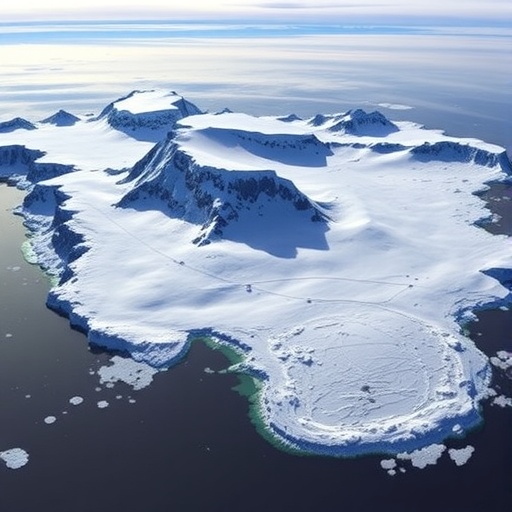
Antarctica has long been treated as the quiet edge of Earth’s geological record, a continent buried beneath kilometres of ice whose exposed rock offers only tantalising glimpses of its deep past. New research published in Communications Earth & Environment argues that this frozen archive deserves far more attention, not least because the preserved portion of the Antarctic continent appears to have grown at a pace that sets it apart from nearly every other landmass on the planet. In a study led by B. Chen, together with I. H. Campbell and R. J. Arculus, the authors reconstruct the growth rate of the preserved Antarctic continent and use it to portray Antarctica as what they call the anatomy of a “late developer” among Earth’s continents.
The central question the researchers address is deceptively simple: how quickly did the continental crust that we see preserved in Antarctica actually form? Continents are not born all at once. They accumulate over billions of years through the addition of new crust, much of it generated in subduction-zone arcs where oceanic plates dive beneath one another and feed chains of volcanoes, and some of it produced through the remelting and reworking of crust that already existed. By measuring how much crust of different ages is preserved within a continent, geologists can chart the tempo of that accumulation. Continents that grew early and fast, such as the ancient cratonic cores of North America, Australia and southern Africa, record bursts of crust production in the Archaean eon, more than 2.5 billion years ago. The new analysis of Antarctica suggests that its preserved continental volume instead grew substantially later, making it a striking exception to the general pattern.
The technique at the heart of the study relies on the ages of detrital and inherited zircon grains, the tiny, extraordinarily durable crystals that crystallise in magmas and can survive multiple cycles of erosion, deposition and melting. Because zircons incorporate uranium into their crystal lattice when they form, their uranium-lead isotopic systems act as built-in clocks, allowing researchers to date the moment each grain crystallised. When zircon age populations from large numbers of samples across a continent are compiled and statistically compared, they reveal the rhythm of magmatic activity through time: peaks correspond to episodes of vigorous crust production, while troughs mark lulls. The authors combine this zircon-based record with models of crustal volume preservation to estimate not just when Antarctic crust formed, but how fast its preserved mass increased over geological time.
What emerges from that reconstruction is a continent whose growth curve looks fundamentally different from those of its neighbours. Rather than showing an early, explosive build-up of continental volume, the preserved Antarctic record indicates that a large share of its crust was assembled relatively late in Earth’s history, during the Proterozoic and Phanerozoic eons, with major contributions tied to the great crustal-generating events that accompanied the assembly of supercontinents. In this sense, the authors describe Antarctica as a late developer: a continent whose anatomy, when dissected, reveals a body built more slowly and later than the classical cratonic shields against which continental growth models are usually calibrated.
This timing matters for more than just Antarctic bookkeeping. Global estimates of continental growth, the curves that trace how much of Earth’s continental crust existed at any given moment in the planet’s history, are built by averaging the records of many continents. If one of those continents grew on a markedly different schedule, and if its record has been under-represented because so much of it lies beneath ice, then the global average itself may be skewed. The study’s findings therefore carry implications that extend well beyond the polar circle. A late-dominant Antarctic contribution would tend to pull the global growth curve toward more rapid crust production in the mid-to-late Proterozoic, a period when some models already suggest a surge in magmatic activity associated with supercontinent cycles, while leaving the Archaean peaks defined by other cratons largely intact.
The physical mechanism behind Antarctica’s late development is tied to its position in the tectonic systems of the ancient southern hemisphere. The rocks exposed along the Transantarctic Mountains and in scattered coastal oases such as the Shackleton Range, the Lützow-Holm Complex and Marie Byrd Land preserve a collage of geological provinces, from Archaean remnants in East Antarctica to vast belts of Proterozoic and Palaeozoic crust. Much of this material was assembled through the accretion of arc systems and microcontinents onto the edge of the East Antarctic craton, a process that culminated in Antarctica’s incorporation into the supercontinents Rodinia and, later, Gondwana. Each collision stitched new crustal blocks onto the growing continent, and each episode of subduction beneath its margins fed fresh magma into the stack. The preserved record, as quantified in the new study, suggests that these late additions dominate the Antarctic crustal inventory to a degree not seen in most other continents.
One of the methodological strengths of the work is its attention to the problem of preservation bias. Zircon age spectra do not record crust production alone; they record what has survived. Old crust is preferentially destroyed or buried, young crust is over-represented near active margins, and sedimentary recycling can mix grains of many ages into single deposits. The authors confront these complications by comparing Antarctic spectra against global compilations and by applying corrections for crustal reworking, using isotopic tracers such as hafnium and oxygen compositions in zircon to distinguish grains crystallised from genuinely new mantle-derived magma from those melted out of older crust. It is this combination, age plus isotopic fingerprint, that allows the growth rate of the preserved continent to be separated from the noise of recycling, and it is the corrected rate that reveals the continent’s late-developing character.
The study also speaks to a long-running debate in geology over whether continental volume grew continuously through Earth’s history or in episodic pulses. Pulsed-growth models point to peaks in zircon production at roughly 2.7, 1.9, 1.2 and 0.6 billion years ago, intervals that coincide with supercontinent assembly and, in some interpretations, with enhanced mantle plume activity or changes in the thermal regime of the mantle. The Antarctic record, with its emphasis on later crustal addition, fits comfortably within a pulsed framework while adding a new and under-sampled data point: a continent whose major pulse arrived later than the classic Archaean peaks. If Antarctica is indeed representative of other fragments of Gondwana that are now dispersed across the southern hemisphere, then the geography of continental growth was more heterogeneous than models built on Northern Hemisphere cratons have assumed.
There are practical consequences as well as conceptual ones. Understanding which parts of Antarctic crust are old and which are young informs reconstructions of how Gondwana fit together before it broke apart, because crustal blocks of matching age and isotopic signature on opposite sides of an ocean are often the best evidence that they were once neighbours. The Antarctic growth curve can therefore sharpen correlations with Australia, India, southern Africa and South America, tightening the jigsaw of a supercontinent whose assembly shaped global climate, ocean chemistry and biological evolution in the late Precambrian and early Palaeozoic. Better reconstructions of that assembly, in turn, feed into models of how mineral deposits formed, since many of the world’s great ore systems are by-products of the very magmatic episodes that built new crust.
The findings come with the usual caveats of deep-time science. The exposed area of Antarctic rock is a small fraction of the continent, and every sample that reaches the surface through ice movement or mountain uplift carries a sampling history of its own. Extrapolating from exposed outcrops to the full crustal volume of a continent the size of Antarctica requires assumptions that future geophysical surveys, and perhaps future drilling, will test. The authors are explicit that their result concerns the rate of growth of the preserved continent, the crust that has survived to the present day, rather than the total crust that may once have existed and been destroyed. Even so, the preserved record is the only direct evidence available, and the new quantification of its growth rate represents a significant advance in making Antarctica a quantitative participant in global crustal evolution models rather than a gap in them.
For a continent often imagined as geologically dormant, Antarctica continues to reshape our understanding of how Earth itself was built. The image that emerges from this study is of a landmass that assembled its bulk while other continents were already mature, incorporating arcs, terranes and sedimentary basins into a late-formed edifice. In doing so, it reminds geologists that the story of continental growth is not a single global narrative but a family of regional histories, each with its own tempo, and that some of the most informative chapters may still be waiting beneath the ice.
Cite Scienmag News
Violet Maxwell. (September 10, 2026). Preserved Antarctic continent’s growth rate reveals anatomy of a late developer. Scienmag. https://scienmag.com/preserved-antarctic-continents-growth-rate-reveals-anatomy-of-a-late-developer/
Violet Maxwell. "Preserved Antarctic continent’s growth rate reveals anatomy of a late developer." Scienmag, 10 September 2026, https://scienmag.com/preserved-antarctic-continents-growth-rate-reveals-anatomy-of-a-late-developer/. Accessed 10 September 2026.
Violet Maxwell. "Preserved Antarctic continent’s growth rate reveals anatomy of a late developer." Scienmag. September 10, 2026. https://scienmag.com/preserved-antarctic-continents-growth-rate-reveals-anatomy-of-a-late-developer/


