


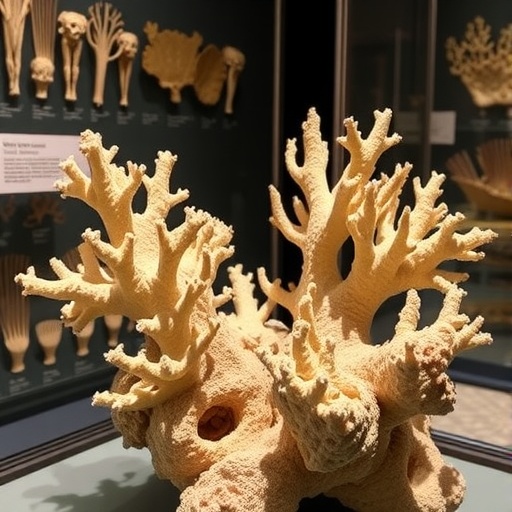
Coral skeletons that grew in some of the saltiest waters on Earth are revealing new secrets about how these iconic reef-builders record ocean conditions in their mineral architecture. A team of researchers led by Gabriela A. Farfan of the Smithsonian National Museum of Natural History, together with Alice C. Kojima, Diane M. Thompson of the University of Arizona, and Andrea M. Quattrini, has completed the first systematic global survey of how sea surface salinity shapes the trace element chemistry, crystal structure, and organic content of massive Porites coral skeletons. The study, published in the journal Coral Reefs, draws on decades-old museum specimens to challenge long-held assumptions about the climate archives stored within coral stone.
Stony corals are often described as super calcifiers of the ocean. They build their aragonite skeletons, a form of calcium carbonate, far faster than would occur through ordinary chemical precipitation in seawater. They achieve this feat by actively and passively pumping ions into a confined space beneath their polyps called the calcifying fluid, driving it to exceptional supersaturation so that aragonite crystals can precipitate. As colonies grow layer upon layer, these skeletons form annual bands, much like tree rings, capturing chemical snapshots of the surrounding ocean over tens to hundreds of years. Paleoclimatologists exploit this archive by measuring trace elements such as strontium, boron, lithium, and uranium in the skeletal aragonite to reconstruct past sea surface temperatures and ocean acidity. Yet, the team argues, one fundamental property of seawater has been almost entirely overlooked as a confounding influence: salinity.
Salinity, the concentration of dissolved ions in seawater, governs the electrochemical gradients that determine how ions move and how they become incorporated into mineral structures. It also varies dramatically across the global tropics, from roughly 31 practical salinity units in fresher regions to about 41 PSU in the evaporation-dominated Red and Arabian Seas. To isolate salinity’s influence, the researchers mined the US National Coral Collection at the Smithsonian’s National Museum of Natural History, which holds more than 1,500 cataloged specimen lots of massive Porites species from 67 countries. From this trove they selected 27 colonies of Porites lobata, P. lutea, and P. astreoides, plus unidentified Porites specimens, collected between 1915 and 1989 from ten localities spanning the global salinity range. All were sampled from shallow depths of about one meter, and each was matched with estimated sea surface salinity and sea surface temperature data from NOAA databases.
The analytical approach combined three complementary techniques on the same micro-milled skeletal powders. X-ray powder diffraction, performed with molybdenum K-alpha radiation and analyzed through full-pattern Rietveld refinement in GSAS II software, yielded precise measurements of the aragonite unit cell, the smallest repeating building block of the crystal, along its a-, b-, and c-axes, plus the percentage of any calcite contaminating the aragonite. Inductively coupled plasma mass spectrometry quantified trace element to calcium ratios, and loss on ignition experiments, in which roughly 45 milligrams of powder were combusted at 500 degrees Celsius for 18 hours, provided estimates of relative organic matter content. The team then applied Spearman and Pearson correlation statistics, principal component analysis, and regression modeling to the full dataset and to a subset restricted to 30 to 36 PSU, the range typical for most tropical corals.
The results reveal a striking pattern: some trace elements track salinity, but the crystal lattice itself remains remarkably stable. Boron to calcium and strontium to calcium ratios showed the strongest positive correlations with estimated salinity across the full dataset, with Spearman coefficients of 0.644 and 0.511 respectively. Uranium to calcium and lithium to calcium also rose with salinity, the latter driven primarily by very high values in corals that grew in the hypersaline Red and Arabian Seas. As expected from decades of paleoclimate work, strontium to calcium, lithium to calcium, and lithium to magnesium ratios all fell as sea surface temperature rose across the full dataset. But when the researchers restricted their analysis to the tropical salinity range, most of these salinity correlations weakened or vanished, with only boron and uranium to calcium ratios retaining significance.
The crystallographic data tell an even more interesting story. Average unit cell dimensions across all 27 samples matched previously published coral aragonite values almost exactly: an a-axis of 4.9652 angstroms, a b-axis of 7.7941 angstroms, and a c-axis of 5.7513 angstroms. Across the full salinity range, no unit cell parameter correlated with either salinity or temperature. Only when the analysis was narrowed to the 30 to 36 PSU tropical range did a significant relationship emerge: b-axis lengthening with increasing salinity, with a Spearman coefficient of 0.545 and a p-value of 0.01. Intriguingly, uranium to calcium was the only trace element ratio to correlate with any unit cell parameter, linking this element to the subtle structural shifts observed in the tropical subset.
Perhaps the most important finding concerns calcite contamination. Previous work by co-author Diane Thompson’s group suggested a screening cutoff of 3.6 percent calcite, below which diagenetic effects on paleoclimate reconstructions were assumed negligible. All samples in this study fell well under that threshold, at roughly 1 to 2.5 percent calcite. Yet even at these low levels, calcite content correlated significantly with lithium to magnesium, magnesium to calcium, and strontium-87 to calcium ratios. Correlations persisted or strengthened in the tropical subset. This suggests that even trace diagenetic alteration, often ignored by the paleoclimate community, can bias the very proxies researchers rely upon to reconstruct temperature and carbonate chemistry.
The organic content story proved more subtle. Loss on ignition measurements, while coarse, revealed a positive correlation with manganese to calcium ratios across the full dataset. This finding is notable because prior studies have assumed manganese substitutes directly for calcium in the aragonite crystal, and they routinely bleach samples to remove organic material before analysis. By leaving their samples untreated, the researchers observed manganese to calcium ratios roughly an order of magnitude higher than those reported in bleached samples from prior work, suggesting that a portion of skeletal manganese may be bound to organic matter rather than housed in the crystal lattice. When the extreme salinity sites were excluded, a significant positive correlation also emerged between organic content and a-axis length, hinting that organics may influence crystal structure under certain conditions.
Tissue layer thickness, measured across each coral slice, added another biological dimension. For corals growing in typical tropical salinity conditions, tissue thickness thinned significantly with increasing salinity, though it showed no relationship with any chemical or mineralogical variable. Meanwhile, boron and uranium behaved in ways consistent with their roles as proxies for ocean carbonate chemistry. Because boron in seawater is fundamentally linked to salinity through the boron-to-chlorinity ratio, and because borate ions may substitute for carbonate in the aragonite lattice, the researchers caution that salinity-driven variations in skeletal boron could confound paleo-pH reconstructions, particularly as global tropics become saltier with warming.
Taken together, the results suggest that coral organisms exert substantial biological control over their internal calcifying fluid chemistry, maintaining remarkably similar crystal structures despite growing under salinity conditions that differ by ten practical salinity units. Trace element incorporation, by contrast, does respond to environmental salinity, particularly at the extremes. The practical implications for paleoclimatology are significant: scientists using boron or uranium to calcium ratios to reconstruct ocean carbonate chemistry, or strontium and lithium proxies to reconstruct temperature, should now consider whether major salinity shifts, or even low-level calcite contamination, might be silently distorting their signals.
Beyond its scientific findings, the study is a testament to the power of museum collections. By leveraging specimens collected up to a century ago, the team avoided the cost, permitting hurdles, and ecological burden of collecting fresh coral samples from reefs already under stress. The researchers acknowledge the assumption that decades of dry storage have not altered skeleton chemistry, supported by the absence of any correlation between collection year and organic content or trace element ratios, though tissue layer thickness did show signs of degradation over time. They now call on other researchers to consider museum holdings as a resource for biomineralization studies, and they encourage future controlled culturing experiments to disentangle the mechanisms by which salinity, trace elements, organic molecules, and crystal structure interact in one of Earth’s most important biomineralizing organisms.
Cite Scienmag News
Bethany Barker. (September 10, 2026). Museum coral skeletons reveal sea temperature and salinity impacts on chemistry. Scienmag. https://scienmag.com/museum-coral-skeletons-reveal-sea-temperature-and-salinity-impacts-on-chemistry/
Bethany Barker. "Museum coral skeletons reveal sea temperature and salinity impacts on chemistry." Scienmag, 10 September 2026, https://scienmag.com/museum-coral-skeletons-reveal-sea-temperature-and-salinity-impacts-on-chemistry/. Accessed 10 September 2026.
Bethany Barker. "Museum coral skeletons reveal sea temperature and salinity impacts on chemistry." Scienmag. September 10, 2026. https://scienmag.com/museum-coral-skeletons-reveal-sea-temperature-and-salinity-impacts-on-chemistry/


